
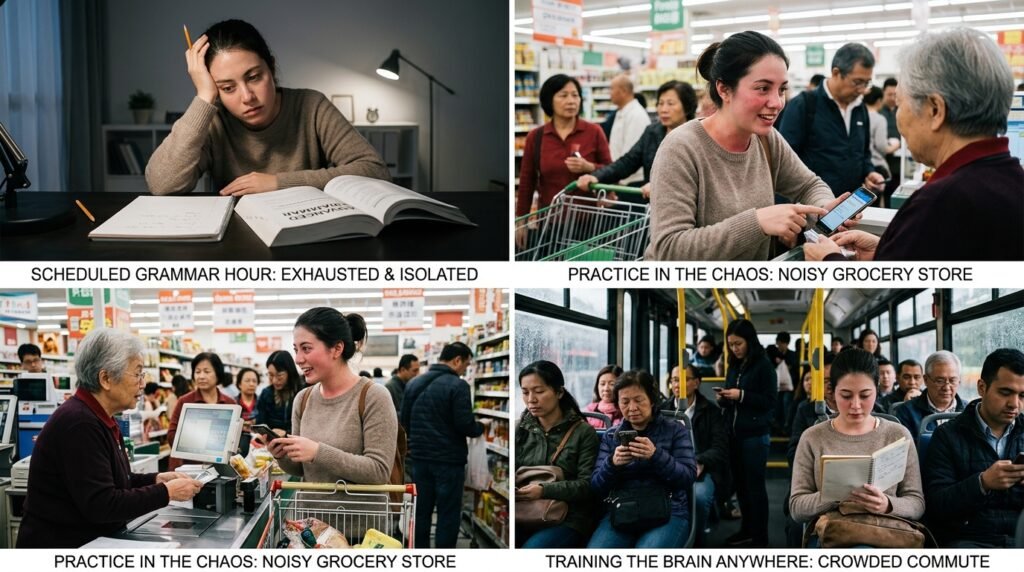
I used to isolate grammar in a tiny, miserable box. I assigned it a highly specific time. Every single evening at exactly seven o’clock, I opened a heavy workbook. I studied for forty continuous minutes. I highlighted tables. I filled in blank spaces. I closed the workbook. I walked away. I left the grammar entirely trapped inside that book on my desk.
When I tried to speak the next morning, the rules were completely missing. They were trapped back in my bedroom.
Language does not survive in total isolation. You cannot quarantine grammar to a specific hour of the day. You have to let it loose in your actual daily life. You have to bump into it constantly.
I decided to completely destroy my strict study schedule. I stopped viewing grammar as an academic subject. I started viewing it as a daily physical reflex. I built a brand new system to scatter grammatical concepts across my entire day.
This completely changed my fluency. It removed the heavy friction of studying. Here is exactly how I made grammar an unavoidable part of my daily practice.
The Failure of the Dedicated Study Block
I used to schedule my language learning perfectly. I blocked out an hour every Tuesday and Thursday evening. I cleared my desk. I sharpened a pencil. I opened my heavy grammar manual to the exact bookmark.
It felt incredibly professional. It was also a complete waste of time.
By the time Thursday evening arrived, I was completely exhausted from a long day of work. My brain absolutely refused to absorb complex verb conjugations. I stared at the pages blankly. I felt massive, heavy guilt when I inevitably skipped a session. The grammar manual became a physical symbol of my own failure.
More importantly, scheduling grammar traps it in a vacuum. You inadvertently train your brain to only access the language when you are sitting quietly at a wooden desk in a silent room.
Real conversations never happen at a quiet desk. They happen in loud grocery stores. They happen on crowded public buses. They happen when you are deeply tired and distracted.
I realized I needed to train my brain to process grammar in chaotic, normal environments. I needed to completely destroy the concept of the scheduled study hour.
The Concept of Habit Anchoring
You cannot simply tell yourself to practice more often. Motivation is an incredibly weak emotion. It disappears instantly when you get hungry, angry, or tired. You need a mechanical trigger.
I discovered the concept of habit anchoring. You take a brand new habit and glue it directly to an old, highly established habit.
You already have dozens of unbreakable daily habits. You brush your teeth. You tie your shoes. You lock your front door. You boil water for coffee. You do these things entirely on autopilot without a single conscious thought.
I decided to attach specific grammar rules to these automatic daily physical actions. I did not need intense motivation. I just needed to link the language directly to my physical environment.
This strategy completely bypasses the need for willpower. It guarantees massive daily repetition. You cannot forget to practice because the practice is permanently tied to an action you must perform to survive your day. I explain the foundational psychology behind this exact approach in How I Built a Routine That Actually Worked for Me so you can identify your own strong behavioral anchors.
The Morning Routine and the Future Tense
I wake up early. I walk straight into the kitchen. I spend exactly four minutes making a cup of hot tea. This became my very first daily anchor.
I dedicated my morning tea time exclusively to the future tense.
While the water slowly boiled, I stood at the kitchen counter and spoke out loud to the empty room. I described exactly what I was going to do that specific day. I used the target language. I forced myself to construct correct future tense sentences.
I said, “I will drive to the office. I will attend a long meeting at noon. I will eat a cold sandwich for lunch.”
I did not write anything down on paper. I did not check a digital dictionary. I just forced my mouth to physically produce the correct grammatical structures over and over again.
Four minutes is a very short amount of time. But four minutes every single morning adds up to a massive amount of spoken output over a month. By tying the future tense strictly to my morning routine, I automated the practice completely. I never had to study the future tense at a desk ever again.
The Commute and the Past Tense
My drive to work takes exactly twenty minutes. I used to listen to the radio. I listened to terrible morning talk shows. I realized this was completely dead time. I could easily convert this dead time into aggressive grammar practice.
I turned off the car radio permanently. I turned the car into a mobile language laboratory.
I dedicated my morning commute entirely to the past tense. I reviewed the events of the previous day out loud while holding the steering wheel.
I forced my brain to switch chronological gears. I described exactly what I ate for dinner last night. I described the exact route I took to the gym. I described a funny phone call I had with a close friend.
The car is the absolute perfect environment for this practice. You are completely alone. You can speak loudly. You can make terrible grammatical mistakes without feeling any public embarrassment.
Practicing the past tense while navigating heavy morning traffic trains your brain to handle major distractions. You learn how to conjugate verbs automatically while checking your blind spots. This builds incredible mental resilience for real world conversations.
The Shower Argument and Conditional Logic
Everyone argues with imaginary people in the shower. You replay old debates. You invent perfect, witty responses to things people said to you three weeks ago.
I took this universal human habit and weaponized it for grammar acquisition.
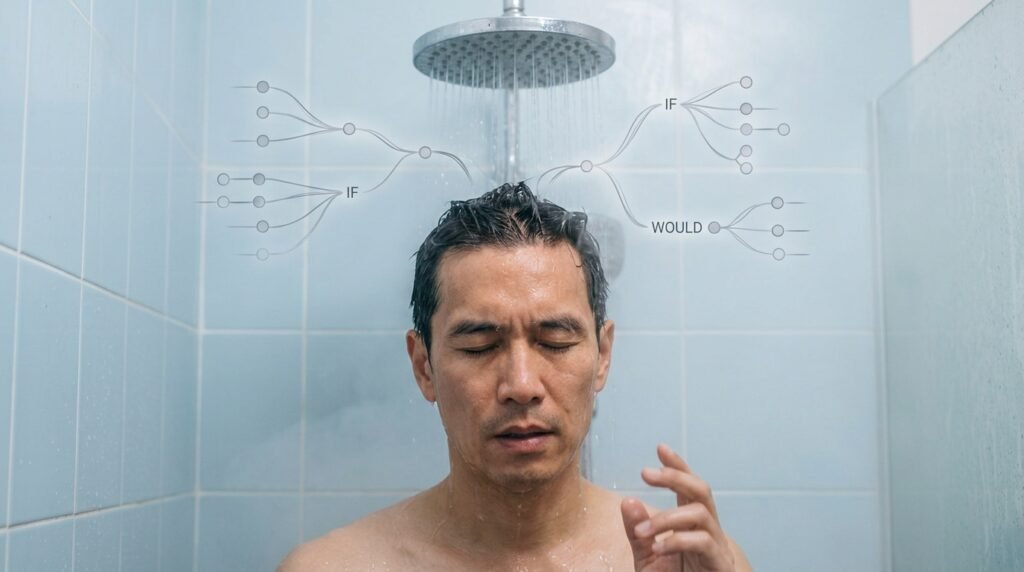
I dedicated my daily shower strictly to conditional tenses. The conditional tense is notoriously difficult for beginners. It requires complex sentence structures. It uses difficult trigger words like “if,” “would,” and “could.”
I stood under the hot water and formulated massive imaginary arguments in my target language.
I said things like, “If you had told me earlier, I would have brought the printed documents.” Or, “If I possessed more money, I would buy a completely different car today.”
The physical act of showering is highly relaxing. It naturally lowers your mental filters. You are not worried about looking stupid. This relaxed physical state allows your brain to experiment heavily with complex grammar rules without any crippling fear of failure.
Grocery Shopping and Spatial Prepositions
Prepositions are tiny words that cause massive headaches. Words like “in,” “on,” “at,” “under,” and “above” do not translate cleanly between different languages. You absolutely have to learn them through physical spatial context.
I turned my weekly grocery shopping trip into a dedicated preposition drill.
As I walked slowly down the aisles, I mentally described the exact physical location of the items. I forced myself to use the correct prepositions.
I thought to myself, “The red apples are located next to the oranges. The cold milk is inside the refrigerator. The fresh bread is sitting on the top shelf.”
I did not do this out loud. I did this entirely in my silent internal monologue.
Walking through a physical space while labeling the relationships forces your brain to connect the abstract grammar directly to concrete reality. You completely stop translating the prepositions from English. You start associating them directly with physical depth and placement. The grocery store is a perfect, highly structured map for this exact exercise. You can see exactly how I map out other locations in The Simple Way I Practice Grammar Every Day to turn any room in your house into a functional classroom.
Digital Friction and Command Forms
You look at your smartphone dozens of times a day. Your phone is constantly giving you direct commands. It tells you to “swipe up.” It tells you to “click here.” It tells you to “delete message.”
These are all imperative verb forms. They are direct, unavoidable commands.
I changed the operating language of my phone to my target language. I changed the language of my email client. I changed the language of all my social media applications.
This creates immediate daily friction. Suddenly, you have to read and understand the target language just to set your morning alarm clock.
You absorb the imperative verb forms completely passively. You see the command for “save” or “send” twenty times a day. Your brain naturally internalizes the grammatical structure without any conscious study effort. You learn exactly how native speakers construct brief, direct orders. It is completely free daily immersion.
Evening Chores and the Passive Voice
The passive voice is a very clunky grammatical structure. We use it when the action is far more important than the specific person doing the action. For example, “The dishes were washed.” It is a structure that deeply frustrates many beginners because the word order feels backward compared to normal speech.
I tied my practice of the passive voice directly to my evening chores. I realized that boring household chores are exactly the kind of impersonal actions that fit the passive voice perfectly.
When I cleaned the kitchen after dinner, I narrated the entire physical process in the passive voice out loud.
I wiped down the countertops with a wet cloth. I said, “The counters are being cleaned.” I took the heavy garbage bag out to the street. I said, “The trash was removed.” I loaded the dirty coffee cups into the dishwasher. I said, “The plates have been loaded.”
It feels highly robotic at first. You sound exactly like a factory machine giving a status report. But this repetitive mental drill completely removes the mystery and the clunkiness of the passive voice. By the time the kitchen is spotless, you have executed thirty perfect reps of a difficult grammar rule. You successfully combined a mandatory household chore with highly productive language acquisition.
The Three Sentence Journal
You need a reliable way to track your daily progress. You need a physical record of your structural improvement over time.
I started a micro journal. I kept a small paper notebook on my bedside table. Every single night, right before I turned off the reading lamp, I wrote exactly three sentences.
I did not allow myself to write more than three sentences. I kept the barrier to entry extremely low so I could never use fatigue as an excuse.
I used these three sentences to practice whatever specific grammar rule I struggled with that specific day. If I messed up a plural noun ending during a conversation at lunch, I wrote three perfect sentences using plural nouns.
I focused intensely on getting those three short sentences structurally flawless. I used a dictionary if I needed to verify a spelling. This was my only deliberate, focused grammar study of the entire day.
It took exactly two minutes. The daily repetition of perfect output slowly ironed out my worst structural mistakes. This powerful method of tiny, consistent improvements is fully explored in How I Made Learning a Language Part of My Daily Life so you can implement your own low friction journal tonight.
Eliminating the Heavy Guilt
The absolute greatest benefit of this daily integration system is the complete elimination of guilt.
When you schedule a strict one hour study session and fail to do it, you feel terrible. You feel incredibly lazy. You feel like a total failure. That heavy guilt destroys your motivation entirely. You start associating the foreign language strictly with negative emotions.
When you simply scatter your practice across your existing daily habits, massive failure is almost impossible.
If you forget to practice the future tense while making tea, it does not matter at all. You still have the commute. You still have the shower. You still have the grocery store. You have a dozen small safety nets built directly into your day.
You constantly accumulate tiny victories. You build massive positive momentum. The language becomes a natural, stress free part of your daily existence.
The Shift from Translation to Instinct
When you study grammar at a quiet wooden desk, you have plenty of time to translate. You read a complex rule, you translate it back into English, and you slowly calculate the correct foreign answer. It is a sterile environment.
When you practice grammar while driving a car in heavy traffic or washing fragile dishes, you do not have the luxury of time to translate. Your brain is heavily occupied with the physical task. You have to rely on pure linguistic instinct.
This divided attention is actually a massive advantage. It forcefully prevents your brain from overthinking the rules.
You completely bypass the slow, analytical part of your conscious mind. You build raw, physical muscle memory in your mouth, your lips, and your throat. The complex grammatical structures start to feel physically correct to your body. You stop asking exactly why a sentence is built a certain way. You just know it feels perfectly right because you have shouted it in the shower a hundred times before. You naturally replace slow mental math with incredibly fast physical reflexes.

Creating a Language Lifestyle
True fluency is never an academic achievement. It is not a printed certificate you hang on your office wall. Fluency is a daily lifestyle choice.
You cannot achieve a lifestyle choice by studying it for an hour on Tuesday nights. You have to actively live it.
Grammar is just the underlying logic of that lifestyle. It is the invisible skeleton that holds your daily thoughts together. You must drag that skeleton out of the heavy textbook and bring it directly into your kitchen, your car, and your workplace.
Stop trying to force massive amounts of abstract information into your tired brain at the end of a long day. Stop treating the language like an enemy you have to defeat through sheer discipline.
Look closely at your daily routine right now. Find the empty pockets of time. Find the automatic habits you already possess. Attach a single, simple grammar rule to each of those physical habits.
Speak out loud to your empty house. Narrate your boring daily chores. Argue with imaginary people in the shower. Transform your normal, mundane life into a continuous, effortless language laboratory. The grammar will finally stick, and you will never have to schedule a painful study session ever again.

Gabriel Henrique is a language enthusiast and productivity writer. After testing countless study methods, he became obsessed with mastering new languages efficiently. He achieves this without burnout, without endless grammar drills, and without losing focus. At Blog The Curious, he shares everything he has learned along the way.