
I work from a very quiet home office. I spend hours running complex statistical models for professional basketball. I track specific player props. I look for the exact probability of a player scoring the first basket, grabbing a rebound, or delivering an assist in a crucial playoff game. After that, I switch screens and manage the legal documentation and content strategy for a network of digital blogs. I am entirely alone for nine hours a day.
When I started learning a new language, this physical isolation felt like a permanent curse. I read all the advice online. Every single expert said the exact same thing. They told me to go out and talk to native speakers. They told me to find a conversation exchange partner immediately.
I looked around my empty living room. There were no native speakers hiding behind my desk. I lived in a city where my target language was completely absent.
I tried using language exchange apps. I waited weeks for people to reply. The time zones never lined up perfectly. The conversations were awkward and forced. I spent more time scheduling the chats than actually speaking the language. My vocal progress completely stalled.
I realized I was using my isolation as a massive excuse to avoid doing the hard, uncomfortable work. I decided to stop waiting for a savior. I transformed my quiet apartment into a dedicated vocal laboratory. I built a rigid system to force myself to speak every single day without another human being in the room. Here is exactly how I practiced speaking when I had absolutely no one to talk to.
The Danger of the Silent Period
Many language learners fall into a trap called the silent period. They believe they need to study the language for a year before they open their mouths. They want to accumulate enough vocabulary to speak perfectly on their very first try.
This is a terrible strategy. Speaking is a physical mechanical skill. Reading a textbook does not train your jaw, your lips, or your vocal cords.
If you stay silent for a year, your brain learns the language, but your mouth remains completely ignorant. When you finally try to speak, your tongue trips over the foreign syllables. You stutter. You panic. You sound like an absolute beginner because, physically, you are one.
I knew I had to bypass this silent period. I had to build physical muscle memory immediately. I had to force my mouth to produce the sounds, even if I was just speaking to the blank walls.

Narrating the Mundane Reality
I started my solo practice with the most basic strategy possible. I aggressively narrated my daily life.
I am deeply meticulous about my morning coffee. I use a V60 pour over. I weigh specific heirloom beans from the Guji region of Ethiopia. I monitor the exact water temperature with a gooseneck kettle. I measure the precise timing of the bloom phase.
I used this highly structured morning routine as my primary speaking drill. While the water boiled, I spoke out loud to the empty kitchen. I described every single physical action I was taking.
I said, “I am grinding the coffee beans. The water is hot. I am pouring the water over the grounds. I smell the intense fruit notes.”
I forced myself to pull the foreign vocabulary directly into my physical reality. When I did not know a specific word for the paper filter or the digital scale, I stopped. I looked the word up on my phone. I wrote it down. I repeated the correct sentence out loud ten times. Integrating the language into these daily habits completely changed my retention. I detail exactly how to build this specific routine in How I Turned Everyday Moments Into Vocabulary Practice to help you lock the words into your physical memory.
The NBA Analyst Drill
Narrating my coffee routine was fantastic for mastering basic nouns and verbs. But I needed to practice building complex, persuasive arguments. I needed to practice expressing probability and logic.
I used my daily basketball research for this exact purpose.
I pulled up the NBA playoff statistics on my monitor. I looked at the historical data for a specific matchup. I stood up from my chair. I paced back and forth across the home office. I pretended I was a professional sports analyst live on television.
I argued my betting predictions out loud in my target language. I explained why a certain point guard was highly likely to record the first assist of the game. I explained how a specific injury would impact the rebounding numbers for the opposing team.
This drill is incredibly challenging. You cannot just drop single vocabulary words. You have to use complex transition words. You have to express doubt, certainty, and statistical trends. If I stumbled over a complex sentence structure, I completely restarted the analysis from the beginning. I forced my brain to build logical bridges entirely in the foreign language.
The Imaginary Argument
To push my brain even harder, I started staging intense debates in my living room. I picked a controversial topic related to my blog network. I manage a site heavily focused on digital automation and mobile productivity.
I assigned myself the role of arguing the first side. I gave a passionate, loud, two minute speech defending the use of aggressive task automation. I spoke clearly. I used strong hand gestures to emphasize my main points.
Then, I physically walked to the exact opposite side of the room. I turned around to face my previous spot. I gave another two minute speech violently attacking the concept of automation. I argued that it destroys human creativity and makes us lazy.
This drill requires massive mental agility. You have to rapidly access completely different sets of vocabulary. You have to physically practice expressing deep frustration and strict certainty. Arguing with yourself removes the heavy fear of offending a real person. You can safely test out strong opinions in total privacy. I explain the exact mechanics of this aggressive solo routine in How I Practiced Real Conversations by Myself because it completely changes your mental processing speed.
The Daily Audio Log
The human brain constantly lies to you. You always think you sound much better than you actually do in reality. The dense bones in your skull physically distort the sound of your own voice. To truly improve your speech, you need cold, objective data.
I started keeping a daily voice note diary on my smartphone.
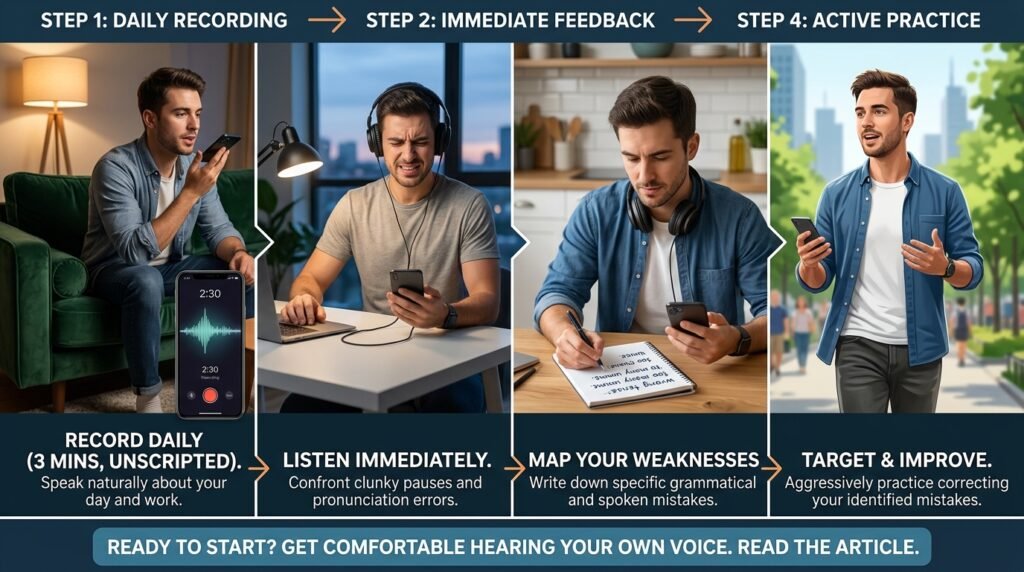
Every single evening, I sat on my couch. I hit record. I spoke for exactly three continuous minutes about my day. I summarized my blog analytics. I talked about the articles I wrote. I did not write a script. I just forced the raw sentences out of my mouth.
Then, I hit stop. I forced myself to listen to the recording immediately.
The first few weeks were absolute psychological torture. The recordings were terribly clunky. The pauses were agonizingly long. My pronunciation was brutally bad.
But the recordings provided an exact, undeniable map of my deepest weaknesses. I heard myself repeatedly using the wrong past tense verb. I took a pen and wrote those exact mistakes down on a piece of blank paper. The very next day, I targeted those exact mistakes aggressively. The digital voice recorder is the most honest, ruthless teacher you will ever have in your life. I outline exactly how to survive the initial cringe of this process in How I Got Comfortable Hearing My Own Voice so you can start gathering real data on your skills.
Shadowing the Native Masters
You absolutely cannot rely entirely on your own brain for vocal input. If you only listen to yourself, you will simply reinforce your own terrible mistakes forever. You desperately need a perfect native model to copy.
I used an intense technique called shadowing.
I opened a video of a native speaker on my laptop. I specifically chose videos of people talking about topics I cared about, like website development or professional sports. I put in my noise canceling headphones. I hit play.
I did not just listen passively. I spoke out loud at the exact same time as the native speaker. I tried to completely overlap my vocal output with their voice.
I mimicked their exact speaking speed. I copied their exact vocal intonation. If they raised their pitch at the end of a long sentence, I raised my pitch. If they paused deeply for breath, I paused for breath.
Shadowing is an intense physical workout. Your tongue will physically ache after ten straight minutes. But it completely destroys your native accent. It forces your vocal cords to adopt the natural, flowing rhythm of the target language.
Translating My Own Thoughts
I spend hours every week drafting content for my language learning blog, Blog the Curious. I write long, detailed articles about habit tracking, vocabulary retention, and study routines.
I realized I possessed a massive library of my own complex thoughts written in perfect English. I decided to use this library for aggressive speaking practice.
I opened one of my published articles on my monitor. I read the English text silently. Then, I forced myself to translate the core meaning of the paragraph out loud into my target language.
I did not try to translate it word for word. Word for word translation is impossible and produces robotic garbage. I read the paragraph, grasped the concept, looked away from the screen, and explained the concept out loud using the foreign grammar structures I knew.
This forces you to bypass the English middleman. It trains you to express your own deeply held beliefs and professional knowledge clearly. It bridges the gap between your high level English competence and your low level foreign vocabulary.
The Speed Constraints
Fluency heavily requires raw vocal speed. When you practice completely alone, you naturally tend to speak very slowly. You give yourself way too much time to think and calculate every single verb ending.
This is incredibly dangerous. Real human conversations do not wait for you to process the grammar rules.
I introduced strict time constraints to my solo practice. I picked a random topic. I set a timer on my phone for exactly sixty seconds.
I hit start. I forced myself to speak about the topic at absolute maximum speed until the timer stopped entirely.
I completely ignored my terrible grammar mistakes. I ignored my sloppy pronunciation. The only acceptable goal was continuous, rapid vocal output. If I completely forgot a vocabulary word, I talked rapidly around it. I never stopped speaking for a single second.
This high speed drill completely short circuits your harsh internal critic. Your brain simply does not have time to judge your grammar. It only has time to survive the intense drill. After doing this drill five times in a row, speaking at a normal conversational speed felt incredibly slow and entirely relaxing.
Embracing the Total Madness
Talking loudly to yourself in an empty room feels completely insane.
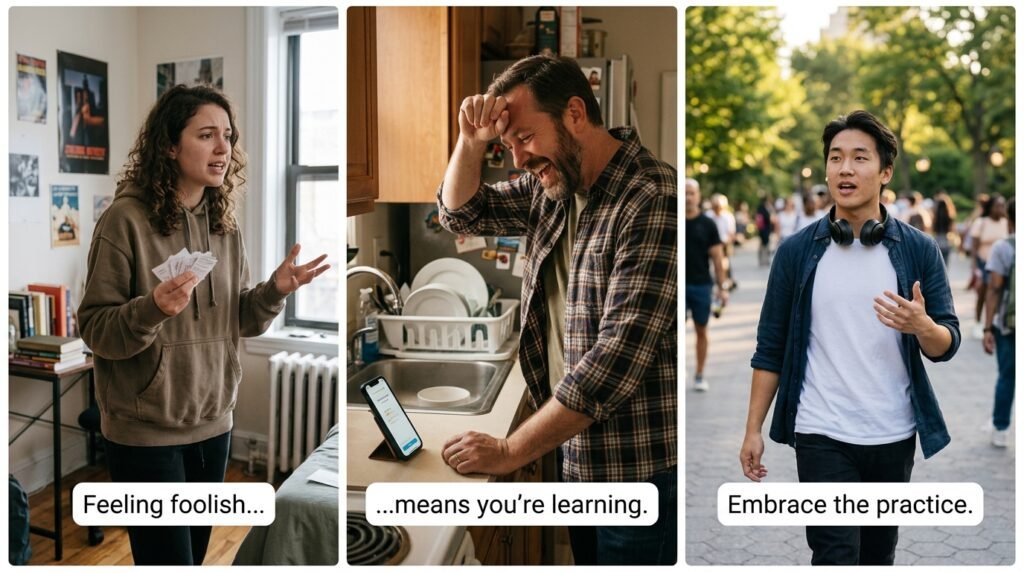
When you start doing this, you will feel incredibly self conscious. You will constantly worry that your neighbors can hear you through the thin apartment walls. You will feel deeply foolish pacing around your living room arguing passionately with your own furniture.
You have to completely let go of this fragile ego. You have to fully embrace the madness.
Learning a foreign language requires a total surrender of your personal dignity. If you are too proud to sound stupid in an empty room, you will never sound intelligent in a crowded room.
I learned to laugh loudly at myself. When my tongue literally tied itself into a knot over a simple word, I did not get angry. I just shook my head, took a deep breath, and started the entire sentence over from the beginning.
The empty room is a perfect sanctuary. It does not judge you. It does not grade you on a strict curve. It just silently absorbs your intense effort.
Preparing for the Real World
Solo practice is not a permanent replacement for real human interaction. It is strictly the training camp. You do the heavy, embarrassing lifting in the dark so you can eventually shine brightly in the light.
After six solid months of talking aggressively to my empty apartment, I finally felt ready. I scheduled a call with a native speaker.
My heart beat incredibly fast. The native speaker asked me a complex question about my work with digital blogs.
I opened my mouth. The foreign words flowed out smoothly. There was absolutely no hesitation. There was zero internal translation blocking my thoughts. My mouth simply executed the exact physical routines I had drilled thousands of times in my quiet living room.
The native speaker smiled and replied normally. We had a completely natural, fluid conversation. All those bizarre hours of sounding crazy in my apartment finally paid off perfectly.
Stop waiting endlessly for a perfect tutor. Stop constantly complaining that you live in the wrong country. Stop using your physical isolation as a convenient excuse to stay completely silent.
Your ability to speak is entirely within your own control. Stand up right now. Look at the random objects in your room. Start naming them out loud. Start narrating your boring physical actions. Build an imaginary podcast studio right in your kitchen. Argue loudly with the blank walls.
Record your terrible mistakes and aggressively fix them one by one. The path to true fluency does not require a native speaker sitting across from you. It only requires you, your vocal cords, and the absolute willingness to practice relentlessly in the empty spaces of your daily life.
Gabriel Henrique is a language enthusiast and productivity writer. After testing countless study methods, he became obsessed with mastering new languages efficiently. He achieves this without burnout, without endless grammar drills, and without losing focus. At Blog The Curious, he shares everything he has learned along the way.