
I used to measure my language learning by how exhausted I felt. If my head hurt after a study session, I assumed I was making progress. I would spend three hours on a Sunday memorizing complex grammar tables. I would copy entire pages of vocabulary into a notebook.
By Wednesday, I had forgotten all of it.
I was working incredibly hard. I was also going absolutely nowhere. I realized that sheer effort is completely useless without a underlying structure. You cannot brute force a language into your brain. You have to build a machine that does the work for you.
I needed a predictable, mechanical system. I stopped treating language learning like a mysterious art form. I started treating it like a daily engineering problem.
This is the exact, simple system I followed to guarantee daily progress. It requires very little motivation. It requires zero innate talent. It only requires the discipline to follow the steps.
Treating Learning Like a Productivity Problem
I manage several niche websites for a living. One of my main projects focuses entirely on mobile productivity and habit tracking. I spend my days testing task automation, analyzing daily routines, and figuring out how to get more done with less effort.
Yet, I completely ignored these principles when I tried to learn a new language.
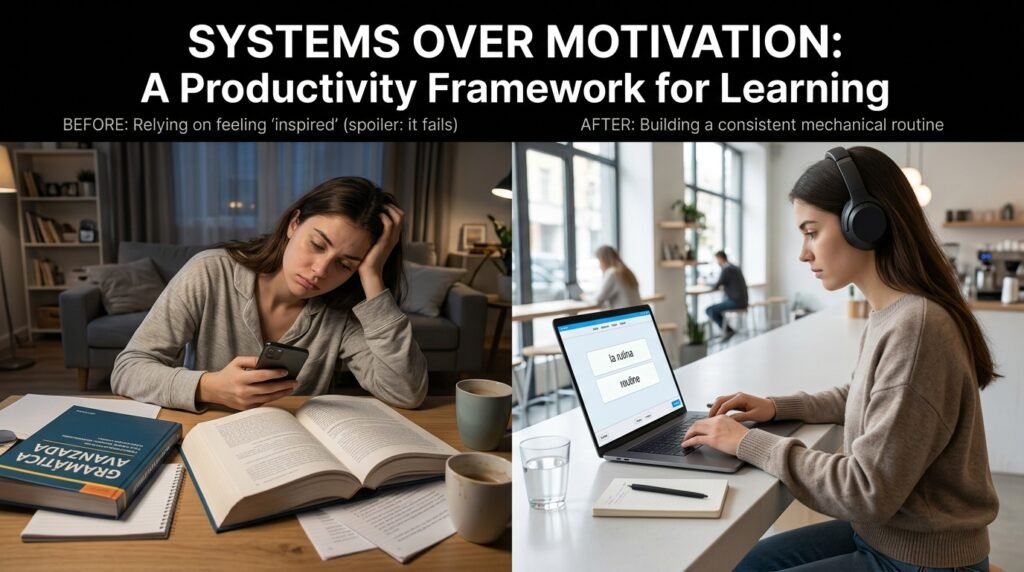
I relied entirely on my mood. If I felt inspired, I studied. If I felt tired, I skipped it. This was a terrible strategy. Motivation is an emotion, and emotions change every single hour.
I sat down and applied my own productivity rules to my study habits. I decided to build a rigid framework. I wanted a routine so tightly integrated into my day that I could execute it on autopilot. I focused intensely on How I Built a Learning System That Didn’t Feel Like Studying by removing all the traditional friction.
I deleted the gamified apps that only provided a false sense of progress. I threw away the massive grammar encyclopedias. I stripped the process down to its bare essential components.
Mini-Summary: Systems Over Motivation Do not rely on feeling inspired to study. Motivation will always abandon you. Treat your learning like a daily productivity task. Build a mechanical system that forces you to act regardless of how you feel.
Component One: The Unbreakable Anchor Habit
A new habit cannot survive on its own. You have to tie it to an old habit.
If you tell yourself you will study sometime in the afternoon, you will inevitably forget. The afternoon is chaotic. You need a specific trigger. You need an anchor.
I looked at my morning routine. I have a very specific, unbreakable habit. Every single morning, without fail, I make a cup of specialty coffee. I prefer manual brewing methods. I measure the beans, heat the water, and pour it over a V60 filter. It takes exactly five minutes.
I decided to make this five-minute window my daily language anchor.
I placed my language notebook and a single pen directly next to my coffee scale. I did not put them in a drawer. I left them right on the counter. When I walked into the kitchen, the notebook was waiting for me.
While the coffee bloomed, I opened the book. I reviewed my vocabulary from the previous day. I read one short paragraph of new text. When the coffee was finished brewing, my study session was finished.
This completely removed the hardest part of studying. Starting is always the hardest part. By tying the start to an automatic action, I never had to negotiate with myself. The coffee meant it was time to study.
Component Two: The Five-Minute Floor
My biggest early mistake was setting a massive daily goal. I wanted to study for a full hour every day.
When my schedule became busy, an hour felt impossible. I would look at the clock, realize I only had twenty minutes, and decide to skip the session entirely. I had an all or nothing mindset. That mindset destroys consistency.
I changed my daily goal to five minutes.
Five minutes is the floor. It is the absolute bare minimum required to keep the habit alive. Everyone has five minutes. You cannot look me in the eye and tell me you do not have five minutes.
If I was exhausted, sick, or working a fourteen hour day, I still did my five minutes. I opened the book, read three sentences, and closed it. I checked the box on my habit tracker.
The magic of the five-minute floor is momentum. Most days, once I opened the book and started reading, the friction vanished. I usually ended up studying for thirty minutes. But on the bad days, the five-minute rule saved me from breaking my streak. You have to protect the habit at all costs.
Component Three: Curating Highly Specific Input
Standard language textbooks are designed for tourists. They teach you how to order a train ticket, how to ask for the bathroom, and how to describe the color of a sweater.
This vocabulary is incredibly boring. Your brain aggressively rejects boring information. It is very difficult to memorize words you do not care about.
I completely changed my input material. I decided to learn words connected directly to my actual hobbies and interests.
I am deeply interested in traditional Japanese tattoo art. I specifically focus on Irezumi folklore motifs. I love studying the historical meaning behind these designs.
I started searching for foreign articles discussing this specific art form. I looked for texts explaining the symbolism of the serpent, the mythology of the kitsune, and the history of the katana. I wanted to learn the specific kanji for concepts like protection, wisdom, and courage.
I used these texts as my primary reading material. I translated them line by line.
I discovered exactly How I Turned Everyday Moments Into Vocabulary Practice by surrounding myself with topics I genuinely loved. I did not need to force myself to memorize these words. My brain absorbed them instantly because I had a deep emotional connection to the subject matter.
Mini-Summary: Ignore General Vocabulary Do not waste time memorizing words you will never use. Find reading material based on your deepest personal interests. Your brain will retain niche vocabulary much faster than generic textbook phrases.
Component Four: The Mandatory Output Rule
You can read foreign books for a decade and still be completely unable to hold a simple conversation. Reading is passive. Language is active.
I realized I was spending ninety percent of my time reading and listening. I was taking in massive amounts of data, but I was never testing my ability to produce it. When I actually tried to speak, I froze.
I built a mandatory output requirement into my daily system.
Every single study session had to end with active creation. I instituted the three sentence rule. Before I could close my notebook, I had to write three entirely original sentences using the new vocabulary I just learned.
I did not copy the sentences from the book. I had to generate them from my own brain.
If I learned the word for serpent, I wrote a sentence about a serpent. If I learned a new verb tense, I applied it to my own life. This practice forced me to recall the grammar rules under slight pressure. It showed me exactly What Helped Me Move From Knowing Words to Using Them in a practical setting.
After writing the sentences, I read them out loud to the empty room. This trained my facial muscles to produce the new sounds. Output is uncomfortable. It highlights your mistakes. But output is the only way to solidify the information.

Component Five: Tracking the Data
When you learn a complex skill, the daily progress is completely invisible.
You do not wake up on a Tuesday suddenly feeling fluent. The growth happens in microscopic increments. Because you cannot see the daily improvement, your brain convinces you that the system is broken. You feel like you are failing, even when you are succeeding.
I needed a way to manufacture visual proof of my progress. I needed hard data.
I opened the habit tracking application on my phone. I created a single daily objective: Execute Language System.
Every time I finished my morning session, I checked the box. A green checkmark appeared on the calendar view. After two weeks, I had a solid green line.
This visual feedback loop is incredibly powerful. You begin to value the streak itself. There were mornings when I desperately wanted to skip my session. But I opened my app, looked at the twenty day streak, and realized I did not want to break the chain. I forced myself to do the five-minute floor just to get the green checkmark.
Track your execution, not your fluency. You cannot control how fluent you feel on any given day. You can entirely control whether or not you open the book. Focus entirely on executing the daily task. Let the fluency take care of itself over time.
Component Six: The Weekly System Audit
A daily routine is powerful, but it will degrade over time if you do not maintain it.
Your notebook gets messy. You fall behind on your flashcard reviews. You run out of interesting articles to read. If you wait until Monday morning to find new reading material, you will waste your entire study session scrolling on the internet.
I created a weekly maintenance block.
Every Sunday afternoon, I spend exactly fifteen minutes auditing my system. I do not learn any new language concepts during this time. This is a purely administrative task.
Here is my exact Sunday checklist:
-
Clean the Workspace: I clear any random papers off my desk. I put my notebook and pen back next to the coffee scale.
-
Select the Input: I find three new articles or podcast episodes for the upcoming week. I download them and place them in my active folder.
-
Review the Output: I read through the sentences I wrote during the previous week. I look for recurring grammar mistakes. I make a note to focus on those specific errors in the coming days.
-
Update the Tracker: I review my habit tracker. If I missed a day, I look at exactly why I missed it and adjust my schedule to prevent it from happening again.
This weekly audit guarantees that Monday morning is completely frictionless. When I wake up, the system is fully loaded and ready to execute.

The Beauty of a Boring Routine
People want language learning to be an exciting adventure. They want a secret hack that uploads vocabulary directly into their brain.
The reality is incredibly boring.
Real progress looks like waking up at the same time every day. It looks like staring at a notebook while your coffee brews. It looks like checking a digital box on your phone. It looks like writing three simple, clunky sentences about your day.
The simple system works precisely because it is boring. It removes the emotion from the equation. It turns a massive, intimidating goal into a small, predictable daily chore.
You do not need more motivation. You do not need to buy another textbook. You just need to build your machine.
Audit your morning routine. Find your anchor habit. Set a five-minute floor. Find reading material that actually matters to your life. Force yourself to write three sentences every day. Track your execution ruthlessly.
Stop thinking about how long it will take to become fluent. The time will pass anyway. Focus entirely on executing the system today. The progress will follow.

Gabriel Henrique is a language enthusiast and productivity writer. After testing countless study methods, he became obsessed with mastering new languages efficiently. He achieves this without burnout, without endless grammar drills, and without losing focus. At Blog The Curious, he shares everything he has learned along the way.