
We have all experienced the silent panic. You are standing in front of a native speaker. They ask you a relatively simple question. You understand the words they are saying. You know the grammar they are using. Your brain registers the meaning perfectly. But when you open your mouth to reply, nothing happens.
The words you need are trapped inside your head. You can see them. You know you studied them last Tuesday. You even remember the color of the flashcard they were written on. But they refuse to travel from your brain to your vocal cords. You end up smiling awkwardly, nodding, and giving a simple “Yes” to a question that required a full sentence.
You walk away feeling incredibly frustrated. You ask yourself why you spend hours studying if you cannot even hold a basic conversation.
This is the gap between passive knowledge and active usage. It is the most frustrating plateau in the entire language learning journey. For a long time, I lived on this plateau. I was a walking, breathing dictionary. I could pass written tests with flying colors, but I was functionally mute in the real world.
I had to completely change my approach. I had to stop collecting vocabulary and start deploying it. Here is the exact strategy that helped me cross the bridge from being a silent scholar to an active speaker.
The Illusion of the Passive Vocabulary
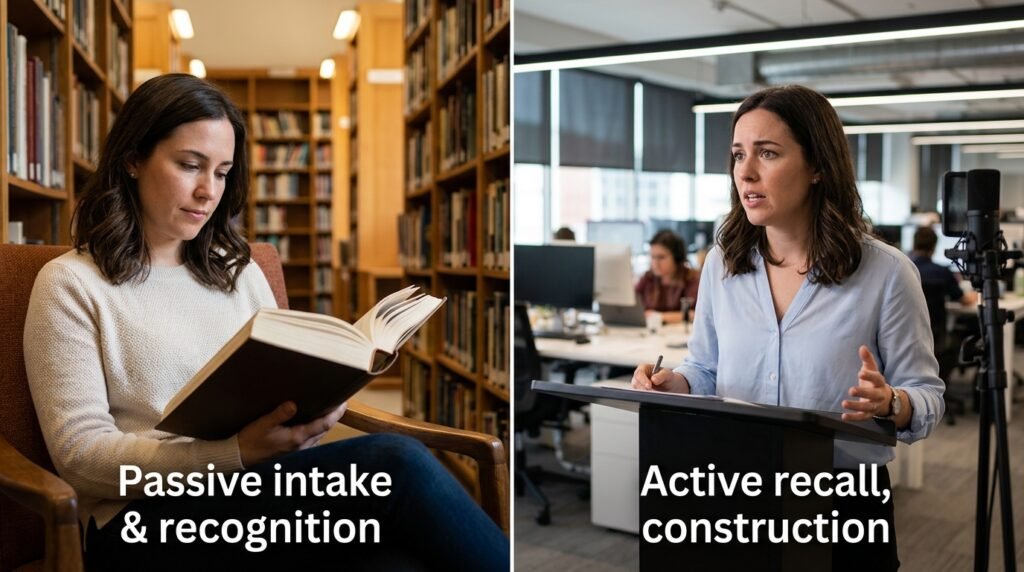
The human brain is incredibly efficient at recognizing patterns. When you read a book or listen to a podcast, your brain is doing passive work. The context is already provided for you. The structure is built. You just have to follow along.
This creates a massive illusion of fluency. Because you can understand a complex news article, you assume you can speak about complex topics. But reading and speaking use completely different neural pathways.
Reading is like eating a meal prepared by a master chef. You can enjoy it, analyze it, and understand the flavors. Speaking is like being thrown into the kitchen and told to cook the meal from scratch while a ticking clock counts down.
I had a massive passive vocabulary. I knew thousands of words. But my active vocabulary—the words I could actually summon on command—was tiny. I had to take a hard look at my study habits. I spent weeks analyzing The Mistake I Was Making With Vocabulary (And How I Fixed It) and realized I was training for the wrong sport. I was training my eyes to read, not my mouth to speak.
The Three-Second Translation Delay
The biggest roadblock to using your words is the translation delay. When a beginner tries to speak, they usually follow a very clunky, three-step process.
-
They form the thought in their native language.
-
They frantically search their mental dictionary for the foreign equivalents of those specific words.
-
They try to assemble those foreign words using complex grammar rules.
This process takes time. Usually, it takes about three to five seconds. In a real-life conversation, three seconds of dead silence feels like an absolute eternity. The pressure mounts. The other person stares at you. Your anxiety spikes, which triggers a stress response that literally blocks your memory retrieval. You freeze.
You have to eliminate the middleman. You have to stop passing your thoughts through your native language. The day I finally grasped How I Learned to Speak Without Translating First was the day my speaking speed tripled. I stopped looking for the exact translation and started looking for the direct concept.
If I wanted to say I was hungry, I stopped thinking the English phrase “I am hungry.” I forced myself to associate the physical feeling in my stomach directly with the target language phrase. By cutting out the English step, the words started to arrive on time.
Speaking is a Physical Skill
We treat language learning like a math problem. We think it is a purely intellectual exercise. It is not. Language is a highly physical skill.
Speaking requires extreme coordination between your lungs, your vocal cords, your tongue, and your lips. When you learn a new language, you are asking these muscles to move in shapes and patterns they have never attempted before.
If you only ever read your vocabulary lists silently in your head, your mouth has zero muscle memory for those sounds. When you finally try to speak in a high-pressure situation, your mouth physically stumbles over the unfamiliar syllables.
You have to train your mouth. You have to get the words out of your head and into the air.
I made a strict rule for myself. I was no longer allowed to learn a new word without saying it out loud at least ten times. I had to feel how the word vibrated in my throat. I had to feel where my tongue hit the roof of my mouth. I needed the physical repetition to build the muscle memory so my mouth could take over when my brain was panicked.
The “Empty Room” Rehearsal
Because speaking to native speakers is terrifying at first, I removed the native speakers from the equation. I needed a safe environment to fail. I needed a place where I could stutter, stumble, and forget my words without feeling embarrassed.
I turned my living room into my primary training ground.
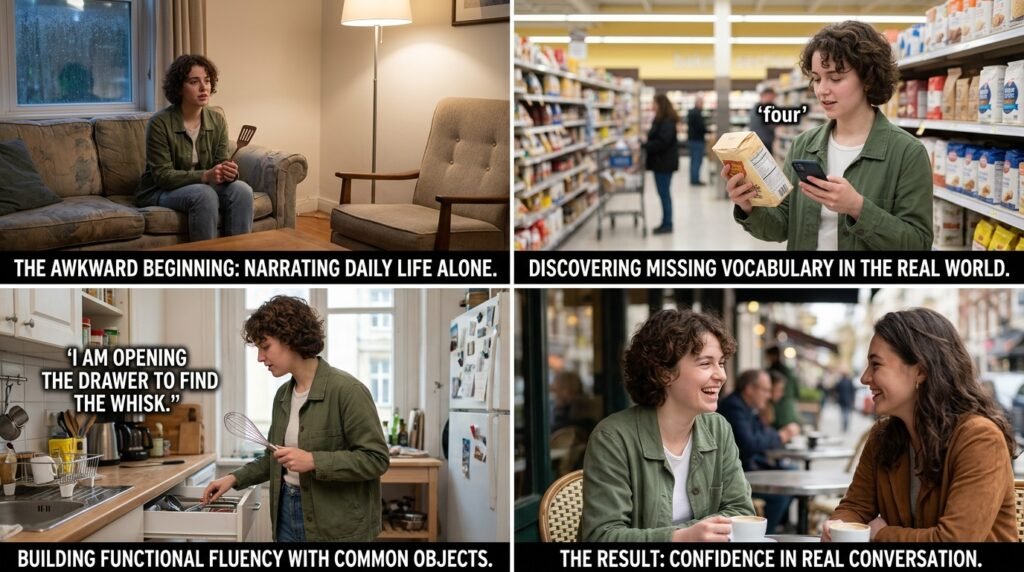
I started narrating my daily life out loud to an empty room. I would walk into the kitchen and talk to myself. “I am opening the fridge. I am looking for the milk. The milk is gone. I need to go to the store.”
It felt entirely ridiculous for the first two weeks. But the results were undeniable. I realized that The Way I Practice Speaking When I’m Alone was actually building the exact neural bridges I needed for real conversations.
When you talk to yourself, you discover exactly which words are missing from your active vocabulary. You might know the word for “government” or “economy,” but when you try to narrate your morning routine, you realize you have no idea how to say “spatula” or “shoelaces.”
This solo practice forces you to find the functional, everyday words you actually need to survive. It builds your confidence. By the time I used a phrase with a real person, I had already said it fifty times to my kitchen cabinets. The fear was gone.
Building “Islands of Fluency”
If you try to be fluent in everything all at once, you will be fluent in nothing. The scope of an entire language is too massive. It causes cognitive overload.
To move words into my active vocabulary, I started building “Islands of Fluency.”
An island is a specific, highly predictable topic of conversation. Think about the interactions you have every day. They follow a script. When you meet someone new, they always ask the same questions.
-
Where are you from?
-
What do you do for a living?
-
Why are you learning this language?
-
What are your hobbies?
Instead of trying to learn every word in the dictionary, I learned every word necessary to answer those specific questions perfectly. I wrote out my answers. I translated them. I memorized them. I spoke them out loud hundreds of times.
I built a massive, rock-solid island for the topic of “My Job.” I built another island for “My Travels.”
When I spoke to a native speaker, I would steer the conversation toward one of my islands. As soon as we landed on that topic, my anxiety vanished. I had the active vocabulary ready to go. I sounded incredibly fluent. If the conversation drifted into unknown territory and I started to stumble, I would just guide it back to another island.
This strategy provides safe harbors in the middle of chaotic conversations. It gives you the confidence to start talking, knowing you have a script to fall back on.
The Power of the “Placeholder”
Perfectionism is the enemy of active vocabulary. The main reason we freeze in conversations is that we cannot remember the exact right word, so we say nothing at all.
You have to learn how to compromise. You have to embrace the “placeholder” strategy.
If I am trying to tell a story about a “skyscraper,” but my brain cannot find the specific word for skyscraper, a perfectionist will stop the story. They will freeze, stare at the ceiling, and try to force the word out.
A functional speaker will use a placeholder. They will say, “the very tall building.”
It is not elegant. It is not poetic. But it keeps the conversation moving. Communication is about transferring ideas, not passing a vocabulary exam. If you cannot remember the word for “surgeon,” say “the doctor who cuts people.” If you cannot remember “exhausted,” say “very, very tired.”
Once I gave myself permission to use simple, ugly placeholders, my speaking speed skyrocketed. I stopped fearing the blank spaces in my memory. I knew I could always talk my way around a missing word.
Utilizing High-Frequency Fillers
When you listen to native speakers in any language, you notice they do not speak in perfectly formed, continuous sentences. They use filler words. They pause. They stall for time.
In English, we say “um,” “like,” “you know,” and “well.”
These words are socially acceptable ways to tell the listener, “I am still thinking, please do not interrupt me.”
When you are learning a language, silence is terrifying. If you pause to think of a word, the other person assumes you did not understand them. They repeat the question louder. This makes you panic even more.
I made it a priority to learn the native filler words of my target language. If I needed three seconds to pull a verb out of my active memory, I would use a filler word to buy that time.
Saying “Well, the truth is…” in the target language gives your brain a crucial runway to formulate the rest of the sentence. It makes you sound natural, relaxed, and culturally aware, even if you are frantically searching your mental dictionary behind the scenes.
Emotional Anchoring for Stubborn Words
Some words simply refuse to stick. You learn them. You use them. You forget them. Repeat.
For these stubborn words, repetition is not enough. You need emotional anchoring. The brain retains information that has emotional weight.
If I needed to move a difficult word into my active vocabulary, I would manufacture an emotional connection to it. I would use the word in an exaggerated, ridiculous sentence. If the word was “appointment,” I would not just write “I have an appointment.”
I would write, “If I miss this appointment, my boss will throw my desk out the window.”
Then, I would say the sentence out loud with intense emotion. I would sound panicked. I would gesture wildly. The physical and emotional performance forces the brain to pay attention. It takes the word out of the abstract realm of text and roots it in a memorable experience.
The 24-Hour Production Rule
I implemented a strict rule to ensure my passive knowledge constantly converted to active skill. It was the 24-Hour Production Rule.
If I learned a new word on a flashcard or read it in an article, I had a 24-hour deadline to produce that word in real life.
I had to use it. I could not just look at it.
-
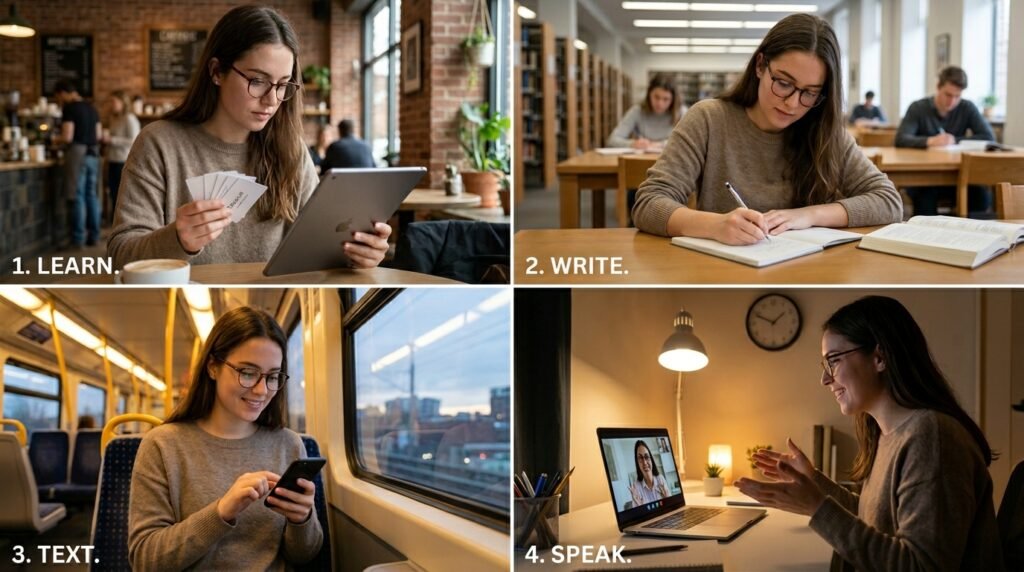
I could write a journal entry using the word.
-
I could text a language exchange partner using the word.
-
I could force the word into a conversation with a tutor.
It did not matter if the usage was slightly clunky. The act of retrieving the word from my brain and pushing it out into the world cemented it in my active memory. If I did not use the word within 24 hours, I considered it lost. This forced me to be highly selective about the words I chose to learn. I stopped learning obscure nouns and focused entirely on high-utility words I could use immediately.
Forgive the Mistakes
The final, and perhaps most important, step in moving words to your active vocabulary is a change in mindset.
You must forgive yourself for butchering the language.
When you start actively using words, you will use them wrong. You will use the wrong gender. You will mess up the verb ending. You will accidentally say a word that sounds similar but means something highly inappropriate.
This is not a failure. This is the exact process of learning.
If you are waiting until you can speak perfectly before you speak at all, you will remain silent forever. The people who progress the fastest are the ones who are willing to look foolish. They are the ones who throw words against the wall to see what sticks.
Native speakers do not care about your grammar mistakes. They care about your effort. They care about the connection. When you smile, look them in the eye, and try your absolute best to communicate using the active vocabulary you have, they will meet you halfway.
Stop staring at your vocabulary lists. Close the textbook. Stand up, walk into the next room, and start describing your life out loud. The bridge between knowing a word and using a word is built entirely out of practice, mistakes, and the courage to open your mouth. Start building.

Gabriel Henrique is a language enthusiast and productivity writer. After testing countless study methods, he became obsessed with mastering new languages efficiently. He achieves this without burnout, without endless grammar drills, and without losing focus. At Blog The Curious, he shares everything he has learned along the way.