
I stared out the window of my small apartment. I desperately wanted to practice speaking my target language. I had a thick vocabulary list on my desk. I had a heavy grammar book. But I had absolutely nobody to talk to. I lived entirely alone. I convinced myself I could not improve my speaking skills without a native speaker sitting across from me.
I used my physical isolation as a massive excuse. I waited weeks for the perfect language exchange partner to reply to my messages online. I wasted highly valuable time waiting for someone else to fix my problem.
Then I realized a brutal truth. You do not need another human being to practice speaking. You have a voice. You have a brain. You have an empty room. That is absolutely all you actually need.
I completely changed my daily routine. I stopped waiting for a tutor. I turned my empty apartment into a dedicated language laboratory. I built a rigid system of solitary vocal drills. Here is exactly how I practice speaking when I am completely alone.
The Trap of the Native Speaker
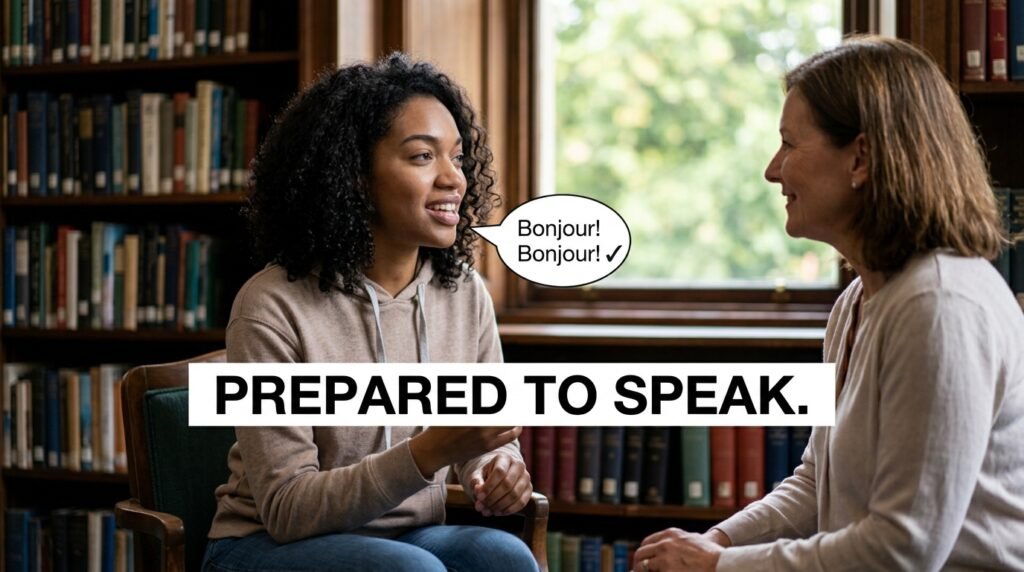
We heavily idolize the concept of the native conversation partner. We think they possess magic powers. We firmly believe simply sitting near them will magically transfer fluency directly into our brains.
This is a massive lie. Native speakers are often terrible practice partners for absolute beginners.
They naturally speak way too fast. They use heavy, localized slang. They easily get impatient when you stumble over a basic verb conjugation. The intense social pressure of talking to a native speaker completely paralyzes you. You freeze instantly. You forget basic vocabulary words. You spend the entire conversation sweating and constantly apologizing for your terrible grammar.
I realized I needed a completely safe environment to fail. I needed to heavily build my physical vocal muscles before I stepped into the ring with a professional native speaker.
The empty room provided absolute safety. It gave me total permission to sound completely foolish without any real social consequences.
Narrating the Mundane Reality
I started my solo practice with the most basic strategy possible. I aggressively narrated my daily chores.
I refused to let my internal monologue stay silent. When I washed the dirty dinner dishes, I spoke out loud to the sink. I described the exact temperature of the running water. I named the exact ceramic plates and metal forks I was scrubbing. I described the smell of the liquid soap.
This sounds incredibly boring on paper. In reality, it is highly challenging.
You quickly realize you entirely lack the vocabulary for your immediate physical environment. You might know how to thoroughly discuss international politics from a textbook. You probably do not know the correct foreign word for a dirty sponge.
Narrating my boring chores forced me to learn the crucial vocabulary of daily survival. I walked around my small apartment and named every single physical object I touched.
When I did not know a specific word, I stopped my chore immediately. I looked it up on my phone. I wrote it down. Then I repeated the correct sentence out loud ten times. This method maps the foreign language directly onto your personal physical reality. I detail how to build this exact physical mapping system in The Exercises That Helped Me Speak More Clearly to help you fix your basic household vocabulary gaps.
The Fake Podcast Interview
Narrating household chores is fantastic for mastering basic nouns and action verbs. But it does not teach you how to express highly complex opinions. You need to intensely practice forming long, coherent thoughts.
I invented a solo game. I pretended I was a highly respected guest on a famous global podcast.
I imagined the host asking me deep, probing questions about my life and my career. I paced aggressively back and forth across my living room floor. I answered the imaginary questions out loud at full volume.
I deeply explained my professional career choices. I aggressively defended my favorite movies. I talked heavily about my earliest childhood memories.
This specific exercise forces you to connect broken sentences. You cannot just drop single vocabulary words into the air. You have to use proper transition words. You have to use complex conjunctions. You have to successfully build a clear narrative arc from beginning to end.
When you speak to an imaginary podcast host, you buy yourself critical time. You can pause. You can restructure a broken sentence entirely without anyone judging you. You can completely restart the entire interview if you get stuck on a difficult verb tense.
Arguing Both Sides of a Debate
To push my brain even harder, I started staging intense political debates in my living room.
I picked a highly controversial topic. I assigned myself the role of arguing the first side. I gave a passionate, loud, two minute speech defending that specific position. I spoke clearly. I used aggressive hand gestures to emphasize my points.
Then, I physically walked to the exact opposite side of the room. I turned around to face my previous spot. I adopted a completely different physical posture. I gave another two minute speech violently attacking the first position I just defended.
This drill requires massive mental agility. You have to rapidly access completely different sets of vocabulary. You have to use highly persuasive grammar structures. You have to physically practice expressing deep doubt, strict certainty, and intense frustration.
Arguing with yourself removes the heavy fear of offending a real person. You can safely test out strong opinions and complex emotional vocabulary in total privacy. This strategy rapidly expands your conversational range. I explain the exact mechanics of building this aggressive solo routine in How I Practiced Real Conversations by Myself because it completely changes your mental processing speed.
The Brutal Bathroom Mirror Technique
Speaking a new foreign language requires your mouth to make completely new physical shapes. Your native language makes your facial muscles incredibly lazy over decades of use. You have to actively train your mouth exactly like a professional gymnast trains their physical body.
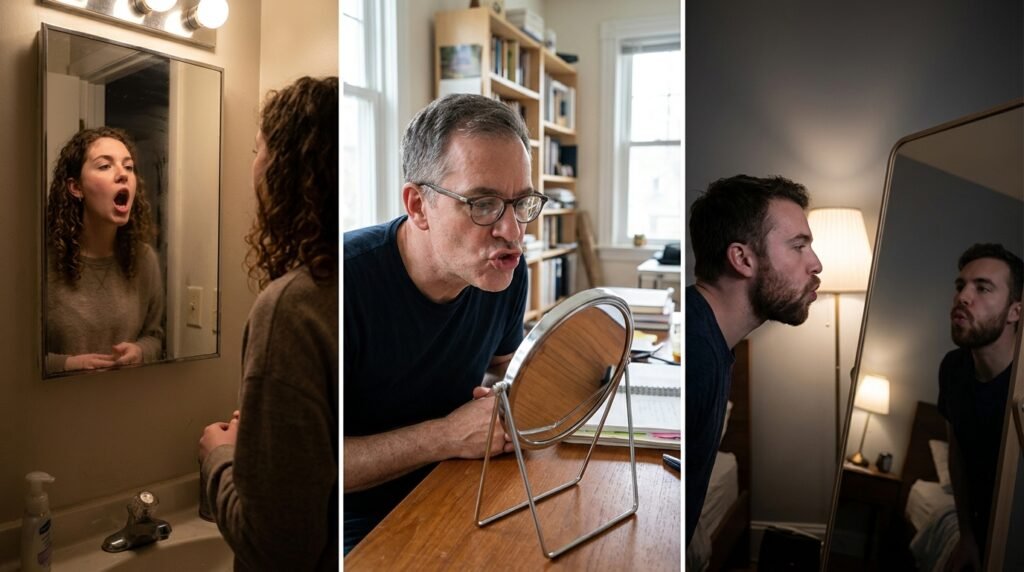
I stood directly in front of my bathroom mirror every single night. I looked intensely at my own mouth. I picked a highly difficult target sentence. I spoke the sentence out loud while watching my lips and jaw move.
I paid close attention to exactly how much I was opening my mouth. Many beginners naturally mumble. They keep their lips completely tight. They are deeply afraid of making the strange foreign sounds.
The mirror directly forces you to confront your physical hesitation. I forced myself to exaggerate the physical movements. I opened my jaw incredibly wide. I stretched my lips tightly. I made the vocal sounds sharp, loud, and completely clear.
Watching yourself speak builds a highly powerful mind and body connection. You start to physically feel the language in your throat instead of just thinking about it mentally in your brain.
Shadowing the Native Masters
You absolutely cannot rely entirely on your own brain for vocal input. If you only listen to yourself, you will simply reinforce your own terrible mistakes forever. You desperately need a perfect native model to copy.
I used an intense technique called shadowing.
I opened a video of a native speaker on my laptop. I specifically chose videos of people giving passionate speeches or telling incredibly fast stories. I put in my heavy noise canceling headphones. I hit play.
I did not just listen passively. I spoke out loud at the exact same time as the native speaker. I tried to completely overlap my vocal output with their voice.
I mimicked their exact speaking speed. I copied their exact vocal intonation. If they raised their pitch at the end of a long sentence, I raised my pitch. If they paused deeply for breath, I paused for breath.
Shadowing is an intense physical workout. Your tongue will physically ache after ten straight minutes. Your brain will completely scramble trying to keep up the rapid pace. But it completely destroys your native accent. It forces your physical vocal cords to adopt the natural, flowing rhythm of the target language.
The Objective Voice Note Diary
The human brain constantly lies to you. You always think you sound much better than you actually do in reality. The dense bones in your skull physically distort the sound of your own voice. To truly improve your speech, you need cold, objective data.
I started keeping a daily voice note diary on my smartphone.
Every single evening, I sat on my couch. I hit record. I spoke for exactly three continuous minutes about my day. I did not write a script. I did not prepare any vocabulary words. I just forced the raw sentences out of my mouth.
Then, I hit stop. I forced myself to listen to the recording immediately.
The first few weeks were absolute psychological torture. The recordings were terribly clunky. The pauses were agonizingly long. My pronunciation was brutally bad.
But the recordings provided an exact, undeniable map of my deepest weaknesses. I heard myself repeatedly using the wrong past tense verb. I heard myself horribly mispronouncing a specific, common vowel.
I took a red pen and wrote those exact mistakes down on a piece of blank paper. The very next day, I targeted those exact mistakes aggressively during my bathroom mirror practice. The digital voice recorder is the most honest, ruthless teacher you will ever have in your life.
The Mistake of Perfect Preparation
Many language learners practice by writing out a massive script. They write a perfect, highly grammatical paragraph in their target language. Then they read it out loud to the wall.
They honestly think they are practicing speaking. They are completely wrong. They are strictly practicing reading.
Spoken language is entirely unscripted. It is highly spontaneous. When you rely on a written script, you completely destroy your ability to think quickly on your feet.
I completely banned written scripts from my solo practice routine. I never wrote down what I was going to say before I said it. I just picked a random topic and started talking immediately.
The resulting sentences were incredibly messy. The grammar was heavily flawed. But the underlying cognitive process was entirely authentic. I was actively training my brain to retrieve vocabulary instantly from deep memory. I was training my brain to assemble grammar rules in real time under pressure.
Scripts are a massive crutch. Throw the paper away completely. Force your brain to do the heavy lifting from the very first second you open your mouth.
The Strategy of Reading Aloud
I added another highly powerful tool to my solo speaking routine. I started reading native books completely out loud.
Reading silently strictly builds your reading comprehension. Reading out loud strictly builds your physical speaking muscles.
I took a popular thriller novel written entirely in my target language. I stood up in the center of my bedroom. I held the heavy book in my hands and read the text at maximum volume.
I physically acted out the dialogue. I used completely different voices for the different characters. I focused heavily on the written punctuation. I paused strictly at the commas. I dropped my vocal pitch entirely at the periods. I raised my pitch dramatically at the question marks.
When you read a professionally written book out loud, you force your mouth to produce absolutely perfect grammar. You do not have to invent the complex sentence structure yourself. The author already did the hard work for you. You just have to supply the raw physical vocal energy.
I read out loud for thirty solid minutes every single night. My jaw actually felt deeply sore afterward. This physical soreness was undeniable proof that I was building brand new muscle.
Building Speed with Time Constraints
Fluency heavily requires raw vocal speed. When you practice completely alone, you naturally tend to speak very slowly. You give yourself way too much time to think and calculate.
This is incredibly dangerous. Real human conversations do not wait for you to process the grammar rules.
I introduced strict time constraints to my solo practice. I picked a random, difficult topic. For example, the specific health benefits of waking up early in the morning. I set a timer on my phone for exactly sixty seconds.
I hit start. I forced myself to speak about the topic at absolute maximum speed until the timer stopped entirely.
I completely ignored my terrible grammar mistakes. I ignored my sloppy pronunciation. The only acceptable goal was continuous, rapid vocal output. If I completely forgot a vocabulary word, I talked rapidly around it. I never stopped speaking for a single second.
This high speed drill completely short circuits your harsh internal critic. Your brain simply does not have time to judge your grammar. It only has time to survive the intense drill. After doing this drill five times in a row, speaking at a normal, conversational speed felt incredibly slow and entirely relaxing.
Embracing the Total Madness
Talking loudly to yourself in an empty room feels completely insane.
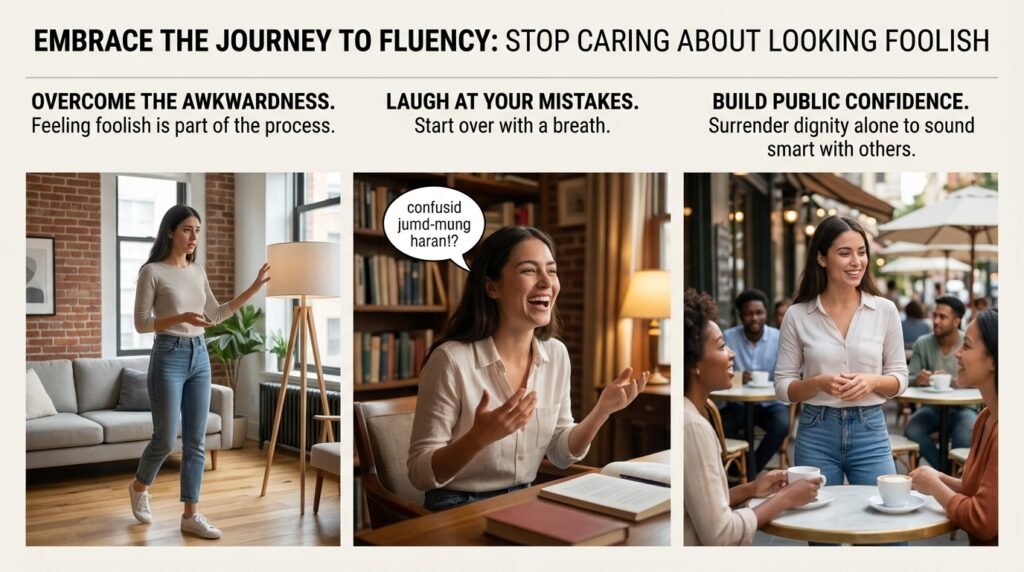
When you start doing this, you will feel incredibly self conscious. You will constantly worry that your neighbors can hear you through the thin apartment walls. You will feel deeply foolish pacing around your living room arguing passionately with the wooden furniture.
You have to completely let go of this fragile ego. You have to fully embrace the madness.
Learning a foreign language requires a total surrender of your personal dignity. If you are too proud to sound stupid in an empty room, you will never sound intelligent in a crowded room.
I learned to laugh loudly at myself. When my tongue literally tied itself into a knot over a simple word, I did not get angry. I just shook my head, took a deep breath, and started the entire sentence over from the beginning.
The empty room is a perfect sanctuary. It does not judge you. It does not grade you on a curve. It just silently absorbs your intense effort. I broke through this specific wall of embarrassment and documented the mental shift in How I Became More Confident Speaking Out Loud so you can finally stop caring about looking foolish.
Preparing for the Real World
Solo practice is not a permanent replacement for real human interaction. It is strictly the training camp. You do the heavy, embarrassing lifting in the dark so you can eventually shine brightly in the light.
After six solid months of talking aggressively to my empty apartment, I finally felt ready. I went to a loud, local language exchange meetup. I sat down directly across from a native speaker.
My heart beat incredibly fast. The native speaker asked me a complex question about my job.
I opened my mouth. The foreign words flowed out smoothly. There was absolutely no hesitation. There was zero internal translation blocking my thoughts. My mouth simply executed the exact physical routines I had drilled thousands of times in my quiet living room.
The native speaker smiled and replied normally. We had a completely natural, fluid conversation. All those bizarre hours of sounding crazy in my apartment finally paid off perfectly.
Stop waiting endlessly for a perfect tutor. Stop constantly complaining that you live in the wrong country. Stop using your physical isolation as a convenient excuse to stay completely silent.
Your ability to speak is entirely within your own control. Stand up right now. Look at the random objects in your room. Start naming them out loud. Start narrating your boring physical actions. Build an imaginary podcast studio right in your kitchen. Argue loudly with the blank walls.
Record your terrible mistakes and aggressively fix them one by one. The path to true fluency does not require a native speaker sitting across from you. It only requires you, your vocal cords, and the absolute willingness to practice relentlessly in the empty spaces of your daily life.
Gabriel Henrique is a language enthusiast and productivity writer. After testing countless study methods, he became obsessed with mastering new languages efficiently. He achieves this without burnout, without endless grammar drills, and without losing focus. At Blog The Curious, he shares everything he has learned along the way.