
I remember the first time I sat down in a small, bustling cafe in a country where I had spent months “studying” the language. I had my textbook phrases ready. I had memorized the formal greetings. I felt like a scholar. When the waiter approached, I delivered a perfectly conjugated sentence: “I would like to request a cup of coffee, please.”
The waiter blinked. He gave me a look that was half-confused and half-amused. Then he said something that sounded absolutely nothing like my textbook. It was fast, it was rhythmic, and it was short. In that moment, I realized I didn’t sound like a person. I sounded like a 1990s GPS system. I was technically correct, but I was culturally invisible.
This is the “Textbook Trap.” We spend hundreds of hours learning how a language is supposed to work, but we spend zero hours learning how it actually lives. Native speakers don’t speak in perfectly formed grammatical blocks. They speak in “chunks,” in slang, and in emotional shortcuts. If you want to bridge the gap between being a student and being a speaker, you have to stop learning a subject and start learning a culture.
As a digital publisher and a massive coffee enthusiast, I apply the same forensic attention to detail to language as I do to a natural process Ethiopian Guji bean. I want to know the origin, the notes, and the “mouthfeel.” Here is the exact strategy I used to stop sounding like a robot and start sounding like a human.
The Problem with Single Words
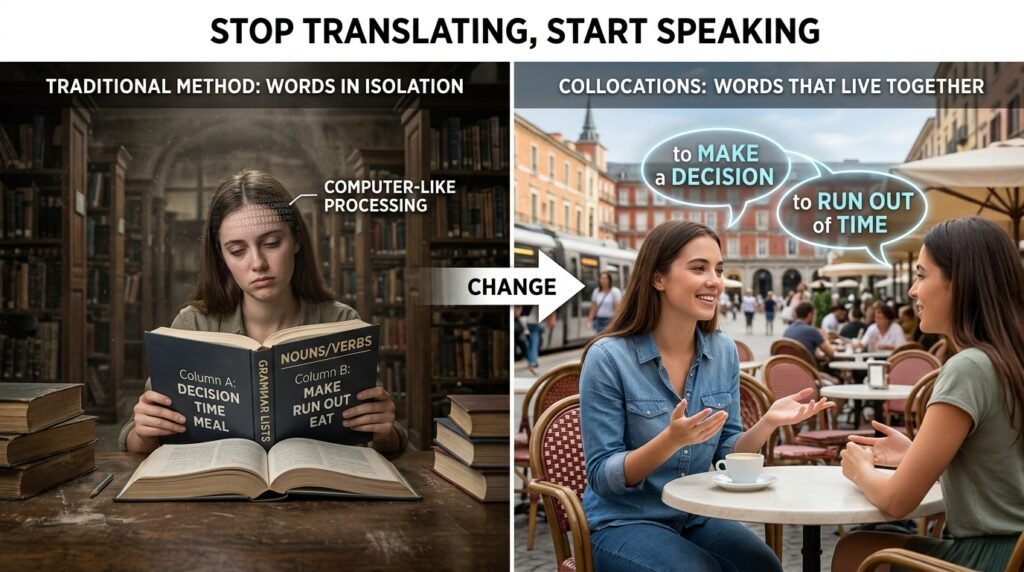
Traditional methods teach you words. They give you a list of nouns and a list of verbs. You are expected to act like a computer, pulling a noun from column A and a verb from column B to build a sentence. This is exhausting for your brain. It is also why most beginners speak slowly and with a heavy “translation delay.”
Native speakers don’t build sentences from scratch. They use “Collocations.” These are groups of words that naturally live together. For example, in English, we say “fast food” but “quick shower.” If you say “quick food,” people understand you, but they immediately know you aren’t a native.
I found that my biggest breakthroughs happened because of What Helped Me Actually Use the Words I Learned since it stopped being about the dictionary and started being about the connection. I stopped learning the word “decision” and started learning the chunk “to make a decision.” I stopped learning “time” and started learning “to run out of time.” Once I started collecting these chunks, my speaking speed doubled almost overnight.
The “Eavesdropping” Method (Digital Edition)
You cannot learn native phrases from a book written by a committee of linguists. You have to learn them from people who are actually living their lives. Since I couldn’t move to another country every time I wanted to learn a language, I turned my digital environment into an eavesdropping station.
I stopped watching “educational” videos. I started watching vlogs. I looked for people who were interested in the same things I am. I followed coffee roasters in Japan, tattoo artists in Brazil, and NBA analysts in Spain.
When you watch a vlog, you hear the language of the street. You hear the “fillers”—those little sounds like “well,” “actually,” and “you know”—that native speakers use to buy time. You hear how they react to a bad call in a soccer game or how they describe the acidity of a V60 pour over.
I paid close attention to how Vasco da Gama fans argued on forums after a loss. They weren’t using the polite “I am disappointed with the result” that you find in a classroom. They were using passionate, messy, and highly specific phrases. By adopting those phrases, I wasn’t just learning words; I was learning the soul of a fan base.
Simplify to Amplify
One of the most liberating moments of my journey was realizing that I didn’t need to be complex to be natural. In fact, native speakers often use very simple words in very clever ways.
In school, we are taught to use big, academic words to prove we are smart. But in real life, a native speaker will often use a simple phrasal verb. Instead of “extinguish,” they say “put out.” Instead of “postpone,” they say “put off.”
It was a relief to see How I Learned Faster Once I Stopped Overcomplicating Everything and realizing I didn’t need a PhD in linguistics to sound like a local. I started looking for the simplest way to say things. I noticed that when I used “get” instead of “understand,” or “go on” instead of “continue,” I sounded much more like the people I was trying to talk to.
The Power of Social Glue
Language is 20% information and 80% social glue. Social glue consists of the phrases we use to show we are listening, to show we agree, or to soften a disagreement.
Textbooks are terrible at teaching social glue. They teach you how to say “I agree.” But a native speaker might say “I’m with you on that,” “Exactly,” “For sure,” or “Tell me about it.”
I started a “Social Glue” section in my notebook. Every time I heard a native speaker react to a story, I wrote down exactly what they said. I practiced these until they were automatic.
This changed my conversations. Instead of being a silent listener who only spoke when I had a “perfect” sentence, I could participate in the rhythm of the talk. I could say “No way!” or “That’s crazy!” at the right moments. This small change made people much more comfortable talking to me. They forgot I was a learner and started treating me like a friend.
Context is the Only King
I am a nerd for performance statistics, especially when it comes to NBA betting analysis. I love looking at first basket percentages, rebounds, and assists. When I started following sports news in my target language, I realized that certain phrases only make sense in that specific context.
The way an announcer describes a “clutch” shot is totally different from how a chef describes a “sharp” knife. If you try to use the “knife” word for the “shot,” you sound like a textbook gone wrong.
I made sure to focus on The Way I Practice Vocabulary in Real-Life Situations because a phrase only stays in your head if you use it to get what you want. I used my sports betting analysis as a high-stakes classroom. If I misunderstood a phrase about a player’s “questionable” status on the injury report, I could lose money. That kind of pressure makes phrases stick better than any flashcard ever could.

The Stalking Method for Slang
Slang changes fast. What was “cool” last year is “cringe” this year. If you use outdated slang, you look like a dad trying to be “hip” at a middle school dance.
To avoid this, I use the “Stalking Method” on social media. I look at the comment sections of popular creators. The comment section is the laboratory of modern language. It is where new phrases are born and old ones go to die.
I look for patterns. If I see a specific phrase repeated ten times in a thread about a Flamengo vs. Vasco match, I know it’s a current, living part of the language. I don’t just learn the phrase; I learn the emoji that usually goes with it. This might sound trivial, but in the digital age, being able to comment “humanly” is a huge part of fluency.
My “Irezumi” Philosophy of Language
I have a deep appreciation for traditional Japanese tattoo designs, specifically the symbolism of the Kitsune and the Ryu. In Irezumi, every element has a place. The background (the wind and the water) is just as important as the main subject.
Native phrases are the “wind and water” of a language. They provide the background and the flow that make the main subjects (your nouns and verbs) look natural. Without the background, the tattoo looks unfinished. Without the phrases, your language looks like a series of disconnected stickers.
I started treating my phrasebook like an art piece. I didn’t just write “Thank you.” I wrote:
-
“Thanks a million.”
-
“I really appreciate it.”
-
“You’re a lifesaver.”
-
“I owe you one.”
Each of these has a different “shade” and “color.” By having a variety of ways to say the same thing, I could adapt my tone to the person I was talking to. I could be casual with a friend at the stadium or respectful with a coffee roaster I admired.
Shadowing: The Secret to Rhythm
Even if you know the right phrases, you won’t sound native if your rhythm is off. Every language has a specific “beat.” Some are staccato, others are melodic.
I used the “Shadowing” technique to fix this. I would take a 30-second clip of a native speaker—maybe a vlogger talking about a new coffee roast—and I would repeat what they said, at the same time they were saying it.
I wasn’t just trying to say the words. I was trying to match their emotion, their pitch, and their speed. I wanted to feel where they took a breath and where they emphasized a word.
This felt silly at first. I felt like a parrot. But after a few weeks, I noticed that my mouth muscles were changing. I was starting to produce sounds without having to think about where my tongue was supposed to be. The phrases were becoming physical.
The “Language of Mistakes”
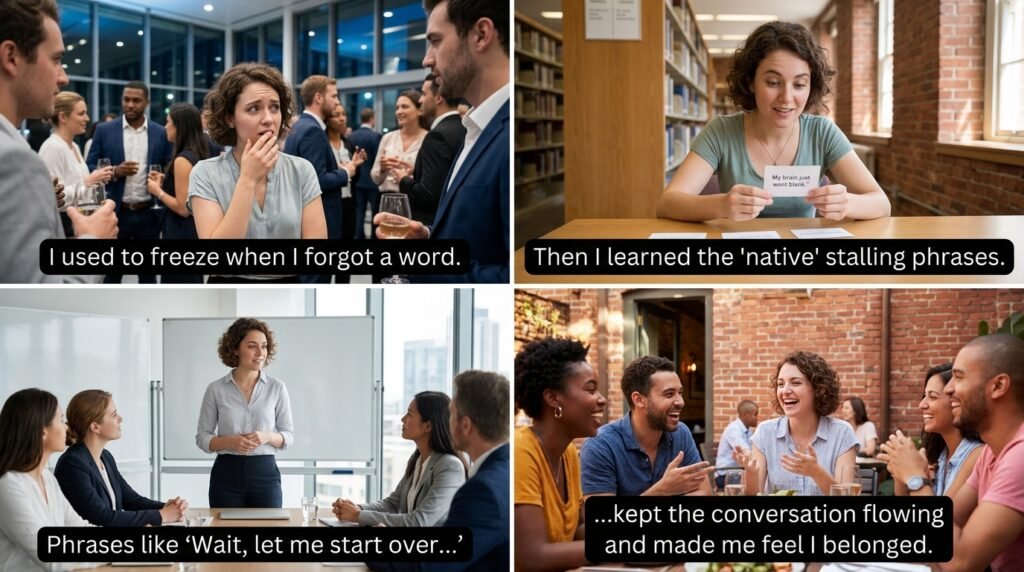
Finally, I learned the phrases that native speakers use when they mess up. This was a game changer for my anxiety.
I realized that native speakers don’t always speak perfectly. They stutter, they forget words, and they change their minds mid-sentence. When they do, they use specific phrases:
-
“How should I put this…”
-
“Wait, let me start over…”
-
“What’s the word I’m looking for…”
-
“My brain just went blank.”
Learning these phrases was like getting a superpower. It allowed me to “mess up” like a native. Instead of freezing in silence when I forgot a word, I could use a native “stalling” phrase. It kept the conversation alive and made me feel like I belonged in the room.
The Result: Living the Language
The day I knew I had succeeded was when I went back to that same cafe. This time, I didn’t use a textbook. I walked up to the counter, caught the waiter’s eye, and said something short, casual, and a little bit slangy.
He didn’t blink. He didn’t give me a confused look. He just smiled, gave me a quick answer, and started making my coffee. We had a thirty-second conversation about the beans they were using. It was fast, it was messy, and it was 100% human.
I wasn’t a student anymore. I was a customer. I was a coffee lover. I was a speaker.
Sounding like a native isn’t about knowing every word in the dictionary. It’s about knowing the right fifty phrases to handle 90% of your life. It’s about listening more than you speak. It’s about being willing to sound “imperfect” so you can sound real.
Stop “studying” and start “absorbing.” Your textbook is a map, but the street is where the journey actually happens. Throw away the formal requests and learn how to ask for a coffee like you’ve lived there your whole life. The world opens up in a completely different way when you speak the language of the heart, not just the language of the classroom.

Gabriel Henrique is a language enthusiast and productivity writer. After testing countless study methods, he became obsessed with mastering new languages efficiently. He achieves this without burnout, without endless grammar drills, and without losing focus. At Blog The Curious, he shares everything he has learned along the way.