
I manage a network of digital blogs. I oversee website optimization, create content, and manage legal policies. I also run statistical models for professional basketball games. I spend hours analyzing data to find the first player to record a score, an assist, or a rebound. My daily schedule is completely packed. I do not have three free hours to sit quietly at a desk. I absolutely cannot dedicate my entire evening to studying a foreign language.
Early on, I tried to force a traditional study routine. I set my alarm for five in the morning. I sat at my kitchen table with a heavy grammar workbook. I stared at conjugation charts for two solid hours. I hated every single minute of it. The words blurred together on the page. My brain refused to absorb the complex rules. I felt entirely exhausted before my actual workday even started.
I quit this miserable routine after just one week. I realized I needed a completely different system. I needed a system that fit naturally into my chaotic life. I decided to completely abandon the concept of long study sessions. I stopped studying grammar entirely. I started practicing it in tiny increments instead. The results were immediate and massive.
Here is exactly how I practice grammar every single day without ever studying for hours.
The Myth of the Marathon Session
Language learning is not a marathon. It is a series of very short, intense sprints.
The human brain has a strict limit on focused attention. When you sit down to study grammar for two hours, you are lying to yourself. You are only truly focused for the first twenty minutes. The remaining hour and forty minutes is completely wasted. Your brain stops absorbing new data. You are just staring at paper to feel productive.
Cramming grammar rules is exactly like trying to eat an entire week of meals in one single sitting. Your body will physically reject the food. Your brain does the exact same thing with dense information.
I stopped trying to force massive amounts of information into my head. I accepted my lack of free time as a strict advantage. It forced me to become highly efficient. I started looking for empty margins in my daily schedule. I realized my day was full of hidden five minute windows. I decided to fill those specific windows with highly targeted grammar practice.

The Five Minute Coffee Laboratory
I am a deep enthusiast of specialty coffee. I appreciate the exact science of a perfect extraction. I buy specific heirloom beans from the Guji region of Ethiopia. I use a digital scale and a precision gooseneck kettle. My kitchen setup looks exactly like a small science laboratory. I spend exactly five minutes every single morning brewing the perfect pour over cup.
I used to spend these five minutes scrolling mindlessly on my phone. Now, I use these five minutes as my primary grammar laboratory.
I pick one single grammatical structure for the morning. Let us say I want to practice the future continuous tense. I stand at the kitchen counter and pour the hot water. While the water drips through the filter, I speak out loud to the empty room. I describe exactly what I am going to be doing later that afternoon. I force my mouth to produce the correct grammatical structure over and over again.
I do not open a heavy textbook. I just force my physical reflexes to do the work. By the time my coffee is ready to drink, I have completed fifty repetitions of a specific grammar rule. This entirely eliminates the need for formal desk study. I detail how to map out these small daily pockets of time in my guide covering How I Built a Routine That Actually Worked for Me to help you escape the absolute trap of long study sessions.
Narrating Live Sports Action
I follow Brazilian soccer clubs very closely. I watch intense matches featuring teams like Flamengo and Vasco. The stadium crowds are massive and the energy is incredibly high. I used to just sit on my couch and watch the games in complete silence. Now, I use these matches as high pressure grammar tests.
I act as the live commentator for the game in my target language. I narrate the action out loud.
When a player runs rapidly down the field, I describe his actions using the present continuous tense. When a player misses a wide open shot, I immediately switch to the past conditional tense to describe what he should have done differently.
This specific exercise forces me to recall grammar rules instantly. The action on the television screen moves extremely fast. I do not have any time to slowly translate the English rules in my head. I have to rely on pure reflex. It builds incredible mental speed. It turns a standard leisure activity into highly effective practice.
The Sixty Second Search Strategy
When you study for hours, you inevitably try to learn things you do not actually need yet. You memorize the future perfect subjunctive tense just because it is the next chapter in your workbook. You will not use that specific tense in a real conversation for another six months. Your brain immediately deletes it to save space.
I changed this approach entirely. I wait until I hit a solid wall in my real life communication.
I try to text a friend a funny story. I suddenly realize I do not know how to combine two specific verbs. I stop immediately. I do a highly targeted Google search on my phone. I find the exact grammar rule I need for that one specific sentence. I read the short explanation. This takes exactly sixty seconds.
I apply the new rule directly to my text message. I hit send. I close the internet browser and move on with my day.
This micro learning strategy is incredibly powerful. You only learn the exact tools you immediately need. Because you apply the rule to a real, personal situation right away, the information sticks to your memory permanently. You never waste a single minute studying useless concepts.
Passive Audio Immersion
I spend many hours every week optimizing my blog network for search engines. It is highly quiet, repetitive work. I use this extended block of time to absorb grammar completely passively.
I put on my headphones. I play podcasts in my target language. I do not listen to boring language learning lessons. I listen to native speakers arguing about sports or discussing interesting daily topics. I focus entirely on the rhythm of their long sentences.
Correct grammar has a very specific musical beat. When you listen to thousands of correct sentences, your physical brain internalizes that beat. You start to physically feel when a sentence is grammatically correct.
If I hear a strange sentence structure, I do not stop my work to write it down. I just let it wash over me. Over the course of a month, I will hear that same strange structure fifty times. Eventually, it stops sounding strange. It starts sounding completely normal. My brain silently maps the grammar rule in the background without any conscious effort from me.

Replacing Essays With Text Messages
Traditional language classes force you to write long, boring essays. This takes hours of dedicated time. It is incredibly tedious.
I stopped writing essays completely. I replaced them entirely with text messages and short voice notes. I communicate with language partners on messaging apps throughout the day.
A thirty second voice note requires highly accurate grammar. It forces you to quickly construct a clear beginning, a middle, and an end to your thought. It is a complete grammatical exercise condensed into half a minute of time.
I send ten voice notes a day. This gives me massive output practice without ever sitting down at a desk with a notebook. It forces me to use the grammar in brief, high pressure bursts. This builds rapid fluency. I break down this specific daily communication habit in The Simple Way I Practice Grammar Every Day to show you how completely easy it actually is to generate output.
The Power of Daily Friction
You must inject the language into your normal environment. You have to create daily friction.
I changed the operating language of my smartphone completely. I changed the language of my email client. I changed the language of my statistical spreadsheets. I force myself to navigate my entire digital life in my target language.
When my phone alerts me to a calendar event, the notification uses specific grammatical structures. I see these structures dozens of times a day. I absorb the syntax simply by trying to check my upcoming meetings.
This constant environmental friction is far more effective than reading a textbook. The language becomes an unavoidable part of your daily survival. You learn the rules simply by trying to operate your tools. You never have to schedule study time because the study time happens automatically every single time you look at a screen.
Focusing Only on High Frequency Patterns
Languages are absolutely massive systems. They contain endless regional variations and obscure rules. You do not need to know most of them.
I completely ignored the advanced grammar rules during my first two years. I put all my focus entirely on high frequency patterns.
You use the exact same ten basic sentence structures for ninety percent of your daily conversations. You state your personal opinions. You ask direct questions. You explain your future plans. You describe past events.
I mastered these specific, high frequency blocks of language. I practiced them until I could say them backwards. Once you master the core structures, the language feels incredibly easy. You can navigate almost any standard human interaction.
Do not waste your precious minutes trying to memorize obscure literary tenses. Master the absolute basics perfectly. The rest of the language will naturally build itself around that solid foundation over time. This approach turns an overwhelming task into a very simple checklist.
Trusting Your Subconscious Mind
We vastly underestimate the power of the subconscious mind. We believe that learning only happens when we are staring at a book and sweating.
Your brain does its absolute best work when you are entirely relaxed. When you flood your day with small, five minute inputs, you give your subconscious mind massive amounts of raw data.
While you are cooking dinner, sleeping, or driving your car, your brain is silently organizing that data. It is connecting the patterns. It is solving the grammatical puzzles entirely in the dark.
You must trust this invisible process. You will have days where you feel incredibly confused by a rule. Do not force it. Do not sit down for two hours trying to beat it into your head. Just let it go. Go to sleep. A week later, that exact rule will suddenly make perfect sense to you out of nowhere. Your brain solved the problem while you were completely ignoring it.
Killing the Guilt of Not Studying
The biggest obstacle to language learning is absolute guilt.
When you fail to complete a two hour study session, you feel terrible. You feel lazy. You tell yourself you lack discipline. This heavy guilt destroys your motivation entirely. You eventually associate the language strictly with feelings of failure.
I had to actively kill this guilt. I redefined what it meant to study.
I decided that listening to a fun podcast for ten minutes was a massive victory. I decided that sending one grammatically correct voice note to a friend was a successful day of practice. I completely lowered the barrier to entry.
When the barrier is incredibly low, you never fail. You never feel guilty. You constantly build positive momentum. You look forward to interacting with the language because it never demands hours of your life. It only asks for a few minutes of your attention.
Tracking Invisible Progress
When you ditch the heavy textbooks, you also lose the traditional metrics of success. You no longer have chapter quizzes to grade. You cannot point to a test score to prove you are improving.
You have to learn how to track invisible progress. You have to measure your success in completely different ways.
I know my grammar is improving when I stop hesitating before speaking. I know I am succeeding when a complex sentence simply falls out of my mouth automatically. I track my progress by paying close attention to my physical comfort level during a fast conversation.
If I can watch a highly chaotic sports interview without getting a headache, I am winning. These metrics are deeply personal. They are completely unquantifiable. But they are the only metrics that actually matter in the real world. Real fluency is a feeling of ease, not a perfect test score. I talk heavily about recognizing these quiet victories in How I Turned Everyday Moments Into Vocabulary Practice so you can stop relying on gamified apps.
Eliminating the Preparation Phase
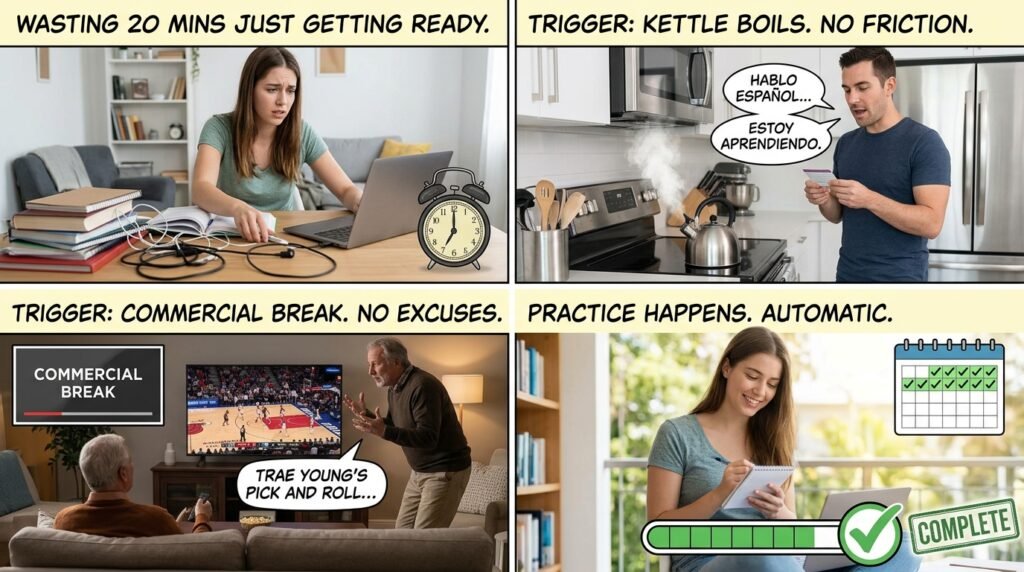
Long study sessions require heavy preparation. You have to clear your desk. You have to find your pens. You have to open the correct software. You waste twenty minutes just getting ready to study.
Micro habits require zero preparation. They happen instantly.
When my coffee water is boiling, I immediately start speaking. When a commercial break hits during a basketball game, I immediately translate the last play out loud. There is absolutely no friction between the trigger and the action.
This immediacy guarantees that the practice actually happens. You cannot procrastinate a task that only takes sixty seconds to complete. By removing the preparation phase, you completely destroy the ability to make excuses. The practice becomes as automatic as brushing your teeth.
Redefining Fluency
Fluency is not the ability to quote the exact academic rules of syntax. Fluency is the ability to connect deeply with another human being without severe friction.
You do not need to study for hours to achieve this. You do not need to be a professional linguist. You simply need to weave the language into the daily fabric of your normal life.
Look at your busy schedule right now. Find the empty five minute gaps. Find the time you spend waiting in line. Find the time you spend commuting in traffic. Find the time you spend waiting for your coffee to brew.
Take those useless margins and fill them strictly with the language. Speak out loud to yourself. Listen closely to native rhythm. Send short, aggressive messages to friends. Let go of the heavy guilt completely. Trust your brain to connect the dots in the background. Consistency will always destroy intensity. Stop preparing to study, and just start using the language right now.
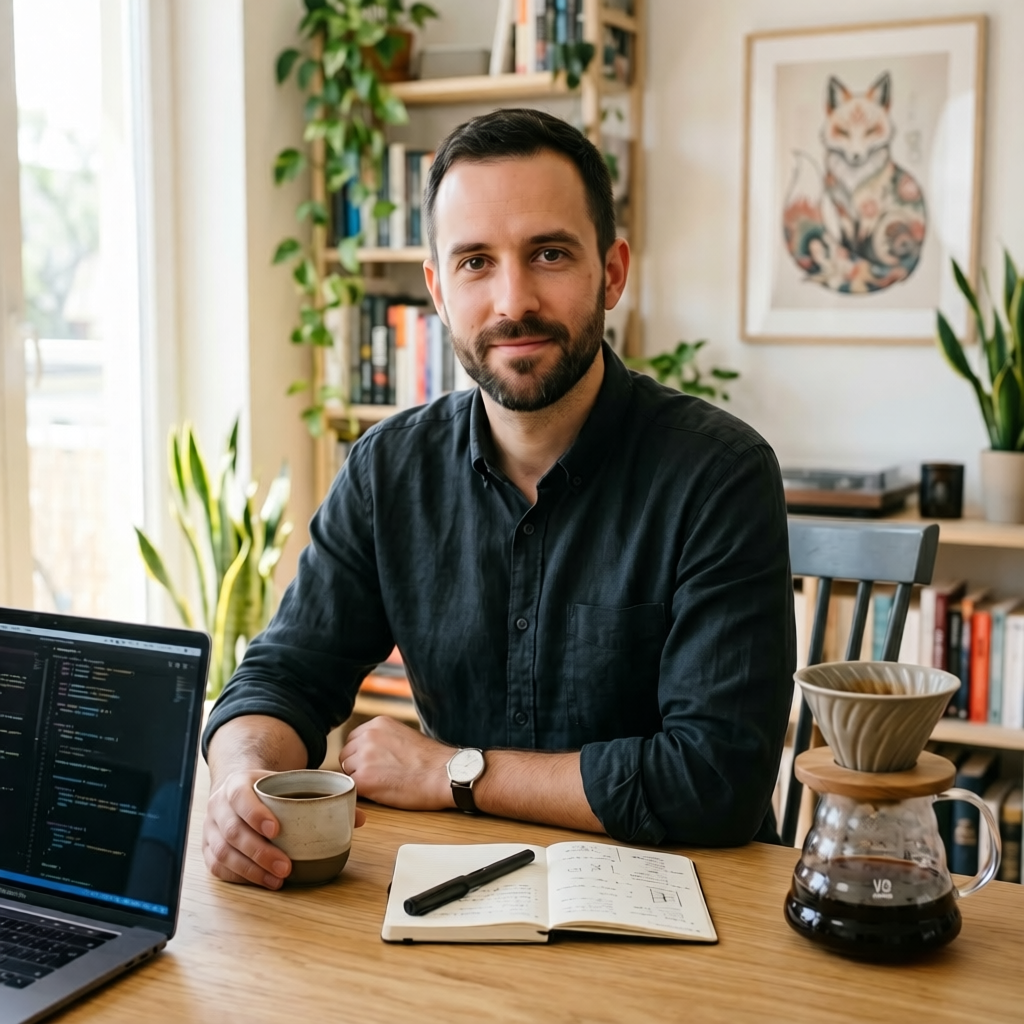
Gabriel Henrique is a language enthusiast and productivity writer. After testing countless study methods, he became obsessed with mastering new languages efficiently. He achieves this without burnout, without endless grammar drills, and without losing focus. At Blog The Curious, he shares everything he has learned along the way.