
Most people believe success requires a massive, painful leap. They think mastering a complex skill requires locking yourself in a room for ten hours. They believe in the cinematic montage. They want to sweat, struggle, and conquer the mountain in a single weekend.
I used to believe this. I would block out entire weekends to learn a new skill. I would buy four different textbooks. I would sit at my desk on a Saturday morning with a massive cup of coffee. I would force myself to study for six hours straight.
By Sunday evening, my brain was completely fried. I felt a false sense of accomplishment. I felt like I had worked incredibly hard. But by Wednesday, the information was completely gone. The retention rate was zero.
I realized human biology does not reward binge learning. Your brain is not a digital hard drive. You cannot simply drag and drop gigabytes of data into your head in one afternoon. Your brain is a living, biological network. It requires frequent, small inputs to build permanent pathways. I completely abandoned the massive effort approach. I switched entirely to micro efforts. Here is exactly how I turn small efforts into big results.
The Biology of Frequent Exposure
When you cram information for three hours, your brain dumps it immediately. It considers the massive influx of data to be a temporary anomaly. It clears the cache to save energy.
If you study a concept for ten minutes every single day, the mechanism changes completely. Your brain registers a repeating pattern. It realizes this specific information keeps appearing in your environment. It flags the data as necessary for your daily survival.
The brain responds by building thick, permanent neural connections. This is the entire secret to mastering a difficult subject. You do not need more hours. You need more frequency. You must distribute your effort across hundreds of tiny moments. A small drop of water hitting a rock every day will eventually split the stone. A massive bucket of water splashed once does absolutely nothing.

Destroying the Perfect Schedule
High expectations paralyze you. If you tell yourself you need a full, quiet hour to study, you will constantly procrastinate. You will wait for the perfect moment.
The house needs to be quiet. Your desk needs to be clean. You need to feel perfectly energized.
The perfect moment never arrives. A busy adult life is loud, messy, and chaotic. If your study system requires perfection, it will fail. You must drop your expectations entirely. You must learn to operate in the dirt. A messy five minutes of practice on a loud train is infinitely more valuable than a perfect hour that never actually happens. You have to lower the bar so you can comfortably step over it.
The Absurdity of the Two Minute Rule
I completely destroyed my ambitious daily goals. I replaced them with an embarrassing minimum requirement.
I told myself I only had to practice for two minutes a day. Two minutes is so incredibly small it feels ridiculous. Your brain cannot form a valid excuse to avoid a two minute task. You can do it while brushing your teeth. You can do it while waiting for water to boil. You simply initiate the action.
The initial friction is the only thing stopping you. Once the action starts, the friction disappears. You almost always keep going. The goal is just to cross the starting line. I noticed How I Turned Small Daily Practice Into Real Progress was entirely dependent on making the start completely effortless.
Capturing Your Hidden Minutes
Look closely at your average Tuesday. Look at the hidden gaps in your schedule.
You wait in line at the grocery store for four minutes. You sit in traffic for twelve minutes. You wait for a zoom meeting to start for three minutes. Most people pull out their phones and scroll through social media feeds. They numb their minds to pass the time.
I stopped throwing this time away. I started capturing it aggressively. I organized my digital tools so they are always exactly one tap away on my home screen. When I stand in line, I do not stare at the ceiling. I review a handful of digital flashcards. I read one paragraph of an article. I complete a tiny cognitive task.
Weaponizing the Dead Time
The volume of time you waste daily is staggering. You can easily reclaim an hour a day without altering your scheduled life at all.
You just have to stop treating these tiny moments as disposable garbage. Treat them as premium learning blocks. A three minute session is highly effective because your brain stays perfectly alert. You do not have time to get bored. You get in, you execute a rapid repetition, and you get out.
I documented exactly How I Turned Everyday Moments Into Vocabulary Practice to prove that you do not need a desk to become fluent. You just need to stop ignoring the gaps in your day.
The Mandatory Frictionless Environment
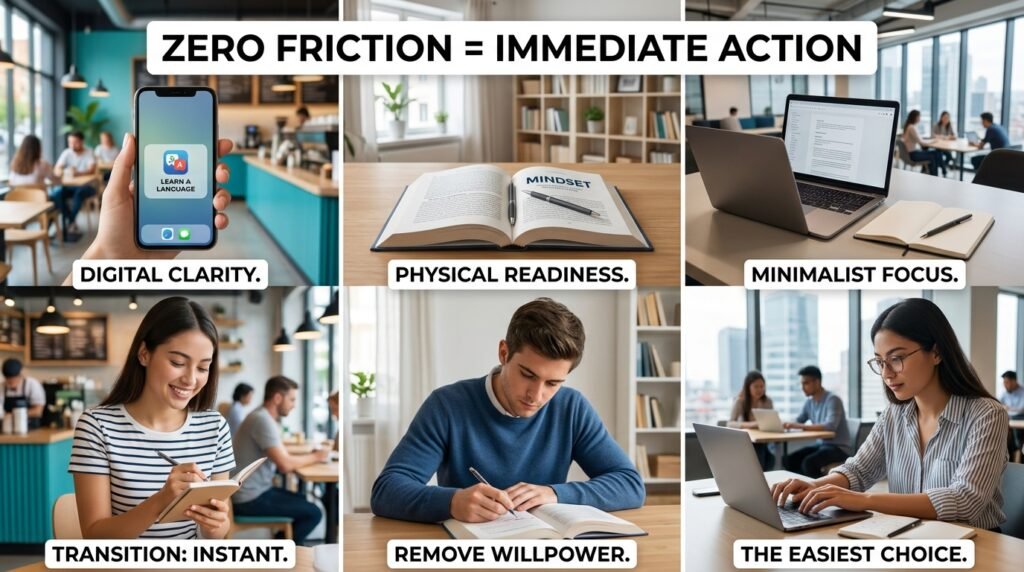
Small efforts require absolutely zero friction to execute. If you have to spend five minutes looking for your notebook, you will skip the session entirely.
You must engineer your physical and digital space for immediate action. Keep your learning application directly on your primary phone dock. Delete the distracting games next to it. Keep your physical book open on your desk with a pen resting on top of it.
When you decide to study, the transition must be instantaneous. You should move from resting to working in less than three seconds. This strict environmental design removes the need for willpower. The setup makes the right choice the easiest choice.
Rejecting Passive Consumption
We often confuse passive consumption with actual effort. Watching a twenty minute educational video feels highly productive.
It is actually completely passive. Your brain is barely working. You are just letting information wash over you. A much smaller active effort produces a much larger, permanent result.
Instead of watching a long video, I spend three minutes writing original sentences. I force my brain to recall the new vocabulary. I force my hands to type out the complex structures. The physical effort is tiny, but the cognitive demand is massive. Active output builds permanent skills instantly. Passive input creates a dangerous false sense of security.
The Illusion of Being Stuck
Small daily efforts are entirely invisible in the short term. If you study for ten minutes today, you will not be a master tomorrow. You will not notice any difference at all next week.
This lack of immediate feedback makes people quit. They think their system is broken. They think they are wasting their time.
You must trust the raw math. Ten minutes a day equals sixty hours a year. Sixty hours of highly concentrated, active recall will transform your abilities completely. The progress compounds quietly under the surface. One day you wake up and suddenly understand a complex rule without thinking. The small efforts stacked up and finally broke the dam.
Tracking the Invisible Chain
You cannot measure small efforts with large yardsticks. If you test yourself on advanced material after a week of micro studying, you will feel like a massive failure.
You must track the daily inputs, not the long term outputs. Track the habit itself. I use a simple visual calendar. I draw a bold mark through every single day I complete my two minute minimum.
The visual chain of marks becomes the primary motivation. You stop caring about the final destination. You only care about keeping the daily chain alive. This fundamental shift in perspective protects your ego. It keeps you moving forward when the actual progress feels slow.
Automating the Background Process
When you stop fighting for massive, painful daily gains, the pressure vanishes completely. Learning stops being a heavy burden.
It becomes a simple background process. It runs automatically in your daily life. You review a flashcard while waiting for an elevator. You listen to a native audio clip while walking to your car. You integrate the material so deeply into your routine that it requires zero conscious thought to execute.
I detailed How I Built a Learning System That Didn’t Feel Like Studying by focusing entirely on this concept of invisible automation. The best routines are the ones you do not even realize you are doing.
The Policy of Immediate Forgiveness
You will inevitably fail. A day will come when you are too sick or too busy to complete even a tiny two minute task. The visual chain will break.
This is the most dangerous moment in the entire process. Perfectionists let one missed day destroy the entire month. They feel immense guilt. They quit completely to avoid the feeling of failure.
You must adopt a strict policy of immediate forgiveness. A missed day is just a blank square on a calendar. It means absolutely nothing in the long run. Do not punish yourself. Do not try to do double the work the next day to catch up. You simply wake up the next morning and execute the standard two minute minimum. You repair the broken chain immediately without emotion.
Shifting the Internal Identity
Eventually, the relentless small efforts change how you view yourself.
You stop being a person who is struggling to learn a new skill. You become a person who simply learns every day. It becomes a daily hygienic habit. It feels exactly like brushing your teeth.
You do not need to read motivational quotes to convince yourself to brush your teeth. You just do it because it is part of who you are. When your small efforts reach this level of automatic, thoughtless execution, failure becomes impossible. The skill is no longer something you are chasing. It is something you are actively building brick by brick.
Eliminating the Planning Phase
The biggest enemy of small efforts is overplanning. People spend weeks researching the absolute best learning method. They optimize their spreadsheets. They compare textbook reviews.
This is just productive procrastination. You are hiding from the actual work. A suboptimal method executed daily will always beat a perfect method executed once a month.
Stop planning. Stop optimizing. Pick a basic tool today and start using it immediately. The flaws in your system will reveal themselves through actual use. You can tweak the system later. Right now, your only job is to start the engine and keep it running.
Isolating the One Next Action
When a project feels too large, the brain shuts down. If your goal is to learn an entire foreign language, the scope is terrifying.
You must shrink the scope to the absolute smallest visible step. Do not think about fluency. Do not think about the grammar test next month. Think exclusively about the very next action.
What is the one next thing you need to do? You need to open the app. That is the only goal. Once the app is open, what is the next action? Read one card. You string these microscopic actions together until the session is complete. You never look at the top of the mountain. You only look at the gravel immediately in front of your boots.
Valuing the Bad Days
Consistency is forged on the days you feel terrible.
Anyone can study when they feel energized and motivated. Doing the work on a great day does not build discipline. Doing the work when you have a headache, when you are stressed, and when you want to quit is where the actual growth occurs.
On bad days, your only objective is to survive the two minute minimum. Do the absolute bare minimum and close the book. You preserve the habit. You prove to your brain that the system does not collapse just because you feel tired. The bad days are the most valuable data points in your entire journey.
The Mathematics of Tiny Gains
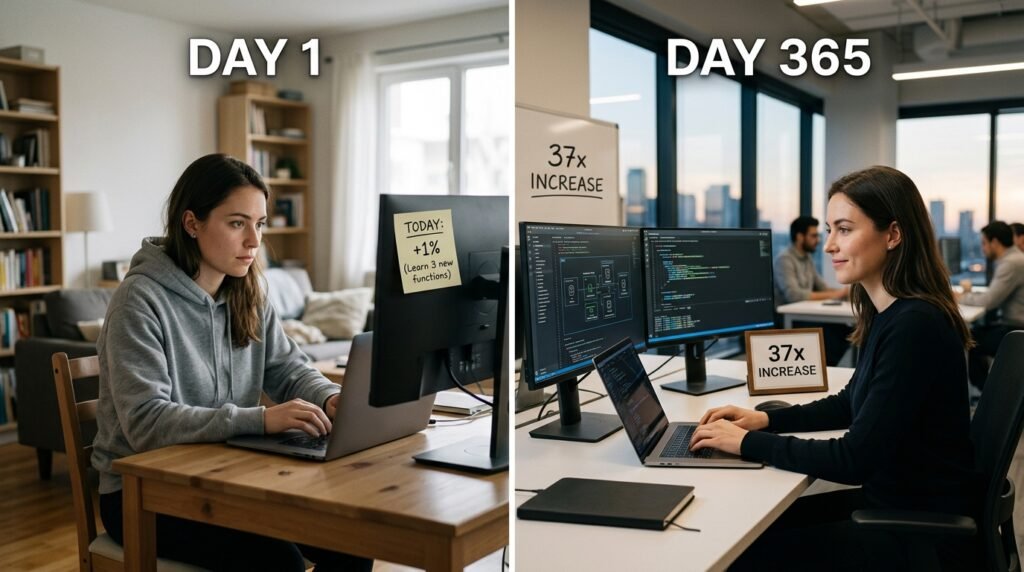
Let the numbers tell the story. A one percent improvement every day seems entirely useless. It is completely invisible to the naked eye.
But a one percent daily improvement compounded over a single year results in a thirty seven times magnitude increase in skill. The math is absolute.
You are not fighting for massive daily leaps. You are fighting for that tiny one percent. You are fighting to know just three more words than you knew yesterday. You are fighting to write one sentence slightly faster. You trust the math to handle the long term result.
The Final Audit
Look closely at your day right now. Stop reading this and find one tiny gap in your current schedule. Find a simple three minute window.
Execute one small action immediately. Read one single sentence. Review one vocabulary card. Write one short phrase on a piece of paper. Do not wait for tomorrow morning to start your perfect new routine. Tomorrow is a lie.
Do it right now. The secret to massive, life changing results is not massive action. It is relentless, microscopic, unbreakable consistency. Stack the small efforts repeatedly. Ignore the lack of immediate progress. Trust the biological reality of frequent exposure. The big results will inevitably follow.

Gabriel Henrique is a language enthusiast and productivity writer. After testing countless study methods, he became obsessed with mastering new languages efficiently. He achieves this without burnout, without endless grammar drills, and without losing focus. At Blog The Curious, he shares everything he has learned along the way.