
I wanted to learn a new language. I had zero experience. I sat at my desk and typed a basic search query into my computer. Three million results appeared instantly.
Every website gave contradictory advice. Read children’s books. Do not read children’s books. Memorize grammar rules. Never study grammar rules. Download this application. Applications are a waste of time.
I felt completely paralyzed. I spent two weeks just reading about learning. I was not actually learning anything. I realized that if I did not pick a single path, I would never start.
I closed all the browser tabs. I grabbed a pen and a notebook. I decided to build my own system from the ground up. This is the exact process I used to navigate the absolute beginner phase without losing my mind.
The Vague Goal Trap
The biggest mistake beginners make is setting a terrible goal. “I want to be fluent” is a useless objective. Fluency is a vague concept. It is a horizon that constantly moves further away as you walk toward it.
When your goal is fluency, every study session feels like a failure. You study for an hour, you still cannot understand a movie, and you feel defeated.
I needed a microscopic goal. I needed something I could actually measure.
I set a goal to understand one specific video about manual coffee brewing. The video was three minutes long. The speaker demonstrated a V60 pour over. I did not need to speak perfectly. I just needed to understand what he was saying about water temperature and grind size.
This specific goal changed everything. The language suddenly had boundaries. I did not need to learn the vocabulary for politics or economics. I only needed the vocabulary for my specific interest.

The Great Resource Purge
You do not need six textbooks and four mobile applications. You need one reliable source of input.
I looked at my phone. I had downloaded every free language app available. I opened them and realized they were just video games disguised as education. Tapping colorful buttons gave me a temporary rush. It did not give me language skills.
I deleted all of them. I needed to clear the clutter.
I bought one highly rated textbook for absolute beginners. I promised myself I would not buy another resource until I finished every single page of that book. Limiting your resources forces you to do the actual work. You stop looking for a magic shortcut. You accept that the textbook in front of you is the only path forward.
Defining the Survival Vocabulary
I opened the textbook. Chapter one taught the names of zoo animals. Chapter two taught the colors of the rainbow.
I closed the book. I was never going to discuss a yellow giraffe in a real conversation.
I needed words that solved immediate problems. I needed a survival vocabulary. I sat down and made a list of the exact words I actually use every single day. I focused on three main categories:
-
Core Action Verbs: To want, to need, to go, to have, to make.
-
Crucial Question Words: Who, what, where, when, why, how.
-
Simple Connectors: Because, but, and, or.
This was my entire focus for the first week. I ignored grammar entirely. I just wanted to know these specific words so well that I did not have to think about them.
Learning these specific words gave me massive leverage. You can communicate almost any basic human desire with a handful of verbs and question words.
I started stringing them together in my notebook. The sentences were grammatically incorrect. I did not care. The point was to build momentum. I needed to see that I could actually create meaning out of foreign sounds. I eventually realized The Beginner Mistakes I Made and How I Fixed Them all stemmed from trying to be perfect too early.
Building a Physical Trigger
A study plan is worthless if you do not execute it daily. Relying on motivation is a guaranteed way to fail. Motivation disappears the moment you have a bad day at work.
I needed a habit. I needed a physical trigger that forced me to study without thinking about it.
I tied my language practice to a habit that was already unbreakable. Every morning, I make a cup of specialty coffee. It is a slow, manual process. I grind the beans. I heat the water. I prepare the paper filter.
I decided that the kitchen counter was my new classroom.
I placed my notebook and a pen right next to the coffee grinder. I did not put them in a drawer. I left them in plain sight.
When I woke up and walked to the kitchen, the notebook was waiting for me. While the water boiled, I reviewed my core words. While the coffee brewed, I read one short paragraph from my textbook.
The entire session lasted fifteen minutes.
Fifteen minutes sounds useless. But fifteen minutes a day equals over ninety hours of study in a year. Consistency beats intensity every single time. By anchoring the study session to my coffee routine, I figured out How I Made Learning a Language Part of My Daily Life without needing an ounce of willpower. The friction was entirely gone.
Consuming Incomprehensible Input
After two weeks, I had a solid grip on my survival vocabulary. I felt confident. I decided to watch a movie in my target language.
I understood absolutely nothing.
The actors spoke incredibly fast. The words blended together into a single, continuous sound. I felt a massive wave of panic. I thought I had wasted the last two weeks.
This is the exact moment most beginners quit. They hit the wall of native-level audio and assume they are not smart enough to learn.
I had to change my expectations. I realized my brain was not broken. My brain just needed time to tune into the new audio frequencies.
I started listening to podcasts designed for toddlers. I watched children shows. The speakers talked slowly. They exaggerated their pronunciation. They pointed at objects on the screen.
It felt ridiculous for an adult to watch cartoons. But it worked.
I stopped trying to understand every single word. That is a massive trap. If you stop the audio every time you miss a word, you ruin the rhythm. You turn a listening exercise into a frustrating dictionary search.
I learned to tolerate ambiguity. I listened for the broad context. If I understood that two people were talking about food, that was a victory. I let the unknown words wash over me. Eventually, my brain started to pick out the boundaries between words. The continuous noise slowly separated into distinct syllables.
The Brutal Reality of Speaking
You cannot read your way to fluency. Language is a physical action. You have to move your mouth. You have to make sounds.
I delayed speaking for a full month. I was terrified of sounding stupid. I wanted my grammar to be perfect before I opened my mouth.
This was a massive error. The longer you wait to speak, the heavier the mental block becomes.
I did not have anyone to talk to. I did not want to hire a tutor yet. I decided to talk to the only person available. Myself.
I started narrating my life out loud.
When I cooked dinner, I spoke to the empty kitchen. When I drove my car, I described the traffic.
This practice exposed every single hole in my vocabulary. If I did not know the word for onion, I could not finish my sentence. I would immediately look up the word and write it down.
Speaking to yourself removes the fear of judgment. I could stumble over my pronunciation. I could conjugate verbs incorrectly. The empty room did not care. This safe environment allowed my facial muscles to get used to the strange new movements.

Forcing the Environment to Change
Studying for fifteen minutes a day is a good start. But if you spend the other twenty-three hours immersed in your native language, progress will be agonizingly slow.
I needed to manufacture immersion. I needed to trick my brain into thinking the new language was necessary for survival.
I made several immediate changes to my daily environment:
-
Operating Systems: I changed the language on my smartphone and laptop. This was deeply uncomfortable for three days, but it forced me to navigate by muscle memory and context clues.
-
Social Media Feeds: I unfollowed local news accounts. I followed international accounts, artists, and musicians from the target country.
-
Background Audio: I swapped my daily work playlists for bands singing in the target language to normalize the natural intonation.
When I opened my phone, the new language was everywhere. I did not have to actively choose to study. The language was aggressively put in front of my face.
You do not need to buy a plane ticket to immerse yourself. You just need to aggressively curate the information you consume every day.
Documenting the Imperfect Journey
When you learn a language from scratch, progress is invisible.
You do not feel smarter on a Tuesday than you did on a Monday. Because the growth is so microscopic, you constantly feel like you are standing still. This feeling breeds frustration and burnout.
I needed mathematical proof that I was getting better.
I started a weekly progress journal. Every Sunday evening, I sat down and wrote exactly three sentences in the new language. I did not use a dictionary. I did not check my grammar. I just wrote whatever came out of my head.
During the first month, the sentences were embarrassing. They were simple, clunky, and filled with errors.
Three months later, I looked back at that first entry. I laughed out loud. The mistakes were so obvious. The vocabulary was so limited. I could now read those old sentences instantly and correct them without thinking.
That visual proof was incredibly powerful. It showed me that my brain was actually changing. It proved that the daily sessions were compounding. When I felt stuck, I would read the journal. I used The Strategy I Used to Avoid Getting Stuck as a Beginner by constantly comparing myself to my past self instead of native speakers.
Breaking the Mental Translation Habit
There is a hidden trap that keeps beginners feeling lost for months. It is the habit of mental translation.
When you learn a new word, you naturally map it to your native language. You see the foreign word for house. You translate it in your head to your native language. Then you visualize a building.
This extra step creates a massive delay in your brain.
When you try to listen to a native speaker, they talk at normal speed. If you are constantly translating every single word back into your native language, you will immediately fall behind. By the time you translate the first sentence, the speaker is already on their third sentence.
I realized I had to sever the tie to my native language. I had to link the new words directly to physical concepts.
I stopped writing text translations in my notebook. Instead, I started drawing terrible, simple pictures. When I learned the word for house, I drew a crude box with a triangle roof. I forced my brain to associate the new sound directly with the image.
I also used visual search engines. If I learned the word for dog, I searched for that specific word in the image tab. I scrolled through hundreds of photos of dogs. I said the word out loud with every photo.
Bypassing your native language completely changes how you process information. The new language stops feeling like a mathematical code you have to decipher. It starts feeling like a direct representation of reality.
The Power of Niche Vocabulary
General vocabulary is boring. It is hard to memorize things you do not care about.
I mentioned earlier that I learned the vocabulary for manual coffee brewing. This was a strategy to build deep emotional investment in the language.
I love traditional art and deep cultural history. I started looking up the specific terms for ink, serpent designs, and mythological creatures. No beginner textbook teaches you the word for a mythological fox. But I learned those words in my first month.
Why? Because I actually cared about them. They held my attention.
When you learn words connected to your personal passions, your brain locks them in immediately. You do not need to repeat them fifty times. The emotional connection acts as superglue for your memory.
Do not let a textbook dictate what you learn. If you love fixing cars, learn the words for engine parts. If you love baking, learn the words for flour and yeast. Build your initial vocabulary around the things that already bring you joy.
Surviving Your First Real Conversation
Eventually, the time comes to test your skills in the real world.
I practiced alone for weeks. I felt ready. I went to a local cafe where the staff spoke my target language. I walked up to the counter to order a simple drink.
I opened my mouth, and my mind went completely blank.
Every single word I had studied vanished. My heart was racing. I panicked and ordered in my native language. I walked away feeling completely humiliated.
I realized that practicing in a quiet room is entirely different from practicing under social pressure. Social anxiety hijacks the brain. It shuts down the cognitive centers required to recall new information.
I had to systematically lower the stakes of my real-world interactions.
The next week, I did not try to hold a conversation. I simply walked into a store, looked the cashier in the eye, and said a basic greeting in the target language. That was it. I paid for my item and left.
The week after that, I said a greeting and a polite thank you.
I slowly desensitized myself to the social pressure. I treated it like physical exposure therapy. I stopped trying to prove my fluency and started focusing purely on surviving a ten-second interaction.
Over time, the panic faded. The words stopped vanishing. I realized the people I was speaking to were not judging my grammar. They were just trying to hand me my receipt.

Final Words of Advice
Learning a language from absolute zero is an exercise in extreme patience.
You are voluntarily rewiring your brain. You are asking your mouth to make sounds it has never made before. It is supposed to be hard. It is supposed to feel awkward.
Do not let the massive volume of information on the internet paralyze you. Pick one simple resource. Write down five verbs. Start talking to your empty kitchen.
The path out of the beginner phase is not found through endless research. It is found through relentless, imperfect daily execution.
Stop looking for the perfect time to begin. Grab a notebook, clear your desk, and start right now.
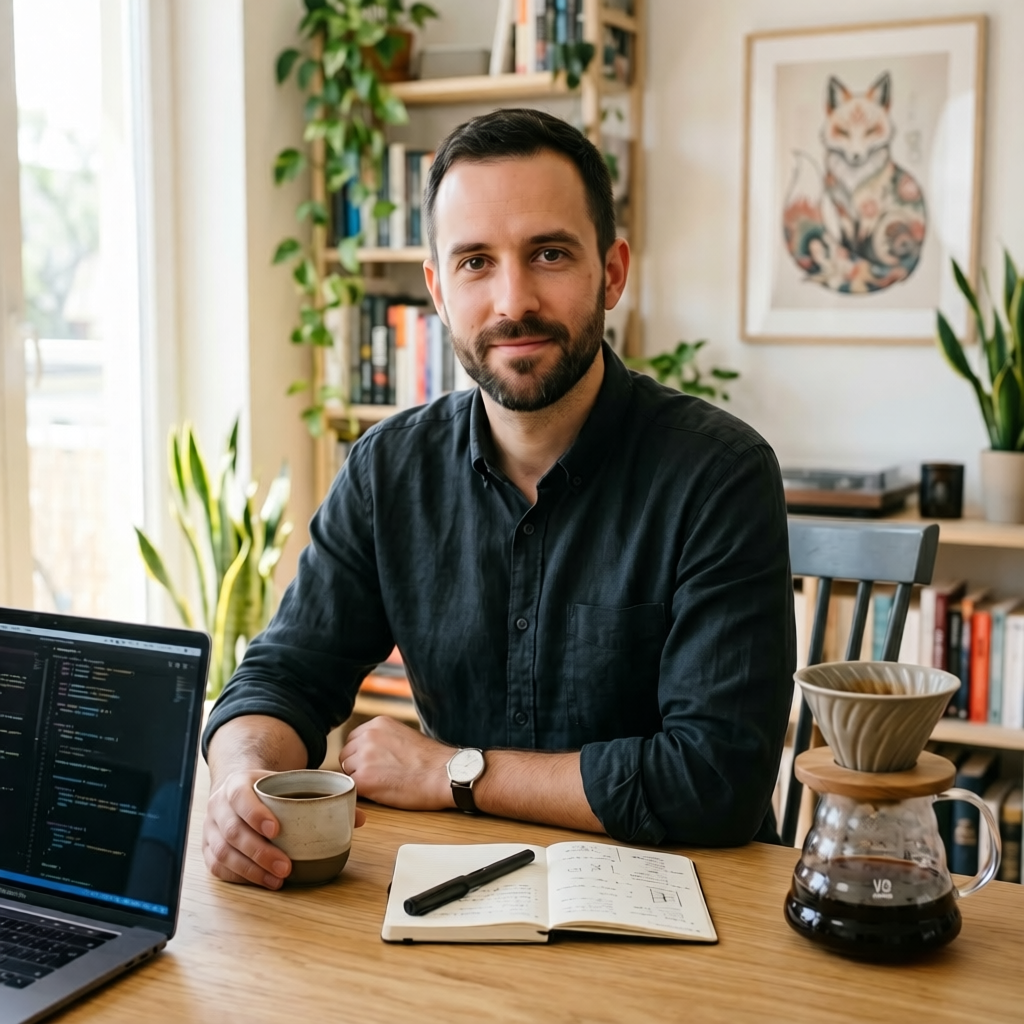
Gabriel Henrique is a language enthusiast and productivity writer. After testing countless study methods, he became obsessed with mastering new languages efficiently. He achieves this without burnout, without endless grammar drills, and without losing focus. At Blog The Curious, he shares everything he has learned along the way.