
I picked up my phone and dialed the number for a local restaurant. I wanted to order food in my target language. I had my textbook open on the living room table. I had a full script written out on a yellow notepad. I felt prepared. The person answered the phone. They did not use the standard greeting I had practiced. Instead, they asked a completely different, rapid question about my exact location and delivery times.
My brain completely locked up. I knew the individual words they used. I knew the specific grammar rules required to answer. But I had to put them all together in real time. I searched my memory for the right subject pronoun. I looked for the correct verb ending for the future tense. I tried desperately to remember the right preposition. The silence on the phone lasted five seconds. It felt like an entire hour. I panicked and hung up the phone immediately.
This was a massive failure. But it taught me the most vital lesson of my entire language learning journey. You absolutely cannot calculate grammar while you are speaking. The human brain is simply not fast enough to remember a rule, apply it to a new word, and physically speak it aloud in real time.
The single trick that solved this problem for me was sentence automation. I stopped learning grammar as a complex math equation. I started learning it as a pure physical reflex. Here is the exact trick that helped me use grammar automatically.
The Bottleneck of Conscious Thought
Grammar rules live in the slow, analytical part of your brain. When you memorize a conjugation chart, you store that information as a conscious memory. To use it in a conversation, you have to actively stop and retrieve it.
This retrieval takes precious time. In a real conversation, you do not have time. The other person is staring at you, waiting for a response. The social pressure builds rapidly. That pressure makes the retrieval process even slower. You start stuttering. You look at the floor. You freeze.
I realized I was treating speaking like a written university exam. I was constantly checking my work before handing it in. Every time I opened my mouth, I ran a strict mental diagnostic test on the sentence. I checked the gender. I checked the verb tense. I checked the word order.
This mental filter was the massive bottleneck. It was physically stopping the language from flowing out of my mouth. I knew I had to completely bypass this filter. I had to move the grammar from the slow, conscious part of my brain directly to the fast, unconscious part.

Muscle Memory Over Mental Memory
Speaking is an intensely physical act. You use your tongue, your lips, your vocal cords, and your lungs. It is a highly coordinated physical movement exactly like throwing a baseball or riding a bicycle.
When you speak your native language, you do not think about these precise physical movements. You certainly do not think about the grammar rules behind them. Your mouth just does the work automatically. Your mouth has built deep muscle memory over decades.
I decided I needed to build that exact same muscle memory for my target language. I needed my mouth to know the grammar rules much better than my conscious brain did. If my mouth knew the correct structure physically, I would not have to think about it mentally.
This is the absolute core of the trick. You stop analyzing the language completely. You start physically drilling it until it becomes an automatic reflex. When someone throws a heavy ball at your face, you do not stop to calculate the trajectory. You just catch it or you duck. Language needs to be that exact same kind of immediate physical reflex.
The Trick of Sentence Frames
The actual trick I used is building and drilling sentence frames. A sentence frame is a fixed grammatical structure with an empty slot at the very end.
Instead of learning the academic rule for the present perfect tense, I learned a single, useful frame. I learned the exact phrase for “I have never.”
I did not learn why it was structured that way. I did not memorize the academic grammar terminology. I simply accepted the phrase “I have never” as a solid block of sound. I treated it like one long word.
Then, I started filling the empty slot with different vocabulary verbs. I have never eaten that. I have never seen that. I have never been there.
The complex grammar is already perfectly baked into the frame. You get the correct syntax completely for free. All you have to do is drop a new vocabulary word into the end of it. This takes zero grammatical calculation. Your brain only has to choose one simple word.
I started collecting these frames immediately. I found them everywhere in the content I watched. I built a massive list of the most common structures I needed for my daily life. I explain exactly how to build this kind of daily routine without burning out in The Simple Way I Practice Grammar Every Day to help you structure your own time.
Selecting High Value Frames
You cannot automate every single sentence in a foreign language. You have to be highly strategic. You must select high value frames.
High value frames are the specific structures you use constantly every single day. Think deeply about your daily conversations. You talk about what you are going to do. You talk about what you just did. You ask for opinions. You express agreement or disagreement.
I made a strict list of ten core frames. “I am going to.” “I need to.” “Do you want to.” “I think that.”
I completely ignored complex, rare grammar structures. I did not care about the past perfect subjunctive mood. I only cared about the practical tools I needed to survive a basic human conversation.
I wrote these ten core frames down on a blank piece of paper. These became my daily automation targets. My only goal was to make these ten structures completely thoughtless.
The Physical Drilling Process
Having a list of frames is entirely useless if you just stare at it. You have to physically drill them.
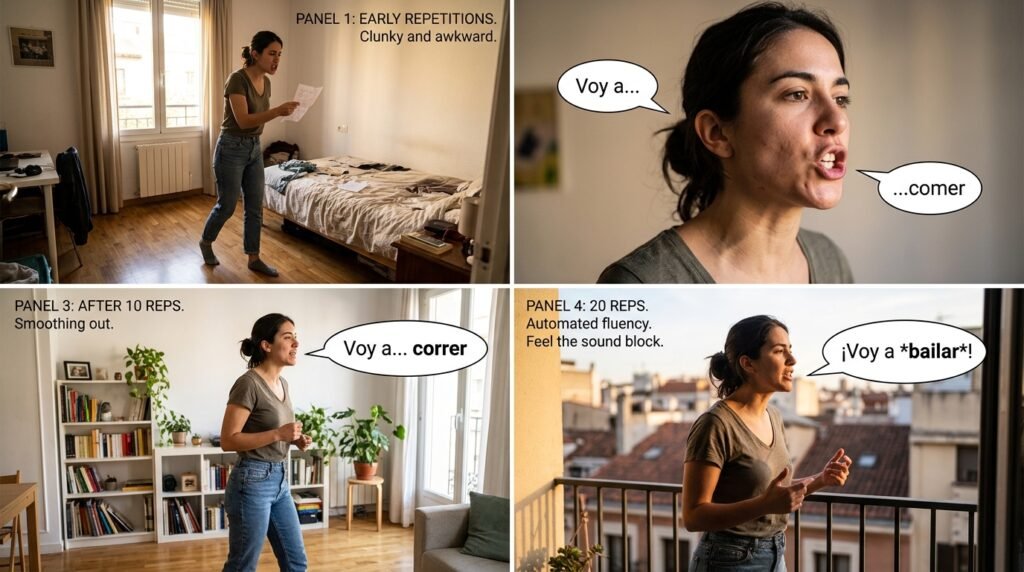
Every single morning, I locked myself in my bedroom. I paced back and forth across the floor. I picked the first frame on my list. Let us use “I am going to” as an example.
I would say the frame out loud in my target language. Then I would add a random action verb. I would say it again with a brand new verb. I would do this twenty times in a row without stopping.
I spoke loudly. I forced my mouth to move aggressively. I wanted to physically feel the sensation of the words in my jaw and throat.
At first, it felt clunky and awkward. My tongue stumbled over the unfamiliar sounds. But after ten repetitions, it smoothed out significantly. After twenty repetitions, the frame became a single, fluid unit of sound. I was no longer saying four separate words. I was saying one long, continuous sound block.
This physical repetition is strictly non negotiable. You cannot automate your grammar by reading silently on a screen. You absolutely must make noise.
Pushing the Speed Limit
Once the frame felt comfortable in my mouth, I aggressively pushed the speed. Speed is the absolute worst enemy of conscious thought.
If you speak slowly, your brain has plenty of time to interfere. It has time to second guess your grammar choices. It has time to try and translate back to your native language.
If you force yourself to speak extremely fast, you lock the conscious brain out of the process entirely.
I would take my daily frame and try to say it as fast as physically possible without slurring the actual words. I repeated the frame over and over at top speed.
This forces the muscle memory to take over completely. Your mouth has to rely on pure reflex to produce the sounds fast enough. This was incredibly tiring at first. My jaw literally ached after ten minutes of practice. But the results were undeniable. I share more strategies on getting out of your own head and trusting your mouth in How I Stopped Overthinking Grammar Rules because mental blocks destroy fluency faster than anything else.
Dropping the Translation Habit Entirely
This automation trick completely destroys the toxic habit of translating in your head.
When you rely on grammar rules, you always start the process with your native language. You think of the English sentence first. You apply the rules to convert it. Then you finally speak.
When you use automated frames, there is absolutely no translation. The frame exists independently in your mind as a pure concept.
When I wanted to express a future action, I did not think of the English phrase “I am going to.” I just instantly felt the physical urge to produce the target language sound block.
The raw thought connected directly to the foreign sound. English was entirely removed from the equation. This is the literal definition of thinking in another language. You do not actually think in words. You think in intentions. The automated frame provides the vehicle for that intention instantly.
Learning Grammar Through Natural Expansion
Once you automate the basic core frames, a beautiful thing happens to your brain. You start learning advanced grammar completely intuitively.
You build a rock solid foundation. You know exactly what a correct, basic sentence feels like in your mouth. When you encounter a new, highly complex grammar structure in the wild, you instinctively compare it to your automated frames.
I started noticing subtle patterns in the media I was consuming. I would hear a native speaker use a slightly different, more advanced version of my automated frame. Because the core structure was already rock solid in my brain, the new addition stood out clearly and vividly.
I did not need to look up the rule for this new addition. I just absorbed it immediately as a variation of the frame I already knew. I expanded my frames naturally without studying.
I added descriptive adjectives. I added secondary clauses. I built upon the solid foundation I had aggressively drilled into my muscle memory. This makes your speech incredibly dynamic. I detail this specific growth phase in What Helped Me Sound More Natural When Speaking so you can clearly see how to level up your basic structures into advanced conversation.
Surviving Real World Tests
Drilling alone in your bedroom is entirely safe. Using the language in the real world is terrifying. You have to test your automated frames under actual pressure.
I went back to the local restaurants. I went to crowded language meetups. I forced myself into uncomfortable conversations with native speakers.
The first few times, the panic tried to return. The old habit of conscious calculation desperately tried to take over my brain. I had to actively force myself to trust my mouth.
I would hear a question. Instead of thinking about the perfect grammatical answer, I would just launch one of my automated frames immediately. I would literally start speaking before I knew exactly how I was going to finish the sentence.
This sounds reckless, but it works flawlessly. By starting the sentence with an automatic, confident reflex, you buy your brain a crucial extra second to find the final vocabulary word.
The sentence comes out smooth, fast, and confident. The native speaker does not hear hesitation or panic. They hear a completely natural response.
The Death of the Internal Critic
The absolute best part about this trick is the deep silence it finally brings to your mind.
When you rely on grammar calculation, your internal critic is constantly screaming at you. It tells you your verb ending is completely wrong. It tells you your pronunciation is bad. It tells you to stop talking before you embarrass yourself further.
Automating your grammar permanently starves that internal critic. The critic operates entirely in the conscious mind. By moving the language to the unconscious muscle memory, the critic has absolutely nothing left to evaluate.
You simply open your mouth and the language comes out. You are no longer performing a difficult, stressful mental task. You are just breathing naturally and making sound.
The relief is massive and immediate. Learning the language instantly stops feeling like a chore. Conversations become genuinely fun. You start actively looking forward to interacting with native speakers instead of hiding from them out of fear.
The Trap of Perfection
Grammar books implicitly teach you that mistakes are moral failures. This is a massive lie that ruins progress. When you speak to a human being, perfection is your worst enemy.
If you try to speak perfectly every time, you will not speak at all. The automation trick works precisely because it accepts minor mistakes. You might accidentally use the wrong preposition at the very end of a flawlessly drilled frame. That is perfectly fine.
The core structure is totally correct. The listener understands your intention completely. You must immediately abandon the desire for a perfect test score. You are communicating an idea, not taking a final exam.
I had to actively unlearn my deep fear of sounding stupid. I made complete peace with the fact that I would sound like a child for a few months. That temporary embarrassment is the mandatory price of admission for real fluency. Once you finally pay that price, the mental blocks disappear forever.
Keeping the Routine Alive
Automation requires strict maintenance. You cannot drill a frame for one week and expect it to stay perfect in your mouth forever.
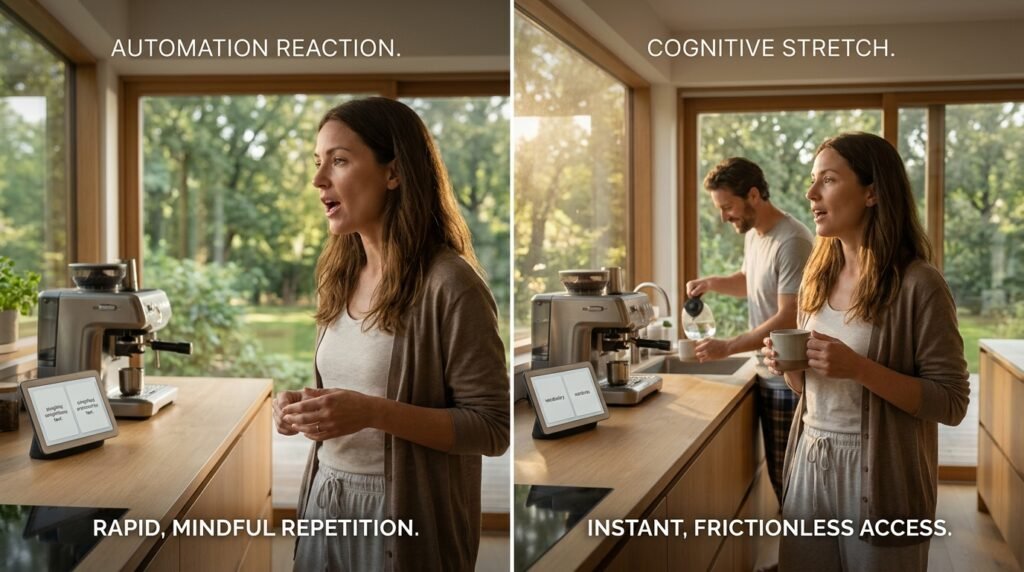
I built a rigid five minute maintenance routine into my morning. While making my coffee, I run through my most important frames. I speak them rapidly out loud to the empty room. I swap the vocabulary words at the end of the frames to keep my brain flexible.
It is exactly like stretching your muscles before a heavy workout. I am simply warming up the physical pathways in my brain and mouth.
This ensures the reflexes stay sharp and fast. It keeps the language at the absolute front of my mind. It guarantees that when I need those words later in the day, they will be instantly available without any mental friction whatsoever.
The Moment of Absolute Clarity
The ultimate reward of this trick is a profound moment of absolute clarity.
It happens completely unexpectedly. You will be sitting at a table with a friend. They will ask you a complex question about your life or your opinions. You will open your mouth and naturally deliver a perfectly structured, grammatically flawless paragraph in response.
You will not hesitate. You will not translate. You will not think about a single academic rule.
When you finally finish speaking, you will pause. You will realize exactly what just happened. Your mouth did all the hard work. Your brain just enjoyed the ride.
That is true fluency. It is not about knowing every single rule in a heavy textbook. It is about completely forgetting the rules even exist because the language has finally become a physical part of you.
Stop trying to solve the language like a crossword puzzle. Stop analyzing every single word order. Take the most useful sentences, lock yourself in your room, and drill them out loud until your jaw hurts. Trust your reflexes completely. The exact moment you stop thinking about the grammar is the moment you will finally start speaking the language.

Gabriel Henrique is a language enthusiast and productivity writer. After testing countless study methods, he became obsessed with mastering new languages efficiently. He achieves this without burnout, without endless grammar drills, and without losing focus. At Blog The Curious, he shares everything he has learned along the way.