
I used to be a collector of yellow legal pads. Every time I started a new language, I would fill these pads with long, neat columns of words. Target language on the left, English on the right. I would spend hours staring at these lists, covering one side with my hand and trying to recite the other. I felt productive. I felt like a scholar.
But there was a problem: I couldn’t actually use any of those words in a real conversation.
Whenever I sat down in a cafe or tried to explain my work as a digital publisher to a new friend, my mind would go blank. I could see the list in my head. I could even remember that the word I needed was the third one down on page five. But the actual sound of the word? The way it fit into a sentence? Gone. It was like trying to build a house by looking at a pile of loose bricks without any mortar.
I eventually realized that the human brain was never designed to memorize abstract lists of data. Our brains are survival machines. They are designed to remember things that are useful, emotional, or connected to our immediate environment. Once I threw away the legal pads and stopped the “brute force” memorization, my vocabulary exploded.
The Brain is Not a Hard Drive
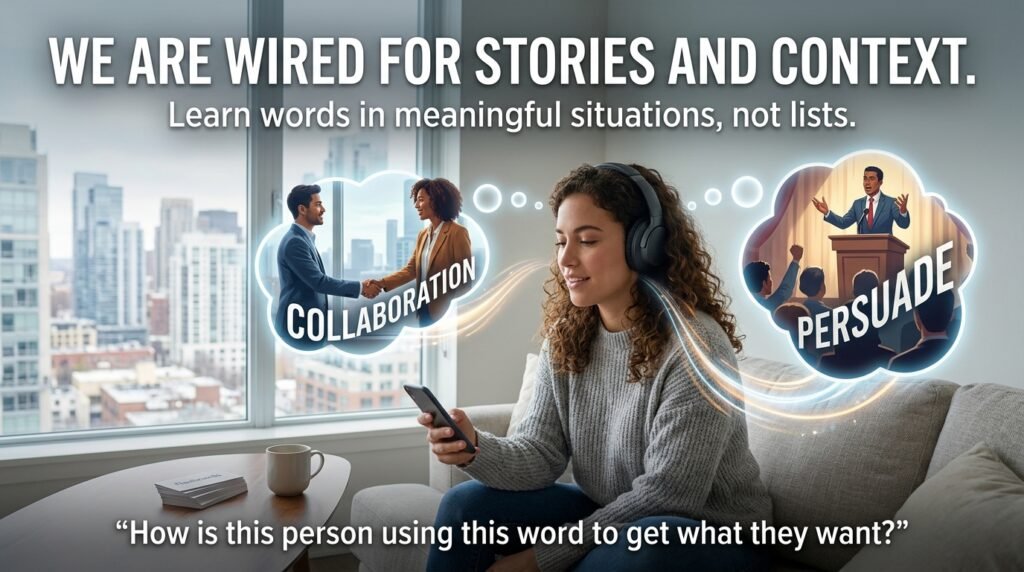
The biggest mistake we make is treating our memory like a computer. A computer can store a list of ten thousand random numbers and recall them perfectly ten years later. A human brain cannot. We are wired for stories and context.
When you learn a word in a list, you are learning it in a vacuum. The word has no “home.” It has no relationship with the words around it. This is why you can “know” a word on a flashcard but completely fail to recognize it when you hear it in a podcast. Your brain hasn’t associated that sound with a meaningful experience.
My vocabulary retention skyrocketed when I committed to The Method I Used to Learn Words in Context because it allowed my brain to see the word as a tool rather than a task. I stopped asking “What does this word mean?” and started asking “How is this person using this word to get what they want?”
The Interest-Driven Vocabulary Strategy
If you want to remember words without effort, you have to stop learning words you don’t care about. Most textbooks start by teaching you the names of colors, animals, and household objects. While these are useful eventually, they are rarely exciting.
I decided to start with my obsessions. I am a major coffee enthusiast. I spend my mornings obsessing over the pour over technique for my Ethiopian Yirgacheffe beans. I want to know about the acidity, the floral notes, and the natural processing methods. So, the first “advanced” words I learned were all related to coffee.
Because I was genuinely interested in the topic, my brain didn’t see the new words as “study material.” It saw them as keys to unlocking more information about something I love. I did the same with my interest in Japanese Irezumi art. Instead of learning generic body parts, I learned the names of traditional motifs: the Kitsune, the Ryu, and the Sakura.
When you follow your curiosity, the “work” of vocabulary disappears. You aren’t memorizing; you are discovering.
The Scavenger Hunt Method
Instead of waiting for words to come to me via a textbook, I started hunting for them in my daily life. I made my environment a constant source of new vocabulary. I stopped sitting at a desk and started focusing on How I Turned Everyday Moments Into Vocabulary Practice which made the learning feel invisible.
Here is how I did it:
-
The Grocery Store Challenge: I would walk through the aisles and try to name every item I put in my cart. If I didn’t know the word for “avocado” or “cinnamon,” I would look it up right there. Because I was holding the object in my hand, the word became anchored to a physical sensation.
-
The Narrative Drive: During my commute, I would narrate my actions out loud. “I am turning left. I am stopping at the red light. The person in the car next to me is wearing a hat.” This forced me to find “utility” words—the boring but essential words that glue a language together.
-
The Tech Swap: I changed the language of my smartphone. This is a brutal but effective way to learn words like “settings,” “edit,” “delete,” and “upload.” You use these buttons every day. After three days, you don’t need to translate them. You just know what they do.
Use it or Lose it: The 24-Hour Rule
A new word is like a delicate plant. If you don’t water it immediately, it will die. I developed a rule for myself: whenever I “captured” a new word from a podcast or a conversation, I had to use it in a sentence of my own within 24 hours.
I didn’t just write the sentence down. I said it out loud. I would try to work it into a conversation with a tutor, or even just say it to my cat. The goal was to move the word from my “passive” memory (words I understand) to my “active” memory (words I can use).
I had to be honest with myself about The Mistake I Was Making With Vocabulary (And How I Fixed It) before I could truly start speaking like a native. That mistake was hoarding words like a dragon hoards gold. I was collecting thousands of words but never spending them. Now, I would rather know 500 words I can use fluently than 5,000 words I can only recognize on paper.
The Power of “Emotional Anchors”
Why is it that we can remember every detail of a childhood vacation or a bad breakup, but we can’t remember the word for “stapler”? It’s because the brain prioritizes emotions.
I started creating “emotional anchors” for difficult words. If I was struggling to remember a specific verb, I would associate it with a funny or shocking mental image. The weirder the image, the better.
For example, if I wanted to remember a word that sounded like “bucket,” I wouldn’t just think of a bucket. I would imagine a giant, purple bucket wearing a tuxedo and dancing on top of my laptop. When I needed that word later, my brain would immediately offer up the image of the dancing bucket, and the sound of the word would follow.

Stop Translating, Start Mapping
The biggest hurdle in vocabulary is the habit of translating everything back to English. When you translate, you are creating a two-step process in your brain. You see an object, find the English word, and then find the target language equivalent. This is too slow for real life.
I started “mapping” words directly to concepts. When I saw my morning cup of coffee, I didn’t think: “That is coffee, and the word for coffee is X.” I looked at the cup and thought only of the target language word.
I stopped using bilingual dictionaries and started using Google Images. If I didn’t know a word, I would search for the image of it. By seeing a hundred different pictures of a “tree” or a “bridge,” my brain associated the new sound with the visual concept rather than an English translation. This builds a direct circuit in your mind that leads to much faster recall.
The Role of “Compelling Input”
You cannot learn words in a vacuum, but you also cannot learn them if you are bored. I stopped reading “educational” texts and started reading things that were actually compelling.
I am a digital content manager, so I started reading blogs about SEO and app development in my target language. I also watched vlogs of people traveling through Ethiopia. Because I wanted to understand the message, my brain worked harder to decipher the vocabulary.
I call this “Reading for Pleasure, Learning by Accident.” If you are engrossed in a story or a video, your brain begins to pick up words through context clues. You don’t have to stop and look everything up. If a word appears five times in one chapter, you will likely understand its meaning by the sixth time without ever opening a dictionary.
Quality Over Quantity
There is a huge pressure in the language learning community to learn “10 new words a day.” This is an arbitrary number that often leads to shallow learning.
I shifted my focus to quality. Some days, I only learn one or two words. But I learn them deeply. I learn how they change in different tenses. I learn which prepositions go with them. I learn the common idioms they appear in.
I would much rather have a deep, intimate relationship with a few hundred “power words” than a nodding acquaintance with a few thousand. These power words—words like “get,” “make,” “point,” and “matter”—can be used in dozens of different ways. Once you master the high-frequency “verbs of all trades,” your ability to express yourself triples overnight.
Dealing with the “Forgetting Curve”
Forgetting is a natural part of the process. You are going to forget words. You are going to forget them three, four, or ten times. This is not a failure. It is your brain deciding what is important.
Every time you forget a word and then look it up again, the “pathway” to that word gets stronger. It’s like walking through a field of tall grass. The first time you walk it, there is no path. After a hundred times, there is a clear trail.
I stopped getting frustrated when I forgot a word I “should” know. I just looked it up again and used it in a new sentence. I realized that the act of “retrieving” a word from your memory is what actually makes the memory stick. If you never have to work for it, you’ll never keep it.
Why Lists Fail the “Stress Test”
The ultimate test of your vocabulary is a real-life conversation under pressure. When you are nervous, your brain shuts down the parts of the mind responsible for complex, abstract recall. This is why list-learners “freeze.”
However, words learned through context, emotion, and physical sensation are stored in a different way. They are more “visceral.” They are closer to your instincts.
When I’m in a situation where I need to speak quickly, I don’t have to reach for a mental legal pad. The words are just there, floating on the surface of my mind, ready to be used. They have become part of my “internal voice” rather than just data points on a screen.

Final Thoughts for the Word-Weary
If you are tired of the flashcards and the endless lists, give yourself permission to stop. You are not a machine. You are a human being who learns through experience and connection.
Go find a podcast about a topic you love. Go for a walk and try to name the birds and the trees. Tell a funny story to yourself while you’re in the shower. Use the language to describe your world, not a textbook’s world.
The goal isn’t to know the most words. The goal is to have the most connections. When you stop memorizing and start experiencing, the language begins to feel like a part of you. The yellow legal pads can stay in the drawer. Your brain has much better things to do.
Focus on the context. Follow your interests. Use the words immediately. If you do these three things, you will find that “learning” vocabulary isn’t something you do for an hour a day. It’s something that happens every time you open your eyes and engage with the world. And that is where true fluency begins.

Gabriel Henrique is a language enthusiast and productivity writer. After testing countless study methods, he became obsessed with mastering new languages efficiently. He achieves this without burnout, without endless grammar drills, and without losing focus. At Blog The Curious, he shares everything he has learned along the way.