
I used to spend three hours a day on language apps. I was obsessed with the digital rewards. I loved the sound of the leveling-up chimes. I fought for the top spot on the weekly leaderboards. My digital streak was over three hundred days long. On paper, I was a star student. In reality, I could not order a simple black coffee without stuttering.
I am a digital publisher. I manage complex networks and write technical policies. I analyze NBA playoff data with a focus on first-action statistics like rebounds and assists. I love systems. I love efficiency. Naturally, I thought that if I followed the software, the software would make me fluent. I was wrong. I was just getting very good at playing a mobile game.
I realized I was treating my phone like a toy. I needed to treat it like a professional tool. I had to stop being a passive user and start being an active architect of my own learning. I made several radical changes to how I used my smartphone. These changes transformed my progress from empty digital points into actual conversational ability. Here is exactly what I changed to get better results.
Moving Away From Passive Tapping
The biggest problem with most popular language apps is the multiple-choice format. You see four options on the screen. Your brain does not have to work hard to recall the word. You just have to recognize the correct shape. This is passive recognition. It is the lowest form of memory.
In a real conversation, nobody gives you four options. You have to pull the word out of thin air. I stopped using apps that relied exclusively on tapping. I looked for tools that forced me to type every single answer. I wanted the friction. I wanted the struggle.
When you type a word, you have to remember every vowel and every consonant. You have to understand the spelling and the gender of the noun. This extra effort is exactly what builds long-term retention. I realized that my previous high scores were an illusion. I had to strip away the easy path to find the real results.

Sourcing My Own Data
I stopped using the default vocabulary lists provided by the apps. Most apps teach you how to ask for the library or describe a red apple. I do not care about libraries. I do not spend my time talking about fruit. My brain is optimized to delete information it finds useless.
I started feeding my own passions into the software. I am obsessed with specialty coffee. I brew Ethiopian Guji beans every morning using a precise V60 method. I track the temperature of the water. I weigh exactly 18 grams of coffee. I began translating my coffee notes into my target language and adding them to my flashcard app.
I did the same with my NBA analytics work. I added terms for point spreads, rebounding probabilities, and offensive efficiency. When I studied these words, I was not bored. I was engaged because these words described my actual life. If you want to see a similar shift in your own progress, you should look at How I Avoid Wasting Time With Ineffective Apps to see how to purge the generic content that is slowing you down.
The Power of Visual Anchors
I am deeply interested in digital photography. I love the retro look of 35mm film. I often use a Canon IXUS for its specific flash aesthetic. I focus on high-precision identity likeness and facial geometry in my edits. I decided to use this visual obsession to improve my vocabulary retention.
I stopped using English translations on my digital cards. Instead, I used my own high-resolution photos. If I wanted to learn the word for “lens” or “shutter,” I took a photo of my actual camera equipment and used that as the prompt.
This completely eliminated the middleman of English. When I saw the photo, my brain went straight to the foreign word. I was no longer translating in my head. I was thinking directly in the language. This change alone halved the time it took for me to lock in new words. It turned my study sessions into a visual archive of my own experiences.
Automation and The Morning Ritual
I used to study whenever I had a “free minute.” This was a mistake. Free minutes are usually filled with social media or email. I had to build a rigid system to protect my focus. I used my background in mobile software to automate my environment.
I created a custom shortcut on my phone. Every morning at 7:00 AM, my phone automatically enters a strict Focus Mode. It silences all notifications. It blocks my email. It hides my distracting apps. The only thing it leaves open is my primary learning tool.
I tied this digital automation to a physical anchor: my morning coffee. While the water is heating in my gooseneck kettle, I do my first set of reviews. While the coffee is blooming in the V60, I do my second set. By the time I take my first sip, I have completed my most important study tasks. This system removed the need for willpower. The routine happened whether I felt motivated or not. You can see the technical breakdown of this setup in How I Turned My Phone Into a Learning Tool where I explain how to hijack your own device for productivity.
Respecting the Audio Feed
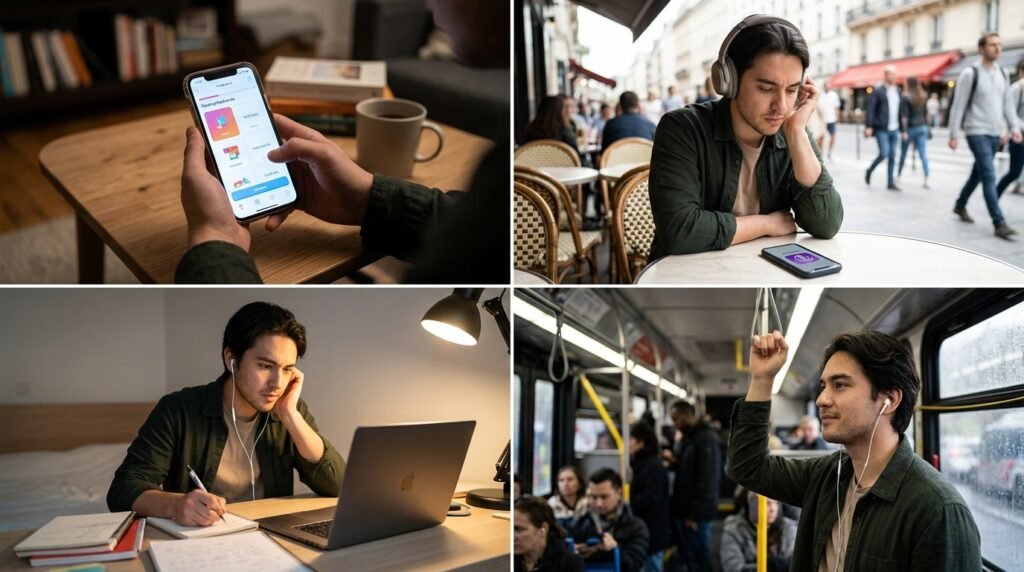
I realized that I was “reading” the language more than I was “hearing” it. Apps are very visual. You spend a lot of time looking at text. But real life is auditory. I had to change how I used audio.
I stopped listening to the robotic voices inside the apps. They are too perfect. They lack the natural slurs and rhythm of a human speaker. I started searching for raw, unscripted audio. I found native podcasts about basketball and tech. I didn’t understand 90% of it at first.
I used a simple trick. I would listen to a thirty-second clip at half speed. I would try to write down exactly what I heard. Then I would listen at full speed. I did this every day. This trained my ears to handle the actual velocity of the language. The app provided the vocabulary, but the real audio provided the reflex.
Deleting the Games
I became ruthless with my app folder. I deleted any tool that used “digital gems” or “health bars” to keep me engaged. These features are designed to keep you addicted to the screen. They do not help you speak.
I switched to a raw, minimalist database tool. It is not pretty. It has no mascot. But it uses a powerful mathematical algorithm called Spaced Repetition (SRS). This algorithm tracks exactly when I am about to forget a word and shows it to me at that precise moment.
This was a massive shift in efficiency. I was no longer reviewing words I already knew. I was spending 100% of my time on my weakest points. It was frustrating and difficult, but it was effective. I stopped playing a game and started doing the work.
Using Voice Memos as a Mirror
Speaking is a physical skill. You have to train the muscles in your jaw and tongue. You can tap buttons all day and still have a terrible accent. I started using my phone’s voice recorder as a brutal mirror.
Every evening, I would record myself speaking about my day. I would talk about the server migration I managed or the NBA point spread I was calculating. Then, I would listen to the recording immediately.
It was painful at first. I could hear every mistake. I could hear where my tongue tripped. But this objective data allowed me to fix my errors. I would record the same sentence five times until it sounded natural. The app gave me the data, but the recorder gave me the physical training.
The Problem with Translation
I made a firm rule: no more instant translation. Most people use apps that allow them to click a word to see the meaning immediately. This is a crutch. If you can see the answer with one click, your brain has no reason to store the information.
I switched to a monolingual dictionary. If I didn’t know a word, I had to read the definition in the target language. I had to use words I already knew to understand new concepts.
This was incredibly slow in the beginning. It felt like I was walking through mud. But after two weeks, my brain started to adapt. I stopped looking for the English equivalent. I started accepting the target language on its own terms. This is the moment where fluency truly begins.
Integrating Real Practice
The biggest change I made was realizing that the app is just the staging area. The real work happens elsewhere. I started a daily habit of “active output.”
I would take the vocabulary I learned in the morning and force myself to use it in a real-world situation that afternoon. If I learned a word for “rebound,” I would go to a basketball forum and write a comment about a specific player’s statistics. If I learned a word for “roast,” I would go to a coffee community and describe my latest batch of Ethiopian beans.
This bridge between the digital and the physical is essential. Without it, the knowledge remains trapped inside your phone. I detailed how I managed this transition in How I Combine Apps With Real Practice because you have to move beyond the screen if you want to actually speak.
The Consistency Audit
I started auditing my app usage every Sunday. I looked at the raw data. I didn’t care about the streak. I cared about the “leech” count—the words I kept getting wrong.
If a word was a leech, it meant my flashcard was bad. I would delete the card and rebuild it with a better photo or a better context sentence. I stopped blaming my memory and started blaming my system.
By treating my learning like a data-driven project, I removed the emotional frustration. I was just an analyst looking for bugs in the code. This objective mindset helped me stay focused and prevented the burnout that usually happens during the “intermediate plateau.”
Why Less is More
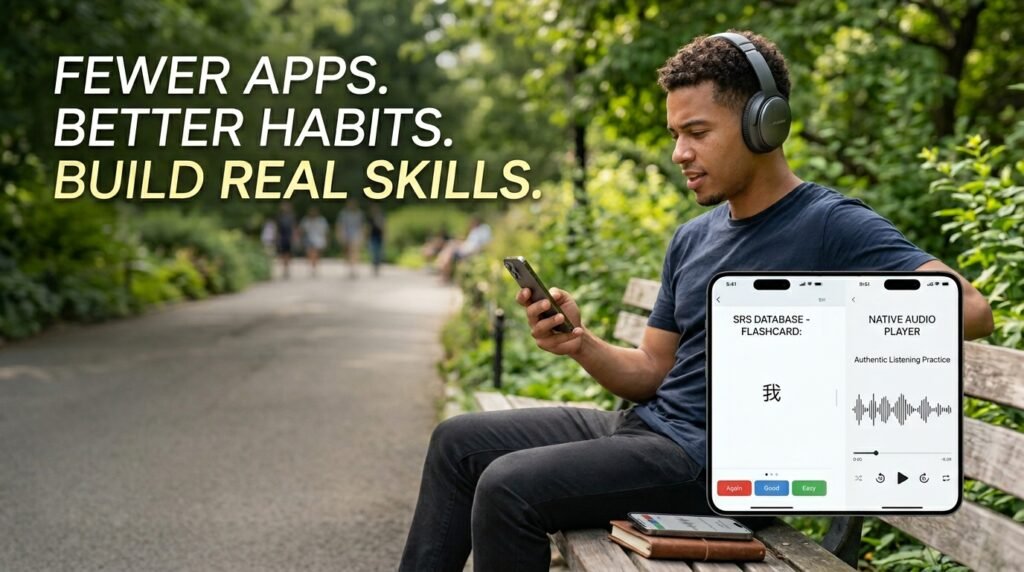
In the end, I realized that I didn’t need more apps. I needed fewer, better habits. I narrowed my digital toolkit down to two raw tools: a high-quality SRS database and a native audio player.
I stopped looking for the “newest” features. I focused on the fundamentals. Active recall. Spaced repetition. High-quality input. Physical production.
The smartphone is the most powerful learning tool in human history, but only if you take control of it. If you let the developers design your routine, you will end up with a high score and a quiet voice. If you design your own system, you will end up with real skills.
A Final Piece of Advice
If you feel like your apps are not working, do a radical audit. Delete the games. Stop the multiple-choice quizzes. Start adding your own passions. Use your camera to create visual anchors.
Anchor your study to a physical ritual like brewing coffee. Use automation to protect your time. Most importantly, stop looking for the easy way out. The struggle is not a sign of failure; it is the sound of your brain growing.
Your phone can either be a distraction or a weapon. It is up to you to decide how you want to use it. Start your own purge today. Rebuild your system from the ground up. The results will not happen overnight, but they will be real, and they will be yours. Stop playing. Start learning. The world is a much bigger place than a five-inch screen, and it’s waiting for you to find your voice in it.

Gabriel Henrique is a language enthusiast and productivity writer. After testing countless study methods, he became obsessed with mastering new languages efficiently. He achieves this without burnout, without endless grammar drills, and without losing focus. At Blog The Curious, he shares everything he has learned along the way.