
I have spent a significant portion of my life staring at whiteboards and flashcards. As a digital publisher managing multiple niche blogs, I am used to processing a lot of information. But language? Language felt different. It felt like my brain was a sieve. I would learn a word on Monday, use it in a practice sentence on Tuesday, and by Wednesday morning, it had evaporated into thin air. It was as if my mind had a “spam filter” for foreign words, and everything I was trying to learn was being sent straight to the trash.
The frustration of the “blank stare” is real. You know that feeling when you are mid-sentence, you can almost see the word in your mind, but you just can’t grab it? It’s sitting there, teasing you, just out of reach. I used to think I needed a better memory. I thought I needed some sort of genius-level cognitive enhancement to make the words stick.
Then, one morning, while I was brewing a V60 of Ethiopian Guji beans, it hit me. I realized I never forgot the technical terms for coffee. I knew exactly what “natural process” meant. I knew the specific acidity profiles of different landrace varieties. I didn’t have to memorize those; I just knew them. Why? Because they were attached to a smell, a taste, and an experience. They weren’t just data points; they were part of my life.
I decided to apply that same “sensory anchoring” to my language learning. I stopped trying to force words into my head and started letting them live in my world. This is the story of the “effortless” trick that changed my vocabulary retention forever.
The Death of the List
The first thing I had to do was kill the vocabulary list. I used to keep long columns of words in my notebooks. English on the left, target language on the right. It felt like work. It looked like school. And my brain hated it. When you look at a list of words, your brain sees it as a chore. It’s an abstract pile of information with no emotional weight.
I had to be honest with myself about How I Learned New Words Without Memorizing Lists and move toward a system that favored images over definitions. I realized that the brain is a visual machine. We evolved to remember where the berry bushes are and what a predator looks like. We did not evolve to remember that X equals Y on a piece of paper.
Why Lists Fail
-
Lack of Context: A list doesn’t tell you how a word feels in a sentence.
-
Zero Emotion: There is no “vibe” to a column of text.
-
Boredom: Your brain literally stops paying attention after the fifth word.

The Trick: The “Identity Anchor”
The real trick I discovered is what I call the Identity Anchor. Instead of learning a word as an abstract concept, I tied every new word to something I was already doing or someone I already was.
As a blogger, I spend hours thinking about SEO and content strategy. As a fan of Brazilian soccer, I feel genuine emotional highs and lows when I watch Vasco play. I started taking new vocabulary and forcing it into these pre-existing emotional structures.
For example, I was trying to learn the word for “frustrating.” Instead of repeating it over and over, I thought about a specific Vasco game where we lost in the final minutes. I sat in that feeling of frustration and said the word out loud. I didn’t just learn the definition; I anchored the word to that specific, gut-wrenching memory of the match. The next time I needed to say “frustrating,” my brain didn’t look for a dictionary—it looked for that feeling.
The word wasn’t a piece of data anymore. It was a feeling.
Visualization and the “Irezumi” Method
I have a deep interest in traditional Japanese tattoo art, specifically Irezumi. The imagery is incredibly vivid—Kitsune foxes, Ryu dragons, and Sakura petals. When I was struggling with Japanese vocabulary, I started using these visual motifs as mental filing cabinets.
If I wanted to remember a word related to “cunning” or “transformation,” I didn’t think of the English word. I visualized a Kitsune mask. I pictured the vibrant oranges and the sharp eyes. I would hold that image in my mind and speak the Japanese word.
By using high-contrast, artistic images that I already loved, I was giving the words a “home” in my brain. This allowed me to navigate the initial stages of How I Started Learning a Language From Scratch Without Feeling Lost because I wasn’t just wandering through a forest of sounds; I was walking through a gallery of my favorite art.
How to use Visualization:
-
Use High Contrast: Don’t just picture a cat. Picture a neon-purple cat wearing sunglasses.
-
Make it Personal: Use images of your own pets, your own car, or your own office.
-
Add Action: If the word is a verb, imagine the image doing something ridiculous. A “dancing” refrigerator is much easier to remember than just the word “refrigerator.”
The Sensory Coffee Layer
I mentioned my coffee obsession earlier. This became one of my most powerful tools for vocabulary retention. Every morning, the brewing process takes about five to seven minutes. It’s a quiet, meditative time.
I started a habit of “sensory narration.” As I poured the hot water over the grounds, I would describe what I was seeing and smelling in the target language.
-
The water is hot.
-
The smell is floral.
-
The coffee is blooming.
Because I was physically doing the actions, the words were being hard-coded into my nervous system through my senses. My nose was smelling the coffee while my mouth was saying the word for “aroma.”
This is the ultimate hack: connect the word to a physical sensation.
If you are learning the word for “cold,” don’t look at a flashcard. Open your freezer, stick your hand inside, and say the word. Your brain will never forget that word because it now has a physical “memory” of the temperature attached to it.

Using High-Stakes Interest: NBA and Stats
Another part of my life involves tracking NBA performance statistics for betting analysis. I’m looking at first-quarter rebounds, assists, and player percentages. This is a high-focus activity for me. I’m locked in.
I started looking for sports commentary and news in my target language. Because I already knew the “math” of the game, I could figure out the language through context. If the announcer said a word I didn’t know while the screen showed a player’s “Rebounds” stat, my brain immediately made the connection.
I didn’t have to study. I was just watching basketball. This is what I mean by “effortless.” You find a high-interest, high-stakes activity and you simply “layer” the language on top of it.
Why Interest-Based Learning Works:
-
Dopamine: You are already excited about the subject, so your brain is “open” for business.
-
Context Clues: You already know what should be said, so your brain fills in the gaps.
-
Frequency: You probably check these stats every day, providing natural repetition.
Talking to the “Invisibles”
One of the most effective habits I built was narrating my digital work. As I’m managing my blogs like coffeenerdlab.com or thebrightlance.com, I talk to myself about what I’m doing.
“I am uploading this image. I am writing the SEO title. I need to fix the internal link.”
I do this out loud, even when I’m alone in my office. It felt strange at first, but it forced my brain to find the “workhorse” words of my daily life. It’s one thing to know the word for “apple,” but it’s much more useful to know the word for “upload” or “schedule” when that is what you actually do for eight hours a day.
This practice was The Simple Habit That Doubled My Vocabulary Retention because it bridged the gap between a “study session” and my actual life. I wasn’t setting aside time to learn; I was learning while I was making money.
The “Micro-Dose” Philosophy
I realized that my brain has a limit on how much new information it can take at once. If I tried to learn thirty words in one sitting, I would remember zero. If I learned three words, I would remember all three.
I started “micro-dosing” my vocabulary. I would pick three words in the morning and write them on a post-it note on my monitor. Throughout the day, every time I took a sip of water or finished an email, I would look at the words and use them in a sentence related to my current task.
This is about frequency, not duration.
Five minutes of focused “usage” spread throughout the day is ten times more effective than an hour-long cram session on a Saturday. Your brain needs time to “settle” the information. It needs to see the word, forget it slightly, and then be reminded of it. This process of “forced recall” is what actually builds the long-term memory.
Forgetting is Part of the Process
Here is a secret that most “polyglots” won’t tell you: I forget words all the time. I forget words I’ve used a hundred times. And that is perfectly okay.
In the past, I would get frustrated when I forgot a word. I would tell myself I was failing. Now, I see forgetting as a necessary step. Every time you forget a word and then look it up or remember it again, the neural pathway gets a little bit thicker. It’s like a muscle. You have to “tear” it through forgetting so it can grow back stronger through remembering.
Don’t aim for perfection. Aim for persistence.
If you forget a word, just laugh, look it up, and use it in a funny sentence. The humor actually helps the word stick better the next time. I once forgot the word for “bread” and accidentally called it “wheat pillow.” My tutor laughed, I laughed, and I have never forgotten the word for bread since. The emotion of the laughter anchored the correction.
The Tech Stack: Use it, Don’t Depend on it
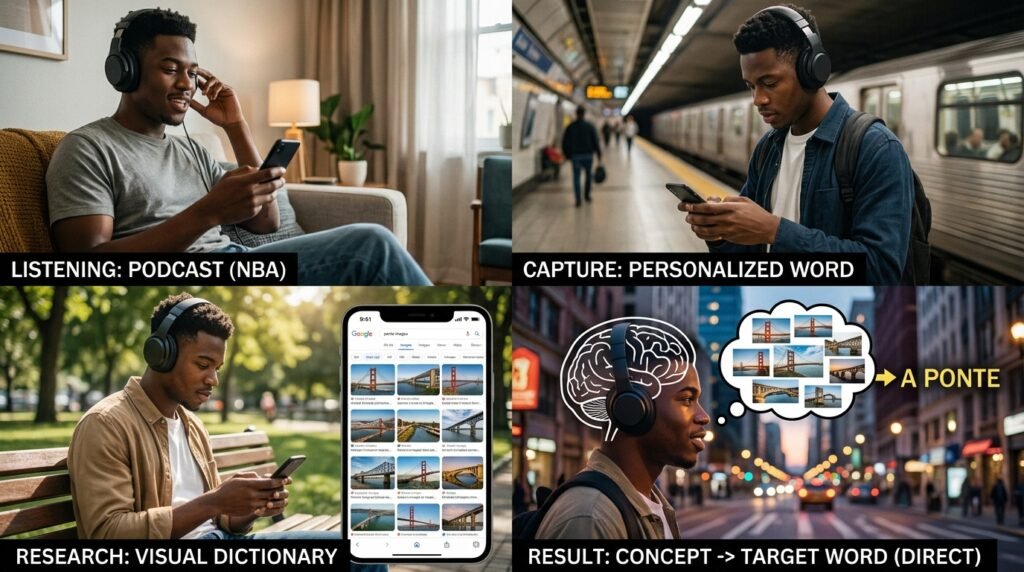
I use a few apps, but I use them differently now. I don’t follow the “pre-made” decks. I create my own. If I hear a word in an NBA podcast or see a phrase on a Vasco fan forum, I add that specific word to my app.
I also use my smartphone as a “visual dictionary.” Instead of looking up a translation, I use Google Images to search for the word. If I see twenty different pictures of a “bridge,” my brain builds a concept of what a bridge is in that language, rather than just linking it to the English word “bridge.”
This removes the “translation layer” in your head. You want to go straight from Concept -> Target Word, rather than Concept -> English Word -> Target Word. The shorter the path, the faster you’ll be able to speak.
Conclusion: Making the Language Yours
The “trick” isn’t a secret formula or a magic pill. It is simply the act of making the language personal. When you stop treating vocabulary as a school subject and start treating it as a tool for your passions—whether that’s coffee, soccer, art, or digital business—the effort disappears.
You don’t have to “try” to remember things that matter to you. Your brain does that automatically.
Start today by picking three things you love. Find five words for each of those things. Anchor them to an image, a smell, or an emotion. Talk to yourself while you work. And most importantly, give yourself permission to be messy.
The goal isn’t to have a perfect vocabulary list in a notebook. The goal is to have a vibrant, living language inside your head. It takes time, but when you stop fighting your brain and start working with its natural visual and emotional strengths, you’ll find that the words stay exactly where you want them.
Now, go brew some coffee, put on a game, and start narrating your world. You’ll be surprised at how much you already know.

Gabriel Henrique is a language enthusiast and productivity writer. After testing countless study methods, he became obsessed with mastering new languages efficiently. He achieves this without burnout, without endless grammar drills, and without losing focus. At Blog The Curious, he shares everything he has learned along the way.