
Have you ever listened to an audio recording of yourself speaking a foreign language? I did. It was a humbling experience. I was a few years into my language journey. I knew thousands of words. I understood the complex grammar structures. I could read books without much trouble. But when I hit play on that voice memo, I winced.
I sounded incredibly stiff. I sounded like an automated customer service menu.
Every word was perfectly pronounced. Every verb was correctly conjugated. But the sentence itself was dead. There was no rhythm. There was no emotion. I was technically correct, but I was culturally invisible. I sounded like a textbook walking down the street.
That recording was a wake up call. I realized that being accurate and being natural are two completely different things. You can have perfect grammar and still sound entirely foreign. You can make a dozen mistakes and still sound like a local.
I decided to stop trying to be perfect. I wanted to be natural. I tore down my entire speaking routine and rebuilt it from scratch. Here is the exact strategy I used to loosen up, find my rhythm, and finally speak like a human being.
The Problem with Perfect
The classroom ruins our natural speech. In a traditional setting, you are taught to enunciate every single syllable. You are taught to leave clear spaces between your words. You are taught to prioritize grammar above all else.
This creates a rigid, robotic speaking style. Native speakers do not talk like this. They do not pause between every word. They do not pronounce every letter. They slur things together. They drop endings. They bend the rules of grammar to fit the speed of their thoughts.
I was trying to speak an idealized version of the language that did not actually exist in the real world. I had to let go of my obsession with correctness. I had to accept that natural speech is inherently messy. It is fluid. It is full of mistakes and corrections. Once I gave myself permission to be messy, the real progress began.

The Rhythm Over the Words
Every language has a melody. It has a specific beat. English has a stress timed rhythm. Some syllables are long and loud, while others are crushed and quiet. Other languages are syllable timed. Every syllable gets the exact same amount of time.
I was taking the melody of my native language and forcing it onto the foreign words. This is the primary reason people have thick accents. An accent is not just about pronouncing a vowel wrong. It is about using the wrong musical beat.
I stopped focusing on the individual letters and started focusing on the music. I listened to native speakers and tapped my foot to their sentences. I paid attention to where their voices went up and where they went down. I realized that if I matched their melody, people understood me better, even if my pronunciation was flawed.
The Shadowing Technique Explained
To fix my rhythm, I relied heavily on a practice called shadowing. Shadowing is the act of listening to a piece of native audio and repeating it out loud at the exact same time. You are acting as an echo.
This is not a casual exercise. It is a highly focused, physical workout for your mouth. Here is exactly how I built my shadowing routine.
First, I found a podcast featuring two native speakers having a casual conversation. I did not use audiobooks or news broadcasts. Those formats are too formal. I needed the messy, overlapping reality of two people chatting.
Second, I took a thirty second clip. I listened to it five times without speaking. I just absorbed the melody.
Third, I started speaking with them. I tried to match their speed. I tried to copy their breath patterns. I tried to mimic their emotion. If they laughed, I laughed. If they whispered, I whispered.
This practice felt ridiculous. But it was the only way to train the physical muscles in my mouth and throat. This daily routine became the foundation of The Way I Practice Speaking When I’m Alone because it allowed me to make mistakes in private. I was building muscle memory without the pressure of a real conversation.
The Magic of Filler Words
If you want to sound natural immediately, learn the filler words.
In school, teachers tell you to stop saying “um,” “like,” or “well.” They view these words as a sign of poor public speaking. In reality, filler words are the glue of human conversation. They serve a vital social function.
Filler words show the other person that you are thinking. They signal that you are not finished talking. They buy your brain valuable seconds to search for the right vocabulary word.
When I spoke my target language without filler words, my pauses were dead and silent. The silence was awkward. The other person would often jump in and finish my sentence because they thought I was done.
I made a list of the most common native filler words. I learned the equivalents of “so,” “anyway,” “look,” and “you know.” I forced myself to use them whenever my brain needed a second to catch up. Mastering these tiny words was a huge part of How I Learned Common Phrases That Native Speakers Actually Use and it instantly made my speech sound more authentic.
Linking and Blending Sounds
Native speakers are lazy. I mean that as a compliment. The human mouth always looks for the easiest path from one sound to the next. This creates connected speech.
In English, we do not say “Do you want to go?” We say “D’you wanna go?” We blend the words together into one long sound. Every language has its own rules for linking words.
I had to stop reading sentences as a series of separate boxes. I started looking at sentences as a single stream of sound. I paid attention to what happened when a word ending in a consonant met a word starting with a vowel. In almost every language, those two words will smash together.
I took a pencil and literally drew connection lines on my reading materials. I physically linked the end of one word to the beginning of the next. I practiced reading those linked words as one single entity. This destroyed my robotic, staccato speaking style and replaced it with a smooth, natural flow.

Stopping the Mental Translation
You cannot speak naturally if you are translating in your head. Translation is a heavy cognitive process. It causes a massive delay between hearing a question and giving an answer.
When you translate, your eyes usually dart to the side. Your face looks strained. Your speech comes out in slow, calculated bursts. It is the opposite of natural.
I had to sever the tie to my native language. I stopped using bilingual dictionaries. I started looking up words using images instead of translations. I wanted to link the foreign sound directly to the concept, bypassing my mother tongue completely.
This was a difficult transition. It required a lot of mental discipline. But learning How I Learned to Speak Without Translating First was the single most important step for my speaking speed. Once I stopped building sentences in my native language first, my responses became immediate and organic.
Slowing Down to Sound Better
There is a dangerous myth in language learning. People think that speaking fast means speaking fluently. This is false.
When you try to speak too fast, your pronunciation degrades. You trip over your own tongue. Your anxiety spikes. The listener struggles to understand your rushed, garbled sentences.
I noticed that confident native speakers actually take their time. They pause. They stretch out certain words for emphasis. They control the pace of the conversation.
I forced myself to slow down. I intentionally spoke at about eighty percent of my maximum speed. This accomplished two things. First, it gave my brain more time to retrieve the correct vocabulary. Second, it made me sound more confident. Rushed speech sounds nervous. Measured, deliberate speech sounds authoritative.
Slow down. Take a breath. Give your words the space they need. You will instantly sound more comfortable in the language.
The Physical Tension Problem
Your body language affects your voice. When you are nervous about speaking a foreign language, your body tenses up. Your shoulders rise. Your chest gets tight. Your throat constricts.
This physical tension changes the timbre of your voice. It makes your pitch higher. It makes you sound squeezed and uncomfortable. It is impossible to sound natural when your body is in fight or flight mode.
I started paying attention to my posture before I spoke. I would actively drop my shoulders. I would take a deep breath into my belly, not my chest. I relaxed my jaw.
By physically relaxing my body, my voice dropped back down to its natural resonance. I sounded like myself again. A relaxed voice signals to the listener that you are safe and comfortable. This puts them at ease, which makes the entire conversation flow better.
Accepting the Messy Middle
You will not go from robotic to natural overnight. There is a long, awkward phase in the middle. You will try to use a filler word and it will sound forced. You will try to link words together and you will stumble.
This is the messy middle. Most people retreat to their comfortable, robotic textbook speech when they hit this phase. They hate feeling clumsy.
You must embrace the clumsiness. You have to push through the awkwardness to get to the authenticity.
I stopped apologizing for my mistakes. When I messed up a sentence, I did not stop and repeat it perfectly. I just kept going. I treated the conversation like a moving train. You do not stop the train to fix a scratched window. You just keep moving forward.
Native speakers forgive grammar mistakes instantly. They do not forgive a lack of connection. If you are making eye contact, smiling, and flowing with the rhythm of the chat, they will barely notice that you used the wrong verb tense.
Finding Your Persona
Speaking a new language often feels like acting. You are adopting a new set of sounds, gestures, and facial expressions.
I stopped fighting this feeling. I leaned into it. I observed how native speakers used their hands. I watched their facial expressions when they were surprised or angry. I started adopting those physical traits when I spoke the language.
You develop a “language persona.” Your voice might be slightly deeper. You might use your hands more. This is normal. A language carries a culture, and to speak the language naturally, you must adopt a small piece of that culture.
Allow yourself to change slightly when you switch languages. Do not try to force your native speaking habits onto a foreign tongue. Let the new language dictate how you move and sound.
Reevaluating Your Input
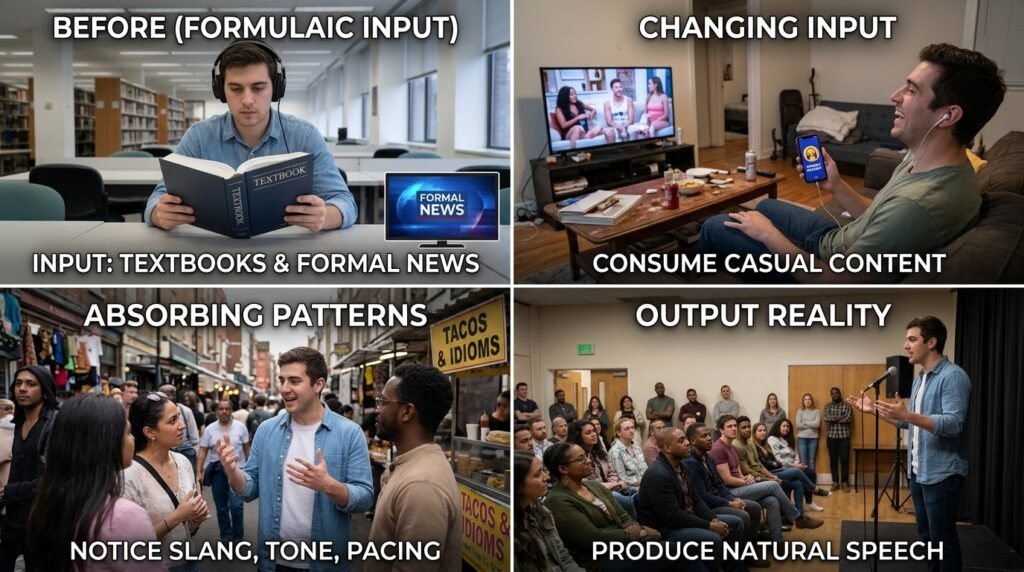
You output what you input. If you only read textbooks and listen to formal news broadcasts, you will sound like a textbook or a news anchor.
I completely overhauled my media diet. I sought out the most casual, authentic content I could find. I watched reality television. I listened to comedy podcasts. I followed vloggers who spoke directly to the camera without a script.
I wanted to flood my brain with the sounds of real life. I paid attention to the slang. I noticed the idioms. I absorbed the pacing of an argument and the tone of a joke.
Your brain is an incredible pattern recognition machine. If you give it enough examples of natural speech, it will automatically start adjusting your own output to match those patterns. But you have to give it the right data. Feed your brain reality, and it will produce reality.
The Final Step
Sounding natural is not about intelligence. It is about exposure and physical training. It is about letting go of the safety of the textbook and stepping into the unpredictable flow of a real conversation.
Stop worrying about being correct. Start worrying about being connected.
Listen to the music of the language. Shadow the speakers you admire. Use the filler words to buy yourself time. Slow down your pace and relax your shoulders.
It takes time to find your voice in a new language. But the moment you stop translating, stop rushing, and simply allow yourself to ride the natural rhythm of the words, you will finally feel at home. The robotic stiffness will fade away. You will stop acting like a student taking an oral exam, and you will finally just be a person having a chat. That is the true definition of fluency.

Gabriel Henrique is a language enthusiast and productivity writer. After testing countless study methods, he became obsessed with mastering new languages efficiently. He achieves this without burnout, without endless grammar drills, and without losing focus. At Blog The Curious, he shares everything he has learned along the way.