
There is a specific kind of frustration that comes with being a “silent” language learner. You spend months studying. You know the grammar rules. You can recognize hundreds of words on a page. But the moment a native speaker looks you in the eye and asks a simple question, your brain turns into a blank slate. You nod, you smile awkwardly, and you walk away wishing you had said literally anything else.
I lived in that “nod and smile” phase for far too long. I was a master of textbooks but a failure at human connection. I realized that my study routine was designed for passing tests, not for having conversations. If I wanted to actually speak to people, I had to stop acting like a student and start acting like a communicator.
I decided to overhaul everything. I threw away my complex schedules and built a routine focused entirely on one goal: reaching a basic level of conversation as fast as possible. This wasn’t about being perfect. It was about being functional. It was about being able to sit in a cafe, order a drink, and ask someone how their day was going without having a panic attack.
Here is the exact routine I followed to break through the silence.
The Morning Brain Wake-Up
My routine started the moment I opened my eyes. I am a firm believer that the state of your brain in the first thirty minutes of the day dictates how well you absorb information. I didn’t reach for my phone to check social media. Instead, I reached for my target language.
I would spend ten minutes doing “active listening.” I would put on a podcast or a news clip specifically designed for learners. I didn’t try to understand every word. I just wanted to hear the music of the language. I wanted to prime my ears for the sounds I would be using later.
During those first few weeks, I Tried Learning a New Language Every Morning — Here’s What Happened and it taught me that my brain is far more receptive right after my first espresso. It felt like I was “booting up” the language part of my brain before the stress of the day could take over.

Building My “Islands of Fluency”
The biggest mistake I made in the past was trying to learn everything at once. When you try to learn a whole language, you end up knowing a little bit about a lot of things, but you can’t talk deeply about anything.
I changed my approach to building “Islands of Fluency.” An island is a specific topic that you can talk about comfortably for two or three minutes. My first islands were:
-
Who I am and what I do for a living.
-
Why I am learning this language.
-
My favorite foods and how to cook them.
-
What I did last weekend.
I spent my mid-morning break “scripting” these islands. I wrote down the sentences I would realistically say in a real conversation. I didn’t use textbook sentences like “The boy is under the table.” I used real sentences like “I work as a content creator and I love specialty coffee.”
By focusing on these specific islands, I gave myself safe harbors. If a conversation started to get too difficult, I could steer it back to one of my islands where I felt confident. This reduced my anxiety significantly because I knew I had “pre-prepared” content ready to go.
The Lunchtime Input Buffet
Lunchtime was for input. I made a rule that I couldn’t eat my lunch unless I was watching or listening to something in my target language. I call this the “Input Buffet” because I would consume a variety of media.
I would watch YouTube videos of people doing normal things: grocery shopping, walking through a park, or vlogging their day. This was crucial for learning “filler words.” Textbooks don’t teach you the sounds people make when they are thinking, like “uhm” or “well” or “actually.” But in a conversation, those sounds are the glue that keeps the rhythm going.
I started mimicking the speakers. If a vlogger said a phrase that sounded natural, I would pause the video and say it out loud five times. I wanted my mouth to feel the shape of the words. I wasn’t just learning the meaning: I was learning the muscle memory.
The Evening Output Phase
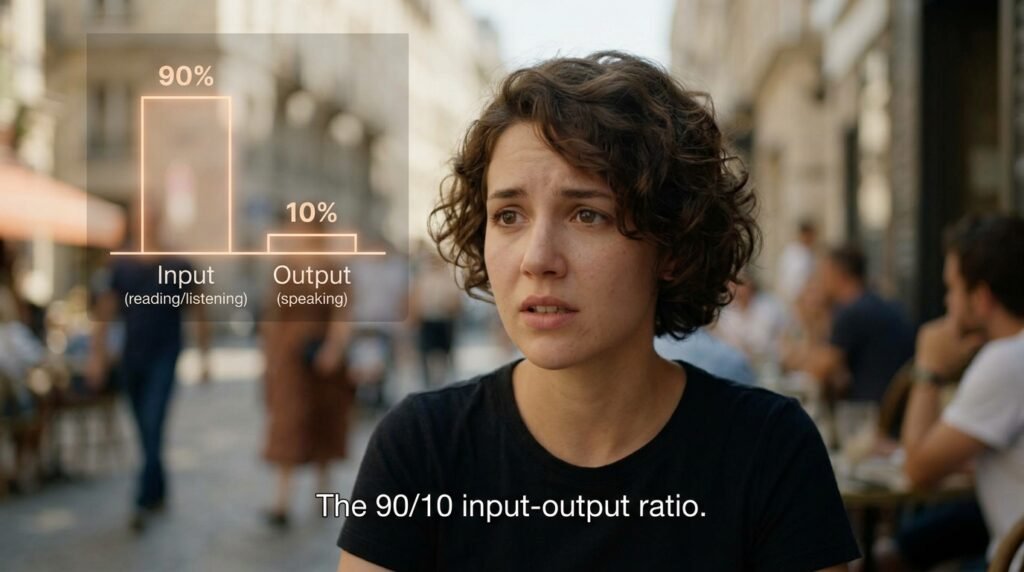
This was the most important part of my routine. Most learners spend 90% of their time on input (reading/listening) and only 10% on output (speaking/writing). I flipped that ratio. Every evening, I dedicated thirty minutes to pure output.
Since I didn’t always have a conversation partner available, I became my own partner. I would stand in my kitchen and narrate what I was doing. “I am cutting the tomato. I need a sharper knife. Where is the salt?”
It sounds ridiculous, but it is one of the fastest ways to find the gaps in your vocabulary. If you don’t know the word for “cutting board,” you find out immediately. You look it up, you use it in a sentence, and you move on.
I started talking to my cat and narrating my cooking because How I Became More Confident Speaking Out Loud was the only way to get my mouth used to the sounds. I needed to hear my own voice speaking the language without the pressure of someone else waiting for an answer.
Mastering the “Survival Phrases”
To get to basic conversations, you don’t need to know how to discuss philosophy. You need to know how to manage a conversation. I call these “Survival Phrases.” These are the sentences that keep a conversation alive when you get stuck.
I memorized these until they were automatic:
-
“How do you say [Word] in this language?”
-
“Can you say that more slowly, please?”
-
“What does that mean?”
-
“I’m sorry, I didn’t understand that last part.”
These phrases act as a safety net. They give you a way to stay in the conversation even when you are confused. Instead of freezing and giving up, you use a survival phrase to get the help you need. This keeps the interaction moving and builds your confidence.
The Simplification Strategy
One of the biggest hurdles for beginners is trying to translate their complex thoughts from their native language directly into the target language. If I wanted to say “The weather is quite unpredictable lately, wouldn’t you agree?”, but I didn’t know the word for “unpredictable,” I would just get stuck.
I learned to simplify. Instead of “unpredictable,” I would say “The weather is good and then bad.” It’s not poetic, but it’s a conversation.
I finally started making real progress How I Learned Faster Once I Stopped Overcomplicating Everything because I stopped worrying about perfect grammar and started focusing on being understood. I realized that “Me want water” gets you a glass of water, while silence gets you nothing.
The Weekend “Real World” Test
Every Saturday, I would do something that forced me to use the language with another human. In the beginning, this was just a five-minute exchange with a tutor online. Later, it was going to a local market where I knew people spoke the language.
The goal wasn’t to be amazing. The goal was to survive. I would set a tiny mission for myself: “Today, I will ask three questions and understand the answers.”
After each “test,” I would go home and do a “debrief.” What words did I miss? What phrase made the other person look confused? I would add those to my islands of fluency for the next week. This created a perfect feedback loop. I was learning exactly what I needed for the real world, not what a textbook author thought I should know.
Handling the Psychological Wall
Let’s be honest: learning a language is embarrassing. You are a grown adult with complex thoughts, but you have the speaking ability of a toddler. It’s humbling. There were many days when I wanted to quit because I felt like I was making no progress.
On those days, I leaned on my routine. I didn’t think about the big goal. I just thought about the next ten minutes. I told myself that every “bad” conversation was just a prerequisite for a “good” one. You have to speak poorly before you can speak well.
I stopped looking at mistakes as failures. I started looking at them as evidence of effort. If I wasn’t making mistakes, I wasn’t pushing myself hard enough. This shift in perspective changed my entire experience. I stopped dreading the “real world” tests and started viewing them as games.
The Transition to “Basic Conversations”
After about three months of this routine, something incredible happened. I was sitting in a park and a woman asked me if I knew what time the bus was coming. Without thinking, I answered her. We ended up talking for five minutes about the weather and the local transport.
It wasn’t a perfect conversation. I used the wrong verb tenses a few times. I had to ask her to repeat herself once. But we were communicating. I was no longer a person who “studied” a language. I was a person who “spoke” it.
The routine had worked. By focusing on high-frequency phrases, islands of fluency, and daily output, I had bypassed the years of struggle that most learners face. I didn’t need to know five thousand words. I just needed to know the right five hundred words and have the courage to use them.
Why This Routine Works
This routine works because it mimics how we actually use language. We don’t use language to solve grammar puzzles: we use it to connect with people. By prioritizing speaking and listening from day one, you train your brain for the real world.
Most people fail because they spend all their time “getting ready” to speak. They think they need one more chapter of the book or one more level on the app. But you only learn to speak by speaking. It is a physical skill that requires practice.
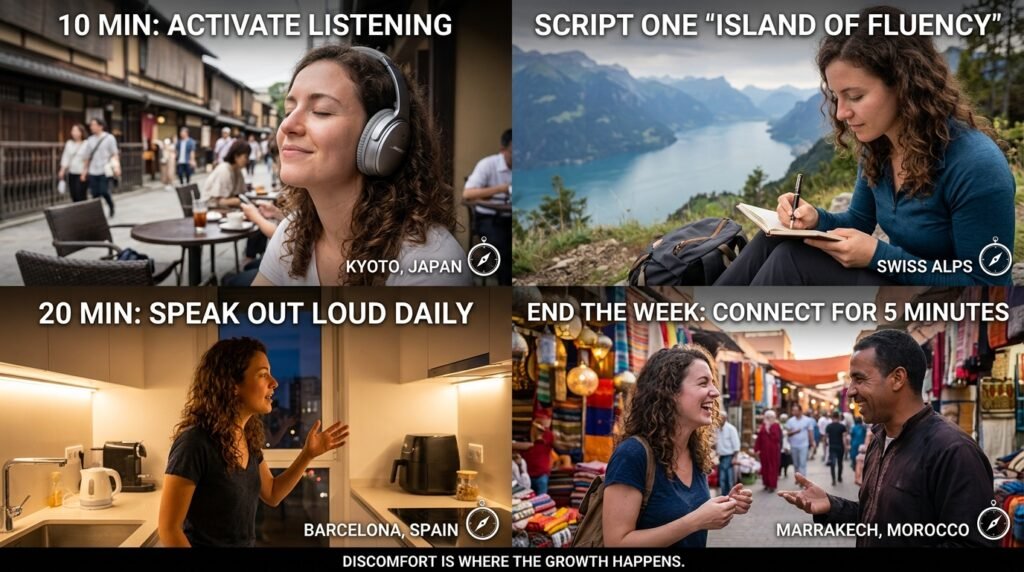
If you are stuck in the “silent” phase, I challenge you to try this for one week.
-
Start your morning with 10 minutes of listening.
-
Script one “Island of Fluency” during your break.
-
Spend 20 minutes in the evening speaking out loud to yourself.
-
Find one person to talk to for 5 minutes by the end of the week.
It will be uncomfortable at first. You will feel silly talking to your kitchen appliances. You will stumble over your words when you finally talk to a real person. But that discomfort is where the growth happens.
Final Thoughts on the Journey
Getting to basic conversations is just the beginning. Once you reach that level, a whole new world opens up. You can start making real friends, watching movies without subtitles, and traveling with a sense of freedom you’ve never felt before.
The routine I followed wasn’t a magic pill. It required consistency and a willingness to be embarrassed. But it was far more effective than any “learn in your sleep” method I had tried before.
Language is a bridge. It connects your world to someone else’s world. Don’t let the fear of making mistakes keep you on your side of the bridge. Walk across it, stumble a few times, and keep moving forward. The view from the other side is absolutely worth the effort.
Stay consistent, keep your “islands” updated, and remember to celebrate the small wins. Every time you say a full sentence and someone understands you, that is a victory. Build on those victories, and soon enough, the “nod and smile” phase will be a distant memory.

Gabriel Henrique is a language enthusiast and productivity writer. After testing countless study methods, he became obsessed with mastering new languages efficiently. He achieves this without burnout, without endless grammar drills, and without losing focus. At Blog The Curious, he shares everything he has learned along the way.