
Learning a language for the first time feels like standing at the base of a massive wall. You look up and see no clear path to the top. You have textbooks, applications, and a vague desire to become fluent. But a desire is not a strategy.
I spent my first few weeks completely unorganized. I would listen to a podcast on Monday. I would ignore the language on Tuesday. I would try to memorize fifty random words on Wednesday. By Sunday, I had forgotten everything. I was putting in effort but seeing absolutely zero return on my investment.
I needed a system. I needed a concrete, repeatable sequence of actions that would guarantee progress.
I stopped consuming random content. I sat down and built a strict curriculum for myself. This plan moved me from complete confusion to holding my first real conversation. It requires discipline, but it removes all the guesswork. Here is the exact blueprint I followed.
Step One: The Calendar Audit and Habit Tracking
You cannot add a massive daily task to your life without removing something else. Your schedule is already full. If you simply tell yourself you will study when you have free time, you will never study. Free time does not exist. You have to manufacture it.
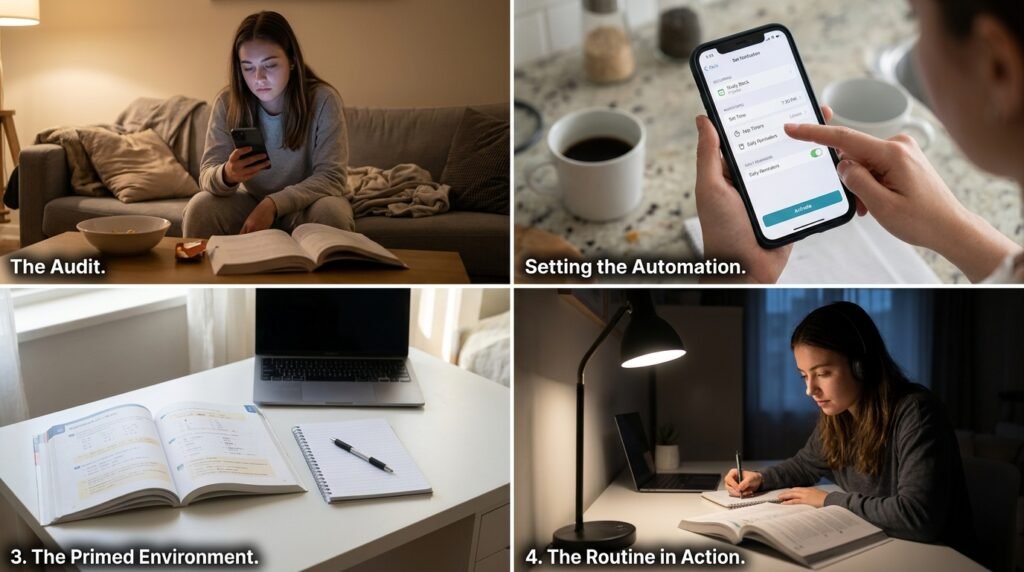
I opened my digital task management app. I use automation and habit tracking heavily to keep my life organized. I knew that relying on human memory to build a study habit would fail. I needed my environment to prompt me automatically.
I audited my week. I tracked exactly how I spent my evenings. I found a massive block of wasted time between dinner and going to bed. I was losing at least an hour to mindless scrolling.
I blocked out thirty minutes every single evening. I set up an automated daily reminder on my phone. At 7:30 PM, my phone locked my social media apps and sent me a single notification to open my language materials.
You must define your study block before you learn a single word. Decide the exact time and the exact location. If you want to see How I Organized My Study Routine When I Didn’t Know Where to Start you must understand that the environment dictates your success. My desk was clean. My materials were open. I eliminated every single decision I had to make before studying.
Step Two: Selecting the Anchor Material
Beginners love to hoard resources. We think buying six different textbooks makes us better students. It actually causes decision fatigue. You waste ten minutes every night deciding which book to read.
I selected one single anchor material.
I chose a highly rated beginner course that included both text and audio. I put every other book in a drawer. I committed to finishing this one resource completely before looking at anything else.
This single constraint changed my entire mindset. I no longer worried about missing out on better methods. I trusted the material in front of me. The anchor material provided the structured progression I lacked. It introduced grammar concepts logically. It built vocabulary progressively.
Your anchor material is your spine. You will add other resources later, but for the first three months, you follow the anchor material religiously. Do not skip chapters. Do not jump ahead. Trust the sequence.
Step Three: Curating Relevant Vocabulary
The anchor material will teach you standard vocabulary. You will learn the words for apple, train, and library. These are necessary, but they are boring. Your brain struggles to remember things it does not care about.
I needed to supplement the standard lessons with words that actually mattered to my daily life.
I am deeply invested in specialty coffee. I spend my weekends testing manual brewing methods and researching international bean origins. I decided to use this interest as a trojan horse for language learning.
I searched for articles about Colombian bean origins written in my target language. I found forums discussing the exact water temperature for a perfect V60 pour over. I did not understand most of the text. But I started pulling out specific vocabulary words.
I learned the words for grind size, boiling water, altitude, and harvest.
This vocabulary stuck immediately. I did not need to review these words fifty times. Because they were directly tied to my physical daily routine, the mental connection was permanent. This targeted approach is What I Changed That Helped Me Remember More Words without relying on painful rote memorization.
Find your anchor interest. If you love fitness, read workout plans in your target language. If you love technology, read software reviews. Extract the vocabulary that you actually want to use.
Step Four: The 30-Minute Daily Execution Block
Having a time slot and materials is only the preparation phase. The execution phase is where the actual acquisition happens.
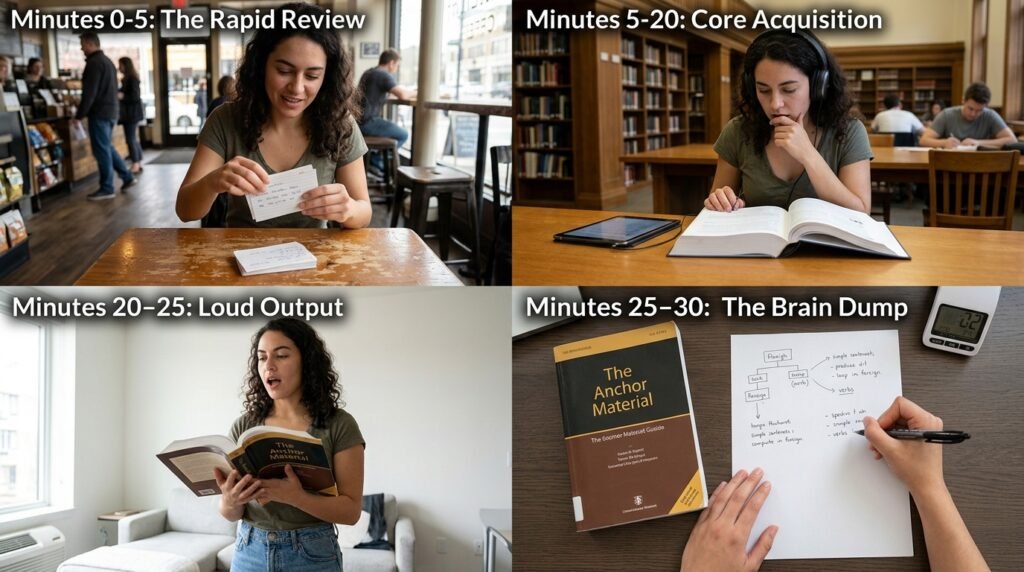
I divided my thirty-minute session into strict micro blocks. I used a timer to enforce the boundaries. When the timer stopped, I moved to the next activity immediately.
Here is my exact breakdown:
Minutes 0 to 5: Review Previous Material I never started with new concepts. I spent the first five minutes reviewing the vocabulary and grammar I learned the day before. This primed my brain. It forced me to actively recall information before loading new data. I used physical flashcards for this rapid review.
Minutes 5 to 20: Core Acquisition This fifteen minute block was dedicated to the anchor material. I read the next chapter. I listened to the accompanying audio. I focused intensely on understanding the new grammar structures. I did not move forward until I fully comprehended the lesson. If a concept took three days to understand, I spent three days on the same page.
Minutes 20 to 25: Loud Output Reading is passive. Speaking is active. For five minutes, I stood up and read the dialogue from the anchor material out loud. I tried to perfectly mimic the audio track. I focused on the rhythm of the sentences. This physical practice trained my facial muscles to produce foreign sounds.
Minutes 25 to 30: The Brain Dump I closed the book. I took a blank piece of paper. I wrote down everything I could remember from the session. I wrote out new verbs. I wrote out simple sentences. This forced recall solidified the information in my short term memory before I closed out the day.
Step Five: Breaking the Grammar Fear
Grammar is the most intimidating part of a new language. Textbooks present grammar as a set of complex mathematical formulas. You look at a table of verb conjugations and feel completely lost.
I changed my relationship with grammar. I stopped viewing it as a list of rules to memorize. I started viewing it as a tool to unlock meaning.
I refused to memorize conjugation tables. Instead, I learned grammar through context. When my anchor material introduced the past tense, I did not write down the rules. I wrote down five sentences about what I did yesterday.
I walked to the store. I drank coffee. I worked on my computer.
I translated those specific sentences into my target language using the new grammar rules. By attaching the abstract rule to a personal reality, the grammar made sense. I could feel how the sentence changed when I talked about the past.
Do not study grammar in isolation. Always attach the rule to a real sentence you would actually say. If you cannot think of a reason to use a specific grammar rule today, do not learn it today. Wait until you actually need it.
Step Six: Integrating Forced Output
You can follow a perfect input schedule for months. But if you never produce the language organically, you will freeze during a real conversation.
I needed a way to force output outside of my structured study block. I needed low stakes practice.
My partner knew I was learning a new language. I asked them to be my sounding board. I started substituting basic English phrases with my target language during our daily routines.
When I made dinner, I announced the ingredients out loud. I asked basic questions. The grammar was terrible. The pronunciation was rough. But I was forming sentences under slight social pressure.
This practice is critical. You must discover The Simple System I Followed to Make Daily Progress by speaking before you feel ready. Do not wait for a perfect moment. Your brain needs the mild stress of real-time communication to forge permanent neural pathways.
If you do not have a partner to practice with, use your phone camera. Record a one minute video of yourself every day. Talk about your plans for tomorrow. Watch the video immediately. You will hear your own mistakes. Correct them the next day.
Step Seven: Engineering Passive Immersion
Thirty minutes of active study is powerful. But you spend sixteen hours a day awake. If you only interact with the language for thirty minutes, progress will be slow.
I engineered my environment to force passive immersion. I looked for dead time in my schedule. Dead time is the morning commute, the time spent folding laundry, or the time spent doing dishes.
I filled this dead time with audio in my target language.
I found a podcast designed for intermediate learners. I listened to it while driving to work. I did not understand every word. I did not try to. I just let the sounds wash over me. I focused on identifying the boundaries between words.
I changed the language on my personal laptop. I navigated my folders and settings using muscle memory and context clues. This forced me to learn technical vocabulary without trying.
Immersion is not about booking a flight to a foreign country. Immersion is a daily choice. You control the media you consume. Replace your local news feed with a foreign news site. Replace your morning music with foreign artists. Flood your ears with the cadence of the language.
Step Eight: The Weekly Progress Audit
When you look at your progress daily, you feel like you are failing. The growth is too microscopic to notice. You will have days where you feel incredibly stupid. You will have days where you forget words you knew perfectly the week before.
I needed a way to measure my actual trajectory.
Every Sunday morning, I conducted a progress audit. I opened my digital journal and spent ten minutes writing about my week. I only used the target language. I did not use a dictionary. I forced myself to communicate with whatever tools I had available in my brain.
During month one, these entries were brutal. They were three sentences long. The grammar was basic.
During month three, I wrote full paragraphs. I was using different verb tenses naturally.
When I felt discouraged on a Wednesday, I would read my journal entry from eight weeks prior. The contrast was always shocking. Seeing undeniable, written proof of my progress killed my imposter syndrome immediately.
You must document your starting line. If you do not track your output, you will convince yourself you are not learning. Keep the journal. Review it when you want to quit.
Step Nine: Escalating the Difficulty
Around the fourth month, my thirty-minute routine became entirely too comfortable. I was cruising through my anchor material. The flashcard reviews were easy.
Comfort is the enemy of acquisition. When the routine feels easy, your brain stops adapting. You hit a plateau.
I intentionally broke my routine to force new growth. I threw away the flashcards. I stopped using the beginner anchor material. I escalated the difficulty across the board.
I started booking weekly sessions with a native tutor online. I demanded that we only speak the target language for thirty minutes. The first session was terrifying. I sweat through my shirt. I stumbled over every sentence.
It was exactly what I needed. The intense pressure forced my brain to work twice as hard.
I also started reading a short novel. I underlined every word I did not know. I looked them up and added them to my active vocabulary list.
You must constantly push the boundary of your competence. The moment you feel safe, you must seek out a harder challenge. Language learning is a continuous process of breaking your own limits.

The Reality of the Step-by-Step Approach
This plan is not a magic trick. It does not promise fluency in thirty days. It is a systematic, mechanical approach to breaking down a massive goal into executable daily steps.
It works because it relies on structure instead of motivation. Motivation will abandon you during the second week. A blocked calendar, a single anchor resource, and automated reminders will keep you moving forward.
Stop researching how to learn. You have the blueprint. Audit your calendar today. Block out thirty minutes. Pick one textbook. Sit at your desk and execute the first block.
The wall looks impossible from the bottom. But if you take one deliberate step every single day, you will eventually reach the top. Stop looking at the height of the wall. Focus entirely on the next step.

Gabriel Henrique is a language enthusiast and productivity writer. After testing countless study methods, he became obsessed with mastering new languages efficiently. He achieves this without burnout, without endless grammar drills, and without losing focus. At Blog The Curious, he shares everything he has learned along the way.