
I used to sit on the commuter train every morning with a heavy textbook on my lap. I spent forty five minutes highlighting grammar rules. I memorized conjugation tables. I filled out blank spaces in practice exercises. I felt incredibly productive. I thought I was building a solid foundation.
Then I stepped off the train and tried to order a simple breakfast pastry in my target language.
The baker asked me a basic question about my order. My mind went completely blank. All the highlighted rules vanished. The conjugation tables dissolved. I stuttered, pointed at the glass case, and used a single vocabulary word. I walked out of the bakery feeling completely defeated. I knew the rules on paper, but I could not use them in real life.
I realized my study routine was completely broken. Reading about grammar does not teach you how to use grammar. Reading about pushups does not make your arms stronger. You actually have to do the physical work.
I changed my entire approach the very next day. I stopped reading the heavy textbook on the train. I started a single, simple daily habit. That one habit completely transformed my understanding of grammar. It made the rules automatic. It removed my fear of speaking.
Here is the exact habit that improved my grammar over time.
The Shift from Input to Output
Most language learners spend ninety percent of their time on input. They read books. They listen to podcasts. They watch videos. They study rules. Input is incredibly important. You need input to learn new words.
But input is completely passive. You do not have to create anything. You just have to recognize things.
Grammar is an active skill. Grammar is the structural glue you use to connect your own thoughts. You cannot practice gluing things together by watching someone else do it. You have to pick up the glue yourself. You have to switch your focus from passive input to active output.
I decided I needed to force myself to produce language every single day. I did not have anyone to talk to on the train. I was too intimidated to talk to strangers. I needed a safe way to practice output. I decided to start writing.

The Five Minute Pocket Journal
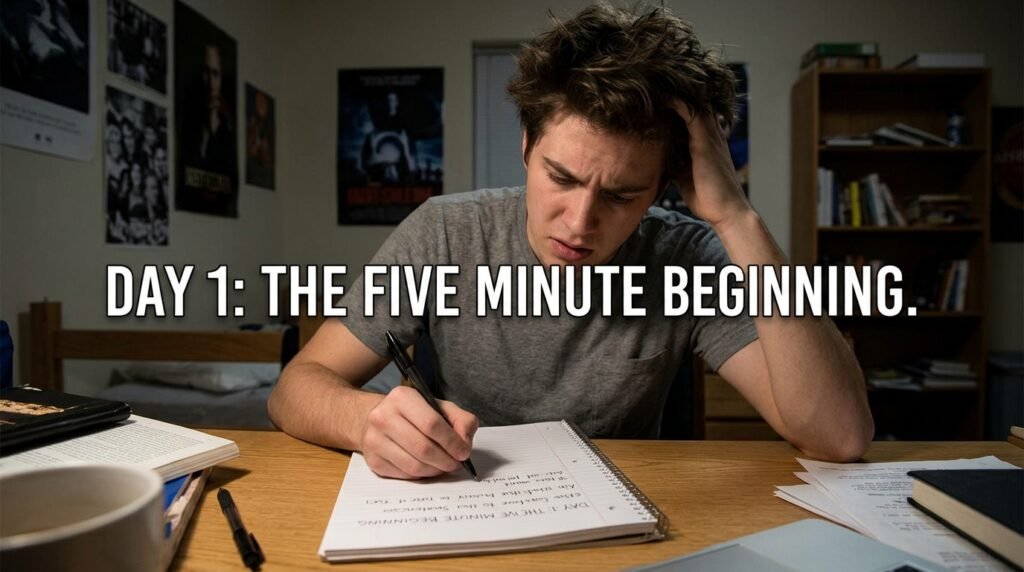
I bought a cheap, small paper notebook. I kept it in my jacket pocket. I brought it with me on the train every morning.
I made a strict rule for myself. I had to write in the notebook for exactly five minutes every single day. I could not write for less than five minutes. I was not allowed to write for more than five minutes. I kept the barrier to entry extremely low.
I did not write essays. I did not write creative fiction stories. I wrote completely mundane, boring facts about my daily life. I wrote about what I ate for dinner the night before. I wrote about the weather outside the train window. I wrote about my plans for the weekend.
At first, this was incredibly painful. Writing a single sentence took a massive amount of mental effort. I had to consciously think about every single word order. I had to slowly calculate every verb ending. The first few pages of my notebook were filled with terrible, clunky sentences.
I embraced the terrible sentences. I knew that producing bad output was the mandatory first step toward producing good output.
Banning the Dictionary
I quickly realized I had a toxic habit. Whenever I tried to write a sentence and did not know a specific word, I immediately reached for my phone. I opened a translation app. I looked up the exact word I needed.
This ruined the entire exercise. The translation app was acting as a crutch. It prevented my brain from doing the actual heavy lifting.
I created a new, unbreakable rule. I completely banned the dictionary during my five minute writing session.
If I wanted to write about a “microwave” but did not know the word, I could not look it up. I had to find a completely different way to express the idea using the limited vocabulary I already possessed. I had to write “the box that makes food hot.”
This forced circumlocution is the exact skill you need in a real conversation. When you speak to a native speaker, you do not have time to check a dictionary. You have to talk around the missing words. Banning the dictionary during my writing sessions trained my brain to become highly flexible. It forced me to rely on the grammar structures I actually knew instead of hunting for perfect vocabulary words.
The Rule of Uncorrected Flow
Schools teach us that grammar must be perfect. If you make a mistake on a test, you get a red mark. This creates a deep psychological fear of failure. This fear causes hesitation. Hesitation destroys fluency.
I had to completely kill my internal perfectionist.
I forced myself to write without stopping. If I was unsure about a past tense conjugation, I just guessed. I wrote down the first thing that came to my mind and immediately moved on to the next word. I absolutely refused to stop and overthink the grammar.
My only goal was to keep the pen moving across the paper for five solid minutes. I prioritized the forward flow of my thoughts over technical accuracy.
This taught my brain a crucial lesson. It taught my brain that communication is still entirely possible even with broken grammar. The message still gets on the paper. The world does not end when you use the wrong preposition. Releasing that heavy pressure was the most liberating moment of my entire language journey. I wrote heavily about this exact mental shift in How I Turned Small Daily Practice Into Real Progress because consistency always beats perfection.
The Power of Delayed Review
Writing terrible sentences is only the first half of the habit. The second half is where the actual grammar improvement happens.
I did not correct my writing immediately. If you correct yourself right after you write, you are still too attached to the thoughts. You are still in output mode. You need to switch to analytical mode.
I waited exactly one week before reviewing my old journal entries.
Every Sunday afternoon, I sat down at my desk. I opened my pocket notebook. I turned to the entry I wrote on the previous Monday. I read the text out loud to myself.
Because a full week had passed, the text felt foreign. It felt like someone else had written it. This distance allowed me to spot my own mistakes instantly.
I read a sentence and immediately realized the verb tense was completely wrong. I noticed I used the wrong gender for a common noun. My brain caught the errors naturally because my passive understanding of the rules was always slightly better than my active ability to produce them.

Becoming Your Own Teacher
Spotting your own mistakes is infinitely more powerful than having a teacher point them out.
When a teacher corrects you, the correction is external. You passively accept it. You usually forget it within ten minutes.
When you spot your own mistake, the correction is internal. You experience a tiny moment of realization. You actively fix the problem yourself. This active engagement burns the correct grammar rule into your long term memory.
I took a red pen and gently corrected the mistakes I found in my old entries. I did not judge myself. I treated the errors as highly valuable data points. They showed me exactly where my current boundaries were.
If I noticed I was consistently messing up the future tense all week, I finally knew what to study. I did not waste time reading the entire grammar textbook. I just opened the book, reviewed the specific chapter on the future tense, and closed it. I only studied the exact tools I needed to fix my own personal errors.
Building Physical Muscle Memory
Grammar is not just a mental exercise. It is a physical habit.
When you write by hand, you are engaging your fine motor skills. You are forcing your brain to send highly specific physical signals to your fingers. This physical act of writing builds deep neural pathways.
Typing on a phone does not have the same effect. Autocorrect fixes your mistakes automatically. You do not have to think about the spelling or the structure.
Writing with a pen forces you to own every single letter. It forces you to construct the entire sentence from scratch. This builds incredible muscle memory.
After a few months of daily writing, I noticed a massive change. Certain grammatical structures started to feel physically correct. My hand automatically wrote the correct verb endings without my brain having to calculate the rule. The grammar bypassed my conscious thought and became an automatic physical reflex.
Transferring the Habit to Speech
The ultimate goal of learning grammar is to speak fluently. Writing is simply the training ground for speaking.
Writing gives you the luxury of time. You can slow down the massive chaos of a real conversation. You can practice assembling thoughts in a safe, quiet environment.
Once you build that structural foundation on paper, it transfers directly to your mouth.
I started noticing this transfer during my interactions at the local bakery. The cashier asked me a question. Instead of freezing, I answered immediately. I used a complex sentence structure effortlessly.
I realized I had written that exact same sentence structure in my pocket journal three days earlier. I had already done the hard work of building the sentence on paper. My mouth simply pulled the prebuilt sentence out of my memory and delivered it.
You build the tools in the quiet of your journal. You deploy the tools in the noise of the real world. I outline this specific physical transition in The Habit That Made Speaking Feel Easier to help you connect your writing practice directly to your vocal cords.
Avoiding the Blank Page Syndrome
The hardest part of this habit is staring at a blank page. Some mornings, you are tired. You have no interesting thoughts. You do not know what to write about.
You must completely eliminate the friction of starting.
I created a simple list of writing prompts on the first page of my notebook. I used these prompts whenever I felt stuck.
Describe the clothes you are wearing right now. Explain exactly how to cook your favorite meal. Describe the personality of your best friend. Argue for or against a controversial topic.
These prompts forced me to use different grammar tools. Describing a meal forces you to use imperative verbs. Arguing a topic forces you to use conditional tenses.
By rotating through different topics, I ensured I was practicing the entire spectrum of the language. I never allowed myself to use writer’s block as an excuse to skip my five minutes of practice.
Embracing the Plateau
When you start a new daily habit, you see massive progress very quickly. You go from zero output to daily output. The improvement is highly visible.
Eventually, you will hit a plateau. You will feel like your grammar is no longer improving. You will feel like you are writing the exact same basic sentences every single day.
This is a dangerous moment. This is when most people quit.
You have to understand that plateaus are a completely normal part of the learning curve. Your brain is consolidating the information. It is resting before the next big jump in ability.
When I hit a plateau, I did not quit. I just slightly increased the difficulty of my daily habit. I forced myself to use one brand new vocabulary word in my journal entry. I forced myself to use one advanced grammar structure I had recently heard on a podcast.
I deliberately pushed myself out of my comfort zone. I made the writing painful again. If you feel stuck in this exact phase, you can apply the tactics from The Strategy I Used to Avoid Getting Stuck as a Beginner to immediately restart your daily momentum.
The Compound Interest of Daily Action
Five minutes of writing sounds entirely insignificant. You might think it is not enough time to actually learn anything.
You must look at the math. Five minutes a day is roughly thirty hours of highly focused, active language output over the course of a single year.
Thirty hours of intense output is infinitely more valuable than a hundred hours of passive reading. It completely rewires your brain.
The small daily actions compound heavily over time. You write three clunky sentences today. You write four slightly better sentences tomorrow. Next month, you are writing full paragraphs without stopping. Next year, you are holding completely natural conversations with native speakers without thinking about the rules at all.
You cannot rush this process. You cannot cram for fluency. You simply have to put in the five minutes of daily work and trust the compound interest to do its job.
Stop Studying and Start Creating
Grammar rules are completely useless if they stay trapped inside a textbook. They only hold value when you use them to share your own thoughts with the world.
Stop treating the language like an academic subject you have to memorize. Start treating it like a physical tool you have to handle every single day.
Go to the store today and buy a cheap pocket notebook. Put it in your jacket. Tomorrow morning, set a timer on your phone for exactly five minutes.
Write down exactly what you see. Write down exactly what you feel. Do not stop to look up words. Do not erase your mistakes. Do not judge your own output. Just keep the pen moving until the timer goes off.
Repeat this simple action every single day. Review your old entries once a week. Correct your own mistakes gently. Watch as the massive brick wall of grammar slowly crumbles into a set of highly useful, automatic daily reflexes.

Gabriel Henrique is a language enthusiast and productivity writer. After testing countless study methods, he became obsessed with mastering new languages efficiently. He achieves this without burnout, without endless grammar drills, and without losing focus. At Blog The Curious, he shares everything he has learned along the way.