
I studied my target language for two entire years. I possessed a massive vocabulary. I understood the complex grammar rules perfectly. I could read thick books and write long emails without using a dictionary. I felt incredibly confident in my academic knowledge.
Then I recorded myself speaking during a language exchange call. I played the audio back the next morning. I was completely horrified.
I sounded absolutely nothing like a native speaker. I sounded like a robotic machine. My sentences were rigid and blocky. I pronounced every single letter with brutal, unnatural precision. I sounded exactly like a talking textbook. Native speakers easily understood me, but they always switched back to English after five minutes. They felt the heavy, uncomfortable friction in my voice.
I realized my academic approach was completely wrong. Perfect grammar does not make you sound native. Natural human speech is messy. It is inherently lazy. It is full of specific cultural shortcuts. I completely stopped trying to speak perfectly. I changed my entire physical and mental approach. Here is exactly what I focused on to sound more like a native speaker.
The Facial Geometry of the Language
I spend hours editing digital portraits. I focus heavily on preserving the exact facial geometry of the subject. A tiny millimeter of change in the jawline alters the entire identity of the person in the photograph. I realized I needed to apply this exact visual obsession to my spoken language.
An accent is simply facial geometry in motion. Your native English mouth has a specific structural shape. It is incredibly lazy and relaxed. Your jaw hangs low. Your lips barely move. To sound native, you must physically rebuild the structural geometry of your mouth.
I stood directly in front of my bathroom mirror. I pulled up close up videos of native speakers. I completely ignored the vocabulary words they were saying. I only watched their physical faces. I noticed they held massive tension in their upper lips. I noticed they pushed their jaws forward.
I physically copied those exact shapes. I forced my mouth to adopt their specific resting posture. I treated my mouth like a mechanical instrument that needed total recalibration. I completely shifted my perspective when I realized What I Focused On Instead of Memorizing Rules was the physical behavior of the language itself.
When you change the physical container, the sound coming out of it naturally changes. My accent immediately became sharper and significantly more authentic.

Mastering the Cultural Hesitation
Every human being hesitates when they speak. You forget a word. You lose your train of thought. You need a second to calculate your next sentence.
In English, we fill that dead silence with very specific sounds. We say “um” or “uh.” We drag out the word “like.” These sounds are deeply hardwired into our brains.
When you use an English hesitation sound in the middle of a foreign sentence, you instantly destroy the illusion of fluency. The native speaker hears that heavy “um” and immediately knows you are a foreigner. It completely breaks the cultural spell.
I made a strict project out of native hesitation. I listened to hours of unscripted native podcasts. I listened strictly for the exact noises the hosts made when they were confused or thinking. Every culture has its own unique filler noises. Some cultures click their tongues. Some cultures make a low buzzing sound in their throat. Some cultures use a specific drawn out vowel.
I memorized those exact native noises. I practiced making them alone in my room. When I forgot a word during a real conversation, I stopped using English filler. I deployed the native hesitation sound instead. This tiny detail makes a massive psychological difference. It signals to the listener that you fully belong in their cultural environment.
Erasing the Invisible Spaces
Language textbooks teach you a dangerous lie. They print words with clear, empty white spaces between them. They train your brain to view a sentence as a collection of isolated, separate blocks.
Native speakers completely erase those spaces. They smash the words together into one continuous, fluid stream of noise. The end of the first word blends perfectly into the beginning of the second word.
I was pronouncing every single word separately. I put a microscopic pause between every vocabulary item. It gave my speech a heavy, blocky, robotic rhythm.
I had to learn how to connect my speech. I took a printed transcript of a native interview. I took a red pen. I drew physical lines connecting the final consonant of one word to the starting vowel of the next word. I visually erased the blank spaces on the paper.
Then I read the transcript out loud. I forced my mouth to glide over the connections. I refused to stop my breath between the words. I slurred the syllables together on purpose. Adopting this native laziness completely removed my robotic stiffness. The words finally began to flow naturally.
Flattening the Musical Pitch
Language is deeply musical. It has a specific pitch, a specific tone, and a specific rhythm.
English has a highly aggressive, bouncing melody. We jump up and down in pitch to emphasize important words. We punch certain syllables heavily and completely swallow others. We use high pitch to show excitement and low pitch to show anger.
Many other languages are entirely different. Some languages operate on a completely flat, steady rhythm. Every single syllable receives the exact same amount of time and physical energy. The pitch stays completely level until the very end of the sentence.
I was constantly applying my bouncing English melody to my foreign vocabulary. My words were correct, but my music was completely wrong. I sounded chaotic and erratic to the native speakers.
I started doing pure melody drills. I listened to native audio and completely ignored the meaning of the words. I just hummed along with the speaker. I matched the exact rising and falling pitch of their voice using only my vocal cords. I flattened out my aggressive English rhythm. I forced myself to speak like a steady, continuous metronome. Changing the music is often much more important than pronouncing the consonants perfectly.
Stealing Authentic Reactions
A conversation is a two way street. You spend half of the time listening to the other person talk. How you react while they are talking heavily defines how natural you sound.
Beginners usually rely on incredibly boring, repetitive reactions. They just nod their heads and say “yes” or “okay” over and over again. It makes you sound like a passive, uninteresting brick wall.
Native speakers have dozens of dynamic ways to agree, disagree, or show surprise. They use specific local phrases. They say things like “no way,” “that is crazy,” or “absolutely.”
I started aggressively collecting these reactions. You must abandon your textbook and study How I Learned Common Phrases That Native Speakers Actually Use to build a massive library of casual reactions.
I watched native talk shows and wrote down exactly how the hosts reacted to shocking stories. I memorized five distinct, punchy responses. The next time a native speaker told me a story, I stopped saying a flat “yes.” I dropped a perfectly timed, authentic cultural reaction. The native speaker’s eyes immediately lit up. Using their specific local slang proves you are not just studying their language, you are studying their actual culture.

Dropping the Polite Filter
Language classes are designed to be extremely polite. They teach you highly formal greetings. They teach you to use the most respectful verb conjugations. They teach you how to speak to a judge in a courtroom.
This extreme formality is entirely useless in a casual setting. If you speak to a native speaker at a local bar using courtroom grammar, you will make them feel incredibly uncomfortable. Formal language creates a massive invisible wall between two people.
I had to actively unlearn my polite habits. I had to learn how to be completely casual.
I started studying the informal verb conjugations. I learned the relaxed street greetings. I paid close attention to how close friends actually spoke to each other in casual environments. I dropped the stiff, academic vocabulary completely.
Switching to casual language removes the heavy academic feeling. It makes you immediately approachable. It signals to the native speaker that they can relax and treat you like a normal friend instead of a foreign diplomat.
Lowering the Vocal Resonance
Your accent is heavily influenced by exactly where your voice physically originates in your body.
When beginners speak a foreign language, they get very nervous. They take shallow breaths into the top of their chest. They speak entirely from their throat and their nasal cavity. This physical tension makes the voice sound thin, weak, and highly unnatural.
Native speakers are completely relaxed in their own language. They breathe deeply into their stomachs. They speak from deep within their chest cavity. Their voices carry a heavy, rich resonance.
I had to consciously retrain my breathing habits. Before I spoke a sentence, I took a massive column of air entirely into my diaphragm. I used that deep air pressure to push the words out strongly. I documented these exact mechanical adjustments in The Small Changes That Improved My Accent to help you permanently fix your resting facial posture.
When you lower your vocal resonance into your chest, you project massive confidence. The deep vibration actually hides many of your minor pronunciation mistakes. Native speakers subconsciously hear that deep, relaxed tone and automatically assume your fluency level is much higher than it actually is.
Adopting the Physical Body Language
Language is a full body experience. You do not just speak with your vocal cords. You speak with your hands. You speak with your eyebrows. You speak with the physical distance you keep between yourself and the other person.
Every single culture has a completely different set of physical rules. In some cultures, wide hand gestures are mandatory. In other cultures, keeping your hands completely still is a sign of deep respect.
I noticed I was speaking my target language while using my rigid, reserved native body language. The physical stiffness completely clashed with the foreign words coming out of my mouth. I looked like a badly dubbed movie.
I started studying native body language exactly like I studied grammar. I watched how people moved their hands when they were angry. I watched how they tilted their heads when they asked a question.
I started mimicking those exact physical movements. When I used a specific foreign phrase, I forced myself to use the exact hand gesture that accompanied it naturally. This physical integration makes a massive psychological difference. When your body perfectly matches your words, the native speaker instantly accepts you as one of their own.
The Power of Cultural Idioms
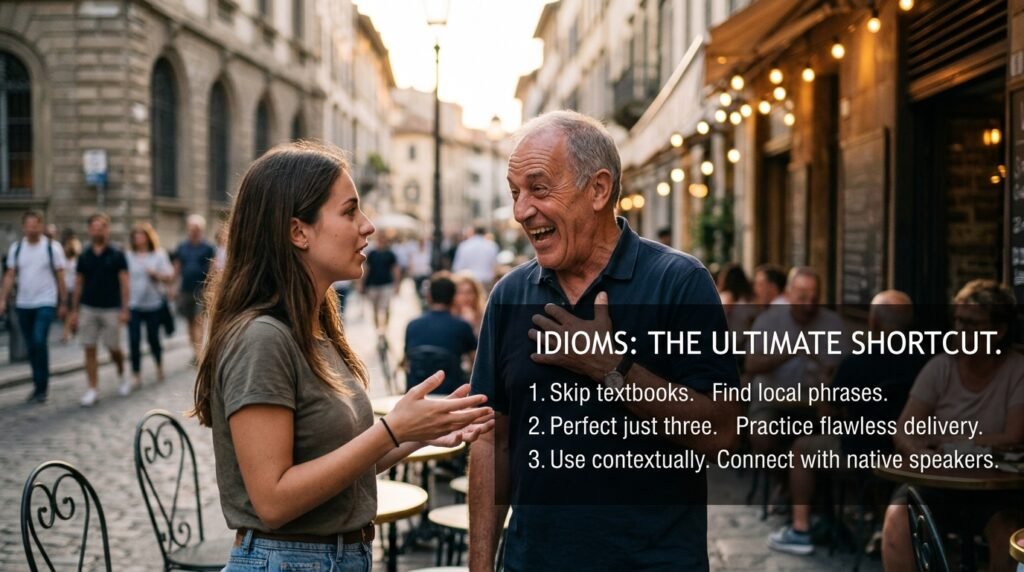
Idioms are the ultimate cheat code for sounding like a native speaker.
An idiom is a strange phrase that makes absolutely zero logical sense when you translate it directly. Every language is completely packed with these bizarre expressions. They are deeply tied to the history and the shared humor of the country.
Textbooks rarely teach idioms because they are too messy. You have to hunt for them in the real world.
I collected a small arsenal of local idioms. I did not memorize hundreds of them. I picked exactly three highly common idioms that fit my personal speaking style perfectly. I practiced them until my delivery was completely flawless.
I waited for the perfect contextual moment in a live conversation to drop one of these idioms. The reaction is always explosive. Native speakers smile widely. They laugh loudly. Using a local idiom correctly is the ultimate proof that you truly understand the soul of the language. It instantly elevates you from a standard student to an integrated speaker.
Forgiving the Daily Chaos
The final barrier to sounding native is your own obsession with technical perfection.
When you constantly monitor yourself for grammar errors, you destroy the natural rhythm of human speech. You stutter. You stop mid sentence to correct a minor verb ending. You sacrifice the fluid flow of the conversation just to fix an irrelevant detail.
Native speakers make terrible grammar mistakes every single day. They use the wrong word. They lose their entire train of thought. They trip over their own tongues constantly. But they do not stop the conversation to apologize for their grammar. They just laugh and keep moving forward.
I made a strict behavioral rule for myself. I completely banned all self correction during casual chats.
If I used the wrong gender for a noun, I completely ignored it. If I mangled a past tense verb, I pushed right through the mistake. I prioritized the forward momentum of the story over strict technical accuracy.
This was incredibly difficult for my ego at first. But the results were absolutely undeniable. By ignoring my small mistakes, I maintained the natural, fluid rhythm of the language. I sounded infinitely more fluent. The native speakers rarely even noticed my tiny grammatical errors because they were too busy listening to the actual story I was telling.
Sounding native is not a genetic gift. It is a highly deliberate collection of mechanical habits. You have to rebuild the geometry of your mouth. You have to steal the local hesitation sounds. You have to flatten your pitch, drop your vocal resonance, and adopt the physical body language of the culture. Put your heavy textbooks back on the shelf. Start watching real people. Copy their exact messy, lazy, brilliant habits. Your robotic accent will disappear entirely, and your true voice will finally emerge.

Gabriel Henrique is a language enthusiast and productivity writer. After testing countless study methods, he became obsessed with mastering new languages efficiently. He achieves this without burnout, without endless grammar drills, and without losing focus. At Blog The Curious, he shares everything he has learned along the way.