
I stared at the thick textbook on my desk and felt a headache starting. The page was filled with charts. There were columns for pronouns. There were rows for verb tenses. There were terms like past participle, subjunctive mood, and intransitive verbs. I was trying to learn how to speak a new language, but I felt like I was studying for an advanced linguistics degree.
I tried to memorize the rules. I wrote them down on flashcards. I passed the written quizzes at the end of the chapter. But the moment I closed the book and tried to have a real conversation, my brain froze completely.
If someone asked me a simple question, I panicked. I tried to apply the formulas. I thought about the subject. I searched my memory for the correct verb ending. I worried about the word order. By the time I constructed a grammatically perfect sentence in my head, the other person had already walked away.
Grammar was not helping me communicate. It was holding me hostage. I realized I was approaching the entire concept backward. I threw the textbook in a drawer and decided to try something entirely different. Here is the exact method I used to master grammar naturally without ever feeling confused again.
The Flaw in the Traditional Method
Schools teach language the wrong way. They treat language like a mathematics problem. They give you a formula. They tell you to plug the vocabulary words into the formula to get a correct sentence.
This works perfectly on a written test. You have plenty of time to sit, think, and calculate the right answer. But human conversation does not happen on paper. Conversation happens in real time. It is fast, messy, and unpredictable. You do not have ten seconds to calculate a verb conjugation. You have milliseconds.
When you rely on memorized rules, you build a massive translation delay into your brain. You are doing too much heavy lifting. You are thinking about the language instead of communicating in the language.
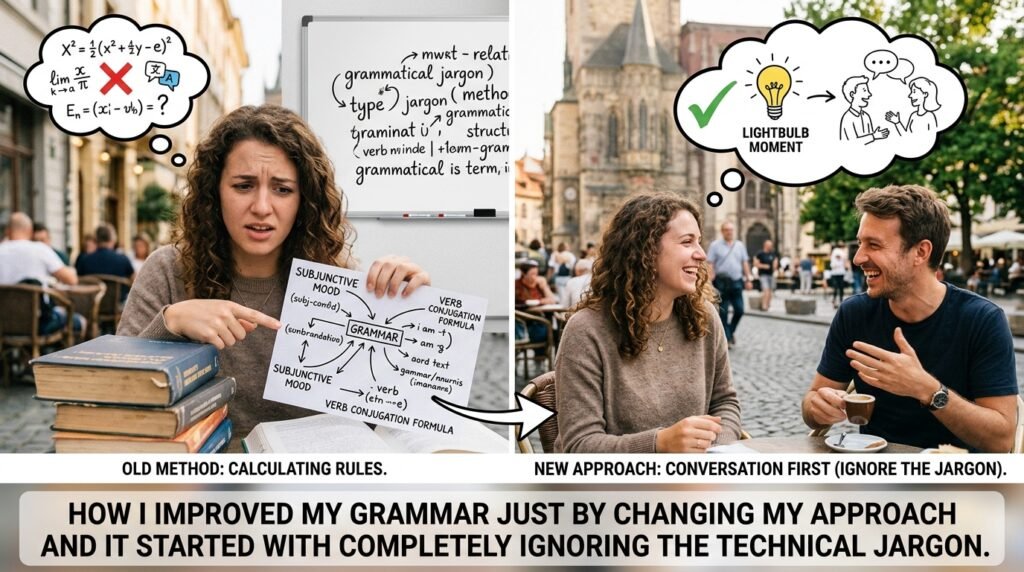
I needed to stop calculating. I had to learn How I Improved My Grammar Just by Changing My Approach and it started with completely ignoring the technical jargon.
Ditching the Linguistic Jargon
The first major shift was deleting grammar terminology from my brain. I decided I did not need to know what a prepositional phrase was. I did not need to know the definition of the imperfect tense.
Native speakers do not know these terms. If you walk up to a native English speaker on the street and ask them to explain the past perfect continuous tense, they will look at you blankly. They cannot explain the rule. But they use the rule flawlessly every single day.
They know how to use it because it simply sounds right to them. They rely on instinct, not terminology.
I stopped studying the names of the rules. I stopped caring about the labels. I shifted all my focus to the function of the words. I wanted to know how a specific word changed the meaning of a sentence. I did not care what category a textbook put it in. This single decision cleared massive amounts of mental clutter.
The Power of Pattern Recognition
The human brain is the most powerful pattern recognition machine on the planet. It is designed to find order in chaos. You do not need to spoon feed it strict rules. You just need to feed it enough raw data.
Think about how children learn their first language. Nobody sits a three year old down and explains verb conjugation. The child simply listens to their parents. They hear the same sentence structures repeated thousands of times. Eventually, their brain connects the dots. They recognize the pattern. They start using the grammar correctly without ever taking a lesson.
I decided to treat my brain the same way. I stopped trying to force the rules in from the outside. I decided to let the rules grow from the inside.
I needed massive amounts of input. I needed to flood my ears and my eyes with correct grammar. The goal was to train my brain to recognize the patterns subconsciously.
Reading for Structure, Not Just Vocabulary
Reading is the ultimate tool for absorbing grammar. When you read, you see perfectly constructed sentences in their natural environment.
I started reading books, news articles, and blogs in my target language. I did not read challenging literature. I read simple, engaging content. I read things I actually cared about.
I changed the way I looked at the text. I was not just reading for the plot. I was observing the architecture of the language.
When I saw a complex sentence, I did not pull out a grammar book to dissect it. I simply noticed it. I noticed that a specific preposition always followed a specific verb. I noticed how the word order shifted when the author asked a question. I let the structure wash over me.
Over time, this exposure builds an internal compass. You start to develop a feeling for the language. You discover The Trick That Helped Me Use Grammar Without Thinking is simply trusting that internal feeling. When you hear a grammatically incorrect sentence, it physically sounds wrong to your ears, even if you cannot explain why.
Learning in Chunks
The biggest mistake you can make is trying to build sentences word by word. If you take a noun, add a verb, and staple an adjective to the end, you are going to make mistakes.
Native speakers do not build sentences from scratch. They use prefabricated blocks of language. Linguists call these lexical chunks.
A chunk is a group of words that are frequently used together. Phrases like “in the morning,” “how are you,” or “I would like to” are chunks.
The brilliant thing about learning chunks is that the grammar is already baked into them. The rule is perfectly preserved inside the phrase. You do not have to think about the word order. You do not have to worry about the verb tense. You just memorize the whole piece and deploy it when you need it.
I stopped putting individual words on my flashcards. I only learned full phrases. If I wanted to learn how to express a past action, I did not memorize a conjugation table. I memorized a complete, useful sentence like “I went to the store yesterday.”
When I needed to talk about going somewhere, I just swapped out the word “store” for “park” or “office.” The grammatical structure remained perfectly intact. I was speaking correctly without doing any mental math.

Shadowing to Build Muscle Memory
Grammar is not just a mental exercise. It is a physical habit. Your mouth needs to learn how to produce the correct structures automatically.
I used a technique called shadowing to build this physical memory.
I would find a podcast or an audiobook in my target language. I would listen to a short audio clip from a native speaker. Then, I would play the clip again and speak out loud at the exact same time. I acted as their shadow.
I tried to mimic their speed, their rhythm, and their intonation perfectly.
This forces your mouth to form grammatically correct sentences at full speed. You do not have time to overthink. You just have to move your tongue and lips. This repetitive physical action burns the grammar rules into your muscle memory. When you are in a real conversation later, your mouth remembers the shape of the correct sentence and delivers it smoothly.
The 80/20 Rule of Grammar
Not all grammar rules are created equal. Some rules are used in every single conversation. Other rules are only used in formal writing or classic literature.
I applied the 80/20 rule to my learning. I wanted to find the twenty percent of the grammar that would give me eighty percent of my conversational fluency.
I focused entirely on the absolute basics.
-
I learned how to make a statement in the present tense.
-
I learned how to ask a question.
-
I learned how to talk about the past.
-
I learned how to talk about the future.
I completely ignored the rare tenses. I ignored the weird exceptions. I ignored the complex conditional structures.
If I needed to express a complex idea, I just used the basic tools I already had. You can communicate almost anything using simple present, past, and future tenses. It might not sound poetic. It might not win a literary award. But it gets the job done. It transfers your idea to the other person clearly and effectively.
Embracing the Messy Middle
The fear of making a grammar mistake is the main reason people never become fluent. They stay silent because they want to be perfect.
Silence is the enemy of progress. You cannot learn to walk without falling down. You cannot learn a language without butchering the grammar.
I had to drop my ego. I gave myself permission to sound foolish. I walked into conversations knowing I was going to use the wrong verb endings. I knew I was going to mix up the word order.
I focused entirely on communication. If the other person understood what I meant, I counted it as a massive victory.
Native speakers are incredibly forgiving. They do not carry red pens in their pockets. They do not grade your conversation. They just want to connect with you. If you make a mistake, they will usually understand from the context. Often, they will gently repeat the sentence back to you with the correct grammar. This real time feedback is invaluable.
Treating Grammar as a Troubleshooting Tool
I did not abandon grammar books completely. I just changed how I used them.
A grammar book is not a novel. You should not read it from cover to cover. A grammar book is a repair manual. You only open it when something is broken.
When I was speaking or writing and I repeatedly hit a wall, I would consult the manual. If I noticed I kept failing to express a specific idea, I would go look up the rule.
Because I already had the context, the rule finally made sense. I was not reading an abstract theory. I was looking for a solution to a real problem I had experienced. I would read the explanation, figure out what I was doing wrong, and immediately apply the fix to my daily practice.
This targeted approach prevents confusion. You only absorb the rules you actually need at that exact moment in your journey.

The Tipping Point
There is no magic pill for learning a language. It takes time, patience, and massive amounts of exposure. But if you stop forcing the rules and start focusing on the patterns, the process becomes incredibly enjoyable.
You stop feeling like a frustrated student. You start feeling like an explorer.
You read more. You listen more. You speak more freely. You let the language wash over you until the structures become second nature.
I vividly recall The Moment Grammar Finally Clicked for Me during a casual dinner with friends. I told a long, complicated story about my travels. I talked for five straight minutes. I used different tenses. I asked questions. I made jokes.
When I finished the story, I realized something incredible. I had not thought about grammar once.
I did not translate anything in my head. I did not calculate any verb endings. I just opened my mouth, and the words flowed out in the correct order. The language had finally moved from my conscious brain to my subconscious instinct.
That is the ultimate goal. You do not want to know the grammar. You want to feel the grammar.
Put down the heavy textbooks. Stop worrying about the subjunctive mood. Start reading things you enjoy. Start listening to real conversations. Learn useful chunks of language. Speak loudly, make a hundred mistakes, and trust your brain to find the patterns. The confusion will fade, and true fluency will finally take its place.

Gabriel Henrique is a language enthusiast and productivity writer. After testing countless study methods, he became obsessed with mastering new languages efficiently. He achieves this without burnout, without endless grammar drills, and without losing focus. At Blog The Curious, he shares everything he has learned along the way.