
I used to look at grammar like a massive brick wall. I thought it was an impossible obstacle. I assumed you needed a naturally gifted memory to master it. I bought heavy textbooks. I downloaded highly rated flashcard apps. I stared at conjugation charts until my eyes burned. I genuinely believed that fluency required suffering through these tedious exercises.
I was completely wrong.
Grammar is not a brick wall. It is not a complex mathematical equation. It is simply a collection of repetitive habits. Once I finally realized this, the entire language opened up for me. The difficulty completely vanished. I stopped fighting the rules. I started absorbing them.
The process became highly intuitive. I stopped feeling frustrated. I actually started enjoying the mechanics of the language. Here is exactly what made grammar much easier than I ever expected.
The Illusion of Academic Complexity
The language learning industry profits heavily from complexity. They sell you thick books filled with terrifying terminology. They use words like pluperfect, subjunctive, and accusative. These words are incredibly intimidating. They make the language feel like an advanced university science course.
You do not need to know these academic words. Native speakers do not know these words. If you stop a random person on the street and ask them to define the past progressive tense, they will look at you with total confusion. Yet, they use that exact tense flawlessly every single day of their lives.
I stopped worrying about the academic names for the rules. I stopped trying to categorize every single sentence I read. I stopped playing the role of a professional linguist. I simply focused on the core meaning of the words. When you strip away the heavy academic terminology, the actual concepts are usually very simple. You are just indicating time, direction, or ownership. The heavy grammar books make these simple concepts look infinitely harder than they actually are. Removing the jargon was my first major step toward fluency.

Mastering the High Frequency Patterns
Languages are absolutely massive. They contain thousands of strange rules and endless regional variations. But you do not use most of them in daily life.
I realized that daily human communication relies on a very small set of core patterns. You use the exact same ten or fifteen sentence structures for the vast majority of your life. You state your personal opinion. You talk about what you did yesterday. You ask a friend for a favor. You talk about your plans for tomorrow morning.
I stopped trying to learn the entire language at once. I completely ignored the advanced grammar chapters at the back of the massive workbook. I put all my daily energy into mastering the basic, high frequency patterns. I realized that mastering the basics first was the only way forward. I explain this fully in The Strategy That Helped Me Build Strong Foundations because it completely changed my focus.
When you strictly master the core patterns, you can handle almost any daily conversation. The advanced rules can wait. You do not need them to survive your first year of speaking.
The Lego Block System
I used to try to build every single sentence completely from scratch. I would pick a subject pronoun. I would search my brain for the right vocabulary verb. I would try to calculate the correct past tense ending. I would look for the right preposition to glue it all together.
This takes way too much mental processing power. It makes you speak incredibly slowly. It causes massive, daily frustration.
I changed my perspective entirely. I started looking at grammar like a simple box of Lego blocks. You do not need to mold the plastic yourself. You just take preassembled blocks and snap them together.
I started memorizing full, complete phrases instead of isolated vocabulary words. I memorized the exact phrase for asking a polite question. I treated it like a single, solid block of sound. I did not analyze why it was constructed that specific way. I just accepted it as a permanent structure.
When I needed to speak, I just grabbed that block and snapped a new vocabulary word onto the end of it. The complex grammar was already perfectly baked into the block. I bypassed the slow calculation process entirely. This simple shift made speaking feel completely effortless and highly natural.
Ignoring the Irregular Exceptions
Every single grammar rule has exceptions. Textbooks absolutely love exceptions. They dedicate entire chapters to irregular verbs. They force you to memorize strange spellings that you will rarely ever encounter in the real world.
This is a massive mental trap. Memorizing exceptions destroys your daily momentum. It makes you feel like you are constantly failing a test.
I decided to completely ignore the exceptions during my first full year of learning. If a verb was irregular, I did not care at all. I applied the standard rule to it anyway. I spoke with incorrect grammar on purpose.
The results were totally fine. Native speakers always understood me. The context of the conversation made my meaning perfectly clear. Nobody ever stopped the conversation to correct my irregular verb endings. They were too focused on the actual topic we were discussing.
By ignoring the rare exceptions, I maintained my speaking speed. I kept my confidence incredibly high. Eventually, I learned the exceptions naturally just by hearing them repeated in movies and daily podcasts. I never actually sat down at a desk to study them.
Treating Grammar as Basic Vocabulary
We are trained in school to separate vocabulary and grammar into two entirely different categories. You memorize lists of words, and then you study the strict rules to connect them.
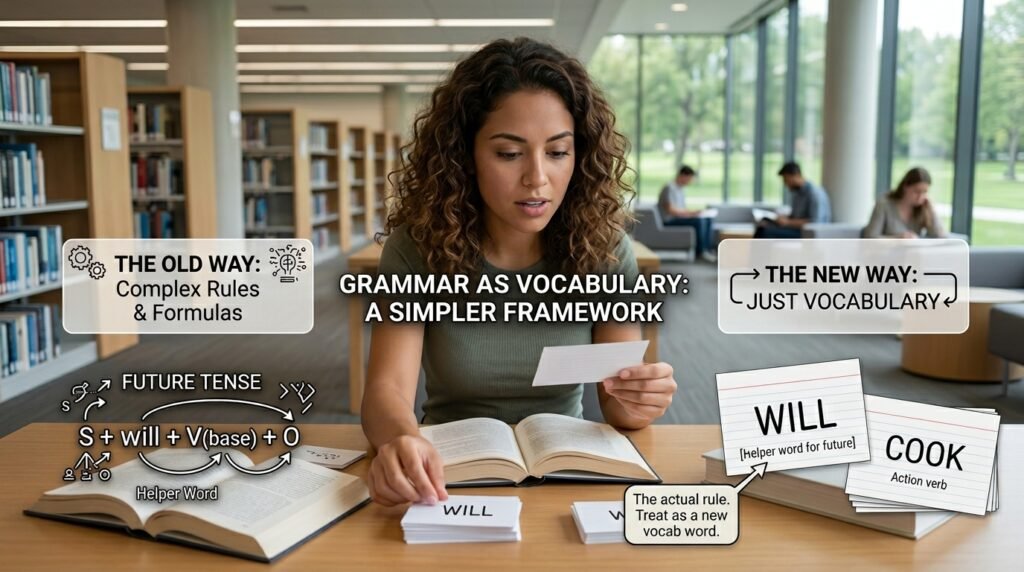
This artificial separation makes grammar feel highly abstract and difficult. I found a much easier way to process the language. I started treating grammar rules exactly like simple vocabulary words.
Many complex grammatical structures are just specific words placed in specific spots in a sentence. For example, indicating the future tense often just involves adding a small helper word before the main action verb.
I stopped looking at it as a complex mathematical formula to solve. I just treated that small helper word as a brand new piece of vocabulary. The academic terminology was completely useless. I needed a better framework for my brain. You can see how I reframed these rules in The Simple Explanation That Helped Me Understand Everything to make them stick instantly.
When you view grammar as just another set of basic vocabulary words, your brain accepts it much faster. You already know exactly how to learn new words. You just apply that exact same skill to the structural pieces of the new language.
Listening to the Physical Rhythm
Correct grammar has a very specific physical beat. It has a specific, recognizable melody. You can literally hear the shape of a correct sentence when a native speaker talks.
I spent hundreds of hours listening to native speakers talk at full speed. I listened to daily podcasts while I washed the dishes. I watched unscripted reality television shows every evening. I did not try to translate the words into my native language. I just paid close attention to the musicality of the spoken language.
After a few months, a very strange thing happened. Incorrect grammar started to physically sound wrong to my ears. It felt exactly like hitting a wrong note on a tuned piano.
I no longer needed to remember the written rule. My ears did the heavy lifting for me. If I tried to say a sentence with the wrong word order, my mouth would naturally stop moving. The rhythm felt completely broken. I would instinctively self correct until the sentence sounded musical again.
This physical rhythm is absolutely impossible to learn from a printed textbook. You have to acquire it through massive, daily exposure to the spoken language in its natural environment.
The Power of Simple Reading
Reading completely transformed my practical understanding of syntax. When you speak to someone, the words vanish instantly into the air. You cannot pause a live conversation to analyze a complex sentence structure.
When you read a physical book, the language is frozen perfectly on the page. You control the speed entirely.
I started reading highly simplified stories. I read books designed specifically for young adults. The sentence structures were incredibly clear and direct. There was no confusing, highly poetic language to slow me down. There were just solid, basic grammatical patterns repeated thousands of times across the pages.
Seeing the grammar visually locked it directly into my brain. I saw exactly how the adjectives always sat next to the nouns. I saw exactly how the punctuation separated the different clauses.
I did not study the text with a highlighter. I just read the stories for pure fun. My brain silently mapped the grammar rules in the background while I enjoyed the plot. By the time I finished a short book, my grasp of the core syntax was rock solid. Reading makes grammar highly visible and completely predictable.
Time is the Ultimate Teacher
We live in a world that demands instant results. We want to read a new grammar rule on Tuesday and use it flawlessly in a conversation on Wednesday. The human brain simply does not work that way.
Grammar takes a long time to settle deeply into your subconscious mind. You will read a rule, understand it perfectly, and then completely fail to use it the very next day. This is entirely normal. It is not a sign of personal failure. It is just the biological reality of learning a new skill.
I stopped getting angry at myself for forgetting the rules. I accepted that time was the ultimate teacher. I knew that if I simply stayed exposed to the language, the rule would eventually stick permanently.
I stopped grinding through boring daily exercises. I detail this relaxing shift in How I Practice Grammar Without Studying for Hours so you can free up your daily schedule too.
You have to let the language breathe naturally. You have to give your physical brain the necessary time to build the new neural pathways. Deep patience makes the entire process incredibly easy.
Making Total Peace With Mistakes
Perfectionism is the absolute worst enemy of progress. If you try to speak perfectly every single time, you will constantly freeze. You will overthink every single word that comes out of your mouth. You will eventually hate the language entirely.
I made a highly conscious decision to embrace my daily mistakes. I realized that mistakes are highly valuable data points. They are not signs of low intelligence. They are simply a map showing you exactly where your current boundaries are located.
When I made a major grammar mistake and a native speaker corrected me, I did not feel embarrassed at all. I felt grateful. That specific correction highlighted a specific blind spot in my knowledge. Because the correction happened in a real, live conversation, I never forgot it. The emotional context of the interaction burned the correct rule into my memory forever.
You have to completely drop your ego. You have to be totally willing to sound like a beginner. The faster you make mistakes, the faster your brain will map the actual rules of the language.
Writing Without Strict Constraints
To practice grammar actively, I started a daily journaling habit. But I implemented one very strict, unbreakable rule. I was not allowed to use a dictionary or a digital grammar checker.
I set a timer for ten minutes every single evening. I wrote strictly about my day. I wrote down whatever random thoughts came into my head.
When I hit a grammar structure I did not know, I simply guessed. I forced myself to keep writing without stopping. I did not pause to look up the correct verb conjugation. I prioritized the forward flow of words completely over perfect accuracy.
This simple exercise was incredibly liberating. It trained my brain to entirely bypass the internal critic. It taught me how to communicate my actual ideas even when I lacked the perfect grammatical tools.
After the ten minutes were up, I would go back and review the text. I would look up the specific rules I struggled with during the writing session. This targeted review was highly effective. I only studied the exact grammar I personally needed to tell my own specific story.
The Shift from Rules to True Meaning
The biggest breakthrough happened when I completely changed my internal focus. I stopped looking at grammar as a strict set of rules to follow blindly. I started looking at it as a flexible set of tools to convey human meaning.
A verb tense is not just a boring column in a printed chart. It is a specific tool you use to tell someone a compelling story about your past. A preposition is not just a confusing tiny word you have to memorize. It is a vital tool you use to tell someone exactly where to find you in an emergency.
When you focus entirely on the meaning you want to share, the grammar naturally falls into place. Your brain is biologically built to communicate meaning to other humans. It is not built to solve abstract, academic puzzles.
I stopped asking myself what the exact rule was for a sentence. I started asking myself how to make the other person completely understand my story. This simple shift in perspective removed all the heavy mental pressure entirely. The language stopped being an exam I had to pass. It became a highly enjoyable way to connect deeply with other human beings.

Grammar is Just a Habit
Grammar is honestly just a shared habit. You do not need to be a genius to master it. You do not need a photographic memory. You definitely do not need expensive, heavy textbooks weighing down your desk.
You just need consistent, daily exposure. You need to read things you actually enjoy reading. You need to listen to real people having real, unscripted conversations. You need to speak loudly without any fear of making mistakes.
Grammar is nothing more than the way a specific group of people have agreed to structure their thoughts over time. You learn these habits strictly through observation and repetition.
Stop overcomplicating the learning process today. Put the heavy textbooks away in a drawer. Stop staring blindly at the conjugation charts. Go find a good story in your target language. Read it. Listen to it. Actually enjoy it. Let the grammar sink deeply into your brain completely on its own. You will be absolutely amazed at how simple the rules actually are when you finally stop fighting them.

Gabriel Henrique is a language enthusiast and productivity writer. After testing countless study methods, he became obsessed with mastering new languages efficiently. He achieves this without burnout, without endless grammar drills, and without losing focus. At Blog The Curious, he shares everything he has learned along the way.